
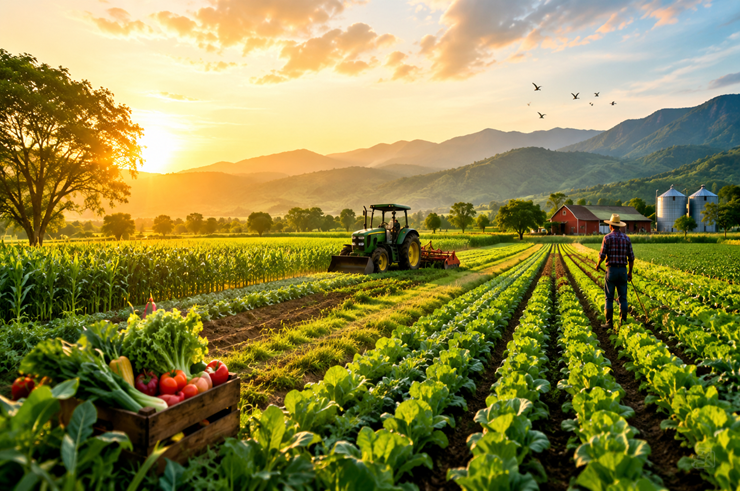
Farming is much more than simply growing crops. Across the world, farmers use different methods depending on the climate, soil, availability of water, size of land, technology, labor, and market demand.
A small farmer may grow crops mainly to feed their family, while another farmer may cultivate hundreds of acres to supply products to markets. Some farmers combine crop production with livestock, while others specialize in crops such as tea, coffee, rubber, or sugarcane.
This is why there is no single farming method that works everywhere.
In this guide, we will clarify the 7 major types of farming, including their characteristics, examples, advantages, and important differences. We will also look at how farmers choose a suitable farming system based on local conditions.
What Is Farming?
Farming is the practice of cultivating crops and raising livestock for food, income, raw materials, and other agricultural needs.
Farming is one of the oldest human activities and continues to play an important role in the economy and daily life of millions of people. Modern agriculture can range from traditional family farming to highly mechanize commercial agriculture. The farming method used in a particular area depends on factors such as land availability, climate, soil fertility, water supply, technology, labor, and consumer demand.
7 Major Types of Farming
The seven major types of farming covered in this guide are:
- Subsistence Farming
- Commercial Farming
- Intensive Farming
- Extensive Farming
- Mixed Farming
- Plantation Farming
- Shifting Cultivation
Let’s understand each type in detail.
#1. Subsistence Farming:
Subsistence farming is a type of farming in which agricultural products are primarily produced to meet the food and basic needs of the farmer’s household.
Unlike large commercial farms, the main objective is usually not to produce crops for large-scale sale. Farmers may sell or exchange a small portion of their production to obtain other necessities.
Subsistence farming is commonly associated with small landholdings, family labor, and traditional agricultural practices. However, the exact methods vary considerably from one region to another.
Common Crops in Subsistence Farming
Depending on the local climate and soil, farmers may grow:
- Rice
- Wheat
- Maize
- Millets
- Pulses
- Vegetables
- Root crops
Main Features of Subsistence Farming
- Production is mainly for household consumption
- Farms are often relatively small
- Family members may provide much of the labor
- Traditional tools and methods may be used
- Farmers may depend heavily on local weather conditions
- Only a portion of the production may be sold
Example of Subsistence Farming
A family growing rice, vegetables, pulses, and other crops mainly for its own food requirements is an example of subsistence farming.
#2. Commercial Farming:
Commercial farming is agriculture carried out primarily to produce crops or livestock for sale.
The scale can vary from relatively small market-oriented farms to very large agricultural operations. Farmers may use machinery, irrigation, improved seeds, fertilizers, storage facilities, and other technologies depending on their resources and production goals.
Market demand is an important factor in commercial farming because farmers generally select products that can generate income.
Common Commercial Crops
Some important commercial crops include:
- Cotton
- Sugarcane
- Wheat
- Maize
- Soybeans
- Coffee
- Tea
- Rubber
Main Features of Commercial Farming
- Production is primarily intended for sale
- Market demand influences production decisions
- Machinery may be used
- Farms can vary greatly in size
- Farmers may use modern agricultural technology
- Profitability is an important consideration
Example of Commercial Farming
A farmer growing large quantities of wheat for sale to food-processing companies or agricultural markets is practicing commercial farming.
#3. Intensive Farming:
Intensive farming is a farming system designed to obtain relatively high production from a limited area of land.
Farmers may use more labor, irrigation, improved seeds, fertilizers, machinery, or other inputs to increase productivity. Intensive agriculture is especially useful in regions where farmland is limited but demand for agricultural products is high.
Rice cultivation in densely populated agricultural regions is one example where intensive methods can be important.
Features of Intensive Farming
- High production is targeted from a relatively small area
- Greater inputs may be used per unit of land
- Irrigation can play an important role
- Improved seeds and fertilizers may be used
- Labor requirements can be relatively high
- Efficient land use is a major objective
Advantages of Intensive Farming
The biggest advantage is the ability to produce more food from a limited amount of land.
This can be particularly valuable in areas with high population density or limited agricultural land.
However, intensive farming needs careful management. Poorly managed use of fertilizers, pesticides, or water can cause soil and environmental problems.
#4. Extensive Farming:
Extensive farming generally involves cultivating large areas of land with relatively lower inputs of labor and capital per unit of land.
Instead of maximizing production from every small area, farmers may depend on the availability of large land areas and use machinery to manage production efficiently.
Extensive agriculture is often associated with regions where agricultural land is more readily available and population density is comparatively lower.
Features of Extensive Farming
- Large areas of land are commonly used
- Labor requirements per unit of land can be relatively low
- Mechanization can be important
- Production per hectare may be lower than intensive farming
- Large-scale crop or livestock production is common
Example of Extensive Farming
A large farm cultivating wheat across hundreds of hectares using tractors and other machinery can be an example of extensive farming.
Extensive Farming: Meaning, Types, Features, Advantages and Disadvantages
#5. Mixed Farming:
Mixed farming combines crop cultivation with livestock rearing on the same farm.
This system allows farmers to earn income from more than one agricultural activity. Crops can provide food or feed for animals, while livestock can provide products such as milk, meat, or eggs.
Animal manure can also be used as organic fertilizer, helping farmers make better use of available resources.
Features of Mixed Farming
- Crops and livestock are raised together
- Farmers can have multiple sources of income
- Animal manure can be used to improve soil fertility
- Crop residues may be used as animal feed
- Farm resources can be reused more efficiently
Example of Mixed Farming
A farmer growing wheat and maize while keeping cows or buffaloes on the same farm is an example of mixed farming.
Why Is Mixed Farming Useful?
One benefit of mixed farming is diversification. A farmer does not have to depend entirely on one crop.
For example, if a particular crop performs poorly because of weather conditions, livestock products may provide another source of income.
Mixed Farming: Meaning, Types, Advantages, Disadvantages and Examples
#6. Plantation Farming:
Plantation farming is a form of large-scale commercial agriculture that generally focuses on a particular cash crop.
Plantations are commonly associated with tropical and subtropical regions where climatic conditions are suitable for crops such as tea, coffee, rubber, cocoa, sugarcane, and oil palm.
Because plantation crops are often produced on a large scale, processing, storage, transportation, and market access can be important parts of the overall agricultural system.
Major Plantation Crops
Some common plantation crops include:
- Tea
- Coffee
- Rubber
- Sugarcane
- Cocoa
- Bananas
- Oil palm
Features of Plantation Farming
- Large-scale agricultural production
- Usually focused on one major crop
- Production is mainly commercial
- Labor can be an important requirement
- Processing and transportation may be closely connected to production
- Suitable climate is essential
Plantation Farming in India
India has several important plantation-growing regions. Tea is strongly associated with Assam and parts of West Bengal. Coffee production is important in southern India, while rubber cultivation is especially significant in Kerala and other suitable areas.
Plantation Farming: Meaning, Types, Crops, Advantages and Disadvantages
#7. Shifting Cultivation:
Shifting cultivation is a traditional farming system in which a piece of land is cultivated for a period of time and then left fallow while farmers move cultivation to another plot.
In some traditional systems, vegetation is cleared and burned before crops are planted. This method is commonly described as slash-and-burn agriculture.
The environmental impact of shifting cultivation can vary significantly depending on factors such as population pressure, land availability, and the length of the fallow period.
Features of Shifting Cultivation
- Land is cultivated temporarily
- Farmers may move cultivation between different plots
- Fallow periods are traditionally important
- Traditional tools may be used
- It has historically been practiced in forested and hilly regions
Shifting Cultivation in India
Shifting cultivation has traditionally been practiced in parts of northeastern India and other hilly regions.
Different communities have their own local names and practices for this type of agriculture.
Advantages and Disadvantages
When practiced within a long fallow cycle and with sufficient land available for regeneration, traditional shifting cultivation can allow soil and vegetation to recover.
However, if fallow periods become too short, repeated clearing can contribute to soil degradation, loss of vegetation, and other environmental concerns.
Difference Between the 7 Major Types of Farming
| Type of Farming | Main Purpose | Typical Land Use | Main Characteristic |
| Subsistence Farming | Household needs | Usually small | Mainly family consumption |
| Commercial Farming | Market and profit | Medium to large | Market-oriented production |
| Intensive Farming | High production | Relatively small | Higher inputs per unit of land |
| Extensive Farming | Large-scale production | Large | Large land area |
| Mixed Farming | Crops and livestock | Varies | Combines crop and animal production |
| Plantation Farming | Commercial production | Large | Usually focuses on a major cash crop |
| Shifting Cultivation | Temporary crop production | Multiple plots over time | Cultivated land is later left fallow |
Factors That Influence the Type of Farming
There is no universal farming method that is suitable for every region. Farmers generally adapt their practices according to local conditions.
#1. Climate
Temperature, rainfall, humidity, and the length of the growing season influence which crops can be cultivated successfully.
#2. Soil
Soil fertility, drainage, texture, and nutrient availability affect both crop selection and farming methods.
#3. Water Availability
Reliable irrigation can support crops and farming systems that require regular water, while rain-fed agriculture depends more heavily on seasonal rainfall.
#4. Land Size
The amount of land available can influence whether a farmer uses intensive or extensive methods.
#5. Market Demand
Farmers with good access to markets may focus more on commercial crops that have strong demand and better economic returns.
#6. Technology
Modern machinery, irrigation equipment, improved seeds, fertilizers, farm-management technology, and other agricultural tools can influence farming practices.
#7. Labor Availability
Some farming systems depend heavily on manual labor, while others use machinery to reduce the amount of human labor required.
Why Are Different Types of Farming Important?
Different farming systems exist because agricultural conditions are different from one place to another.
A farming method that works well in a densely populated region with small farms may not be suitable for an area with vast amounts of agricultural land.
Similarly, a tropical region may specialize in plantation crops, while a dry region may depend on farming methods suited to limited rainfall.
Understanding different types of farming helps us see how farmers adapt agriculture to land, climate, water, technology, labor, and market conditions.
FAQs About Types of Farming
Q1. What are the 7 major types of farming?
The seven major types of farming discussed in this guide are subsistence farming, commercial farming, intensive farming, extensive farming, mixed farming, plantation farming, and shifting cultivation.
Q2. What is the most common type of farming?
There is no single type of farming that is most common everywhere. Farming systems vary according to climate, land availability, population, economic conditions, and local agricultural practices.
Q3. What is the difference between subsistence and commercial farming?
Subsistence farming mainly focuses on meeting the farmer’s household needs, while commercial farming primarily produces agricultural products for sale in markets.
Q4. What is intensive farming?
Intensive farming aims to obtain relatively high production from a limited area of land by using greater inputs such as labor, irrigation, improved seeds, fertilizers, and technology.
Final Thoughts
Farming may look simple from the outside, but the way agriculture is practiced depends on many different factors.
A small family farm growing food for household consumption is very different from a large plantation producing crops for international markets. Similarly, intensive farming uses land differently from extensive farming, while mixed farming combines crops and livestock to make better use of farm resources.
The 7 major types of farming explained in this guide—subsistence, commercial, intensive, extensive, mixed, plantation, and shifting cultivation—help us understand these differences. As agriculture continues to develop, farmers are also adopting better technology, improved resource management, and more sustainable practices. Understanding traditional and modern farming systems can help us appreciate how agriculture continues to adapt to changing environmental and economic conditions.
6 thoughts on “Types of Farming: 7 Major Types of Farming Explained”