
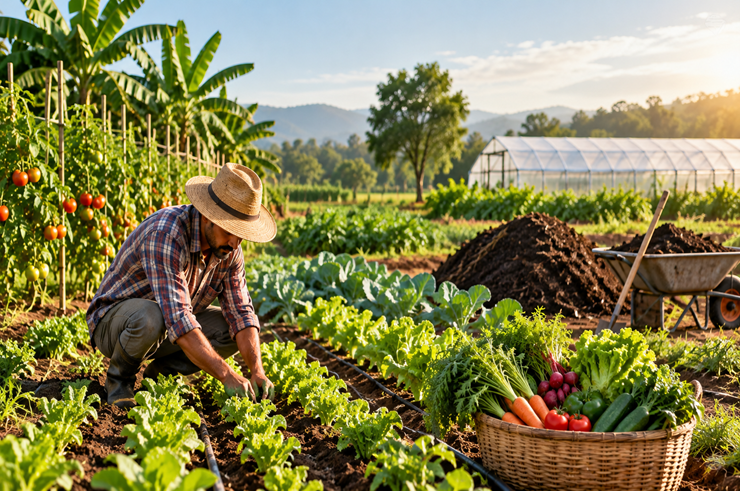
Organic farming is an agricultural approach that focuses on soil health, crop diversity, responsible resource management and the use of inputs permitted under applicable organic standards. It encourages farmers to work with natural processes while producing crops and other agricultural products.
Many farmers explore organic farming to improve soil management, reduce dependence on certain synthetic inputs and reach customers interested in organically produced food. However, organic farming also requires careful planning, pest management, suitable nutrient sources and access to reliable markets.
Organic farming is not simply farming without chemicals. It is a complete production system with specific management practices and, where regulated organic claims are made, applicable certification or compliance requirements.
In this guide, we explain 10 organic farming methods, the main types of organic farming, its benefits and challenges, and the practical steps involved in starting an organic farm.
#1. What Is Organic Farming?
Organic farming is a production system that follows organic standards for growing crops and, where applicable, raising livestock. It emphasizes practices such as crop rotation, composting, soil fertility management, biological pest control and biodiversity.
Organic production standards generally restrict many synthetic fertilizers and pesticides and specify which inputs and practices are permitted. The exact rules depend on the country and certification system.
Common organic farming practices include:
- Using compost and suitable organic nutrient sources
- Rotating crops between growing seasons
- Planting cover crops and green manure
- Managing pests through prevention and approved controls
- Improving soil structure and organic matter
- Conserving water and protecting biodiversity
- Keeping appropriate records of farm activities and inputs
Organic farming can be used for vegetables, fruits, cereals, pulses, oilseeds, spices and other crops when the growing conditions and management requirements are suitable.
#2. Principles of Organic Farming
Organic farming is guided by several broad principles.
Soil Health
Healthy soil supports root development, nutrient availability and water movement. Organic farmers often use compost, crop residues, cover crops and rotation to maintain soil quality.
Ecological Balance
Organic farming aims to support useful organisms and manage agricultural land as an interconnected system. Crop diversity and suitable habitats can help support beneficial insects and other organisms.
Responsible Input Use
Farmers must choose fertilizers, pest-control products and other inputs according to the applicable organic standard. A product being described as natural does not automatically make it acceptable for certified organic production.
Long-Term Farm Management
Successful organic farming involves planning beyond a single harvest. Soil fertility, crop rotations, pest pressure, labour, market access and financial viability all matter.
#3. 10 Organic Farming Methods
#1. Composting
Composting turns suitable organic materials, such as plant residues and properly managed animal manure, into a more stable material that can be used to improve soil.
Well-managed compost can add organic matter and contribute nutrients. Its nutrient content varies according to the ingredients and composting process.
Farmers should use mature compost, avoid contaminated materials and plan application rates according to soil and crop needs.
#2. Crop Rotation
Crop rotation involves growing different crops in a planned sequence rather than planting the same crop repeatedly in a field.
For example, a farmer may rotate a cereal crop with a suitable pulse crop. Different crops can have different nutrient requirements, rooting patterns and pest relationships.
Rotation can help diversify production and interrupt some crop-specific pest and disease cycles.
Read more information on Crop Rotation.
#3. Green Manuring
Green manuring involves growing plants and using their biomass to improve soil management. Some crops are incorporated into the soil, while others may be cut and left on the surface.
Suitable leguminous plants can contribute nitrogen under the right conditions. Green manure can also add organic material and protect the soil.
The best crop depends on local climate, water availability and the time between the main growing seasons.
#4. Cover Cropping
Cover crops are planted mainly to protect and improve the soil rather than to provide the primary commercial harvest.
Depending on the species and management, cover crops can help reduce erosion, suppress some weeds, add organic matter and capture nutrients.
Farmers should select species that fit their climate and avoid cover crops that may compete excessively for water or interfere with the next crop.
#5. Mulching
Mulching means covering the soil surface with suitable materials, such as straw, leaves or crop residues.
It can help conserve moisture, reduce temperature fluctuations near the soil surface and suppress some weeds.
The choice of mulch should depend on the crop, climate and pest risks. Materials should be clean and suitable for the intended production system.
#6. Organic Nutrient Management
Organic nutrient management uses permitted nutrient sources and good soil management to meet crop requirements.
These sources may include compost, properly treated manure, green manure and other inputs permitted by the applicable organic standard.
Farmers should consider nutrient availability and timing. Organic materials can still cause nutrient imbalances if used excessively, so soil testing and nutrient planning remain important.
#7. Biological Pest Management
Biological pest management uses suitable living organisms or biological products to help manage agricultural pests.
Depending on the crop and pest, options may include beneficial insects, microbial products and other approved biological controls.
Farmers should correctly identify pests and check whether a product or method is permitted under their organic certification requirements.
#8. Natural Weed Management
Weed control in organic farming may involve mulching, crop rotation, hand weeding, mechanical cultivation, cover crops and suitable planting densities.
The right approach depends on the crop, field size, labour availability and weed species.
Planning weed management before planting is often more effective than waiting until weeds become difficult to control.
#9. Biodiversity and Companion Planting
Crop diversity, suitable flowering plants and managed field margins can provide habitat for beneficial organisms.
Some farmers also use companion planting, where selected plants are grown together for a specific management purpose. Results depend on the plant species, spacing, climate and local pest pressures.
Companion planting should be based on a practical reason rather than the assumption that any two plants grown together will automatically benefit one another.
#10. Integrated Organic Farm Management
Integrated management combines several compatible practices into one farm plan.
For example, a farmer might use crop rotation, compost, cover crops, regular pest monitoring, mulching and careful irrigation together.
This approach helps farmers consider soil, crops, water, pests, labour and costs as parts of the same production system.
4. Types of Organic Farming
Organic farming can be practised in different agricultural systems, depending on the farm’s size, crops and resources.
Organic Crop Farming
Organic crop farming involves producing cereals, pulses, oilseeds, vegetables and other crops according to organic production requirements.
Organic Vegetable Farming
Vegetable growers may use compost, crop rotation, mulch and approved pest-management methods to produce vegetables.
Market planning is particularly important because many vegetables are perishable.
Organic Fruit Farming
Organic fruit farming applies organic management practices to fruit trees, vines and other fruit crops.
Orchard planning, pollination, disease management and post-harvest handling are important considerations.
Organic Livestock Farming
Organic livestock production is subject to additional standards covering animal feed, living conditions, health management and other requirements.
Farmers should check the applicable rules before selling livestock products as organic.
Mixed Organic Farming
Mixed organic farming combines more than one agricultural activity, such as crop production and livestock, under a coordinated management plan.
Organic Greenhouse Farming
Organic crops can be grown in protected structures where the production system and inputs comply with the relevant organic standard.
Greenhouse production may require additional investment in ventilation, irrigation, temperature management and infrastructure. Read More Information about Greenhouse Farming
5. Soil Fertility and Nutrient Management
Soil fertility is one of the central concerns in organic farming. Crops need a balanced supply of nutrients, and organic nutrient sources do not always release nutrients at the same rate as crops require them.
Practical soil management includes:
- Testing soil to understand nutrient levels and pH
- Applying mature compost where appropriate
- Using suitable crop rotations
- Growing cover crops when practical
- Returning clean crop residues where suitable
- Preventing erosion and soil compaction
- Monitoring crop growth for possible nutrient deficiencies
Organic farming still requires accurate nutrient planning. An organic input should not be assumed to provide every nutrient that a crop needs.
6. Pest and Weed Management
Pests and weeds can create production losses in organic systems, so farmers need a planned approach.
Useful measures include:
- Inspecting crops regularly.
- Identifying pests and diseases correctly.
- Selecting suitable crop varieties.
- Rotating crops where appropriate.
- Maintaining suitable crop spacing and field hygiene.
- Using physical or biological controls where effective.
- Selecting only inputs permitted by the relevant organic standard.
Organic farming does not mean that pest problems disappear. Preventive management and timely action are essential.
7. Organic Farming Certification
Certification is important when a farmer intends to sell products using regulated organic claims.
Requirements vary by country and market. They may include approved inputs, farm records, inspections, handling procedures and rules for the transition period.
Farmers should:
- Identify the organic standard relevant to their target market.
- Confirm which inputs and practices are permitted.
- Maintain records of seeds, treatments and other farm inputs.
- Separate organic products from non-organic products when required.
- Understand inspection and certification costs.
- Verify the rules for labelling and marketing organic produce.
In India, farmers should consult the relevant official organic certification framework and current requirements before making certified-organic claims. Growing crops without certain synthetic inputs does not automatically mean that produce qualifies for a regulated organic label.
8. Crops Suitable for Organic Farming
Many crops can be grown organically when their growing requirements and pest-management needs can be met.
| Crop group | Examples | Important consideration |
|---|---|---|
| Cereals | Wheat, rice, maize | Nutrient management and weeds |
| Pulses | Chickpea, lentil, mung bean | Variety and disease management |
| Vegetables | Tomato, spinach, okra | Pest control and rapid marketing |
| Fruits | Mango, guava, apple | Orchard management and quality |
| Oilseeds | Mustard, soybean, sunflower | Growing conditions and buyer access |
| Spices | Ginger, turmeric, coriander | Planting material, disease and processing |
The most suitable crop depends on local climate, soil, water, available inputs and market demand.
9. Benefits of Organic Farming
Organic farming may offer several benefits when well managed.
Soil management: Compost and crop residues can help maintain soil organic matter.
Crop diversity: Crop rotation and diversification can reduce dependence on one crop.
Resource recycling: Suitable farm residues and organic materials can be returned to the production system.
Market opportunities: Some consumers and businesses seek organically produced products, although premiums and demand vary.
Environmental management: Practices such as cover cropping and mulching can help protect soil and reduce erosion.
Long-term planning: Organic production encourages farmers to plan soil fertility and pest management across growing seasons.
These benefits depend on the practices used and the farm’s conditions. Organic farming does not guarantee higher yields, lower costs or higher profits.
10. Challenges of Organic Farming
Farmers should understand the possible limitations before changing production systems.
- Weed management: Controlling weeds without prohibited herbicides can require additional labour.
- Pest and disease pressure: Some problems may be difficult to control.
- Nutrient planning: Organic nutrients may not be available exactly when crops need them.
- Transition period: Farmers may need time to adjust their practices and qualify under an organic standard.
- Certification and records: Compliance may involve paperwork, inspection and fees.
- Market access: Organic produce may need specific buyers, handling or distribution arrangements.
- Yield variability: Results differ by crop, location and management.
Farmers should evaluate both production requirements and business feasibility before investing.
11. Organic Farming vs Conventional Farming
| Feature | Organic Farming | Conventional Farming |
|---|---|---|
| Fertility management | Compost and permitted nutrient sources are commonly used | May use synthetic fertilizers and organic materials |
| Pest management | Preventive, biological and permitted control methods | May use a broader range of conventional pest-control products |
| Weed management | Rotation, mulch and mechanical methods are common | May include herbicides and mechanical methods |
| Certification | Required for regulated organic claims where applicable | Organic certification is not generally required |
| Production costs | May involve higher labour or certification costs | Costs depend on inputs, equipment and the production system |
| Yields | Vary by crop and management | Vary by crop and management |
Neither system performs identically in every situation. Outcomes depend on soil, climate, crop variety, farm management and other local factors.
12. How to Start an Organic Farm
Step 1: Assess your land
Check soil condition, drainage, water availability and which crops suit your area.
Step 2: Plan soil fertility
Identify suitable compost, permitted nutrient sources and crop rotation options.
Step 3: Choose suitable crops
Select crops based on growing conditions, pest risks, available labour and realistic buyer demand.
Step 4: Plan sales and handling
Identify potential buyers and consider packaging, storage, transport and product quality.
Step 5: Track performance
Record input costs, labour, yields, sales and losses. Review the results after each growing season.
If you plan to sell certified organic produce, check the relevant certification requirements before starting the conversion process.
13. Organic Farming Costs and Profitability
Organic farming costs depend on the crop, land, labour, inputs, equipment and marketing arrangements.
Common expenses include:
- Seeds and planting materials
- Compost and other permitted inputs
- Labour and weed management
- Irrigation
- Pest and disease management
- Harvesting and packaging
- Transportation and storage
- Certification, where applicable
Use this basic formula to evaluate a farming business:
Net Profit = Total Sales Revenue − Total Costs
For example, if a farm earns ₹1,50,000 from sales and its total costs are ₹1,10,000, its estimated profit is ₹40,000.
These figures are illustrative only. Organic farming is not automatically more profitable than conventional farming. Actual results depend on yields, costs, market access and the price buyers are willing to pay.
For a detailed calculation Farming Cost & Profit
14. Common Organic Farming Mistakes
Avoid these common mistakes when planning or managing an organic farm:
- Assuming all natural inputs are approved for organic production.
- Applying compost without checking nutrient requirements.
- Ignoring soil testing and crop planning.
- Waiting until weeds or pests become difficult to manage.
- Choosing crops without identifying potential buyers.
- Underestimating labour and harvesting costs.
- Making organic claims without meeting applicable requirements.
- Expecting immediate improvements in soil or profitability.
Good records, careful observation and realistic financial planning can help farmers identify problems and improve their practices over time.
FAQs.
Q1. What is organic farming in simple words?
Organic farming is a production system that follows organic standards and emphasizes soil health, crop rotation, permitted inputs and preventive pest management.
Q2. What are the main methods of organic farming?
Common methods include composting, crop rotation, green manuring, cover cropping, mulching, organic nutrient management, biological pest management, natural weed control, biodiversity management and integrated farm planning.
Q3. Is organic farming better than conventional farming?
Neither is universally better in every situation. The outcome depends on crop, location, production methods, environmental impacts and economic results.
Q4. Can organic farming be profitable?
Yes, organic farming can be profitable, but profit is not guaranteed. Farmers need to manage production costs, yields, product quality and access to buyers.
Q5. Does organic farming require certification?
Requirements depend on the country and intended market. Farmers selling products with regulated organic claims should verify the applicable certification and labelling rules.
Q6. Which crops are suitable for organic farming?
Cereals, pulses, vegetables, fruits, oilseeds and spices may be suitable. Crop selection should be based on local conditions, pest pressure, available resources and market demand.
Conclusion:
Organic farming combines soil management, crop diversity, responsible input selection and planned pest control into a structured agricultural system. Methods such as composting, crop rotation, cover cropping and mulching can support soil management when used appropriately.
However, organic farming also requires careful planning, labour, monitoring and market research. Before starting, understand the applicable organic standards and estimate your likely production and marketing costs.
A well-managed organic farm should aim not only to follow the relevant production requirements but also to maintain productive soil, use resources responsibly and operate as a financially viable business.
3 thoughts on “Organic Farming: 10 Methods, Benefits, Types & Examples”