
Farming does not always begin with the goal of selling crops in a market. In many parts of the world, farming is still closely connected with a family’s daily life. People grow crops mainly to feed themselves, keep a few animals, and meet the basic needs of their household. This traditional approach to agriculture is known as subsistence farming.
For a small farmer, the harvest can mean much more than income. It can mean food for the family, seeds for the next season, and security during difficult times. This is what makes subsistence farming different from large-scale commercial agriculture.
In this guide, we will look at what subsistence farming means, how it works, its major types, common crops, advantages, disadvantages, and its importance in rural communities.
What Is Subsistence Farming?
Subsistence farming is a type of agriculture in which farmers grow crops and raise animals mainly to meet the food and basic needs of their own families rather than producing large quantities for sale.
Farmers practicing subsistence agriculture generally work on small areas of land. They may use family labor and relatively simple farming tools instead of expensive machinery.
The amount produced is usually intended primarily for household consumption. If there is any surplus after meeting the family’s needs, it may be sold or exchanged locally.
For example, a family may grow wheat, rice, maize, vegetables, or pulses on its land. They may also keep chickens, goats, cows, or other livestock. The combination provides food for the household and sometimes a small additional income.
Key Features of Subsistence Farming
Subsistence farming can vary from one region to another, but several characteristics are commonly found.
#1. Production Mainly for Family Consumption
The main purpose is to provide food for the farmer and their family. Selling crops is usually secondary.
#2. Small Farm Size
Subsistence farms are often relatively small compared with large commercial farms. The land available to a family may be limited.
#3 Family Labor
Much of the farm work may be carried out by family members. Activities such as planting, weeding, harvesting, and caring for animals can involve the whole household.
#4. Limited Use of Expensive Machinery
Many subsistence farmers rely on traditional tools and manual labor. The level of mechanization depends on the region and the farmer’s resources.
#5. Diverse Crops
Farmers may grow several crops rather than depending entirely on one crop. This can help provide different types of food throughout the year.
#6. Local and Traditional Knowledge
Knowledge about soil, rainfall, seeds, seasons, and local crops is often passed from one generation to another.
#7. Limited Market Dependence
Because much of the production is consumed at home, the farmer may be less dependent on selling every harvest to generate income.
Types of Subsistence Farming:
Subsistence farming is not one single farming method. It can take different forms depending on the climate, land, population, and local traditions.
Intensive Subsistence Farming
In intensive subsistence farming, farmers try to obtain as much food as possible from a relatively small piece of land.
This type is commonly associated with areas where population density is high and agricultural land is limited. Farmers may invest significant labor in preparing the soil, planting, irrigation, weeding, and harvesting.
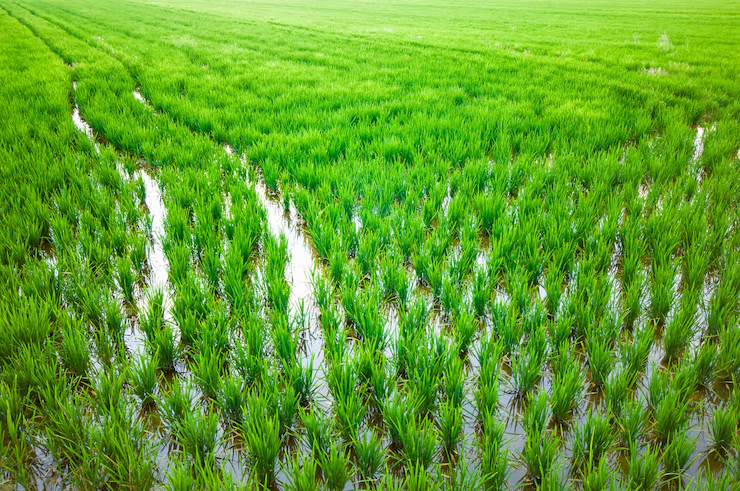
Rice cultivation is a common example in parts of Asia where suitable climate and water conditions allow intensive cultivation.
Primitive Subsistence Farming
Primitive subsistence farming generally involves traditional techniques and relatively simple tools.
Two well-known examples are shifting cultivation and nomadic herding.
In shifting cultivation, farmers may clear and cultivate a piece of land for a period before moving to another area when soil fertility declines. Nomadic herding involves moving livestock from one grazing area to another.
Modern agricultural development has changed many traditional systems, so the exact form of primitive subsistence agriculture differs significantly between regions.
Common Crops Grown in Subsistence Farming
The crops grown depend heavily on climate, soil, water availability, and local food habits.
Common examples include:
- Rice
- Wheat
- Maize
- Millet
- Barley
- Pulses
- Potatoes
- Cassava
- Vegetables
- Fruits
- Beans
A farmer may grow more than one crop to provide a balanced food supply and reduce the risk of losing the entire harvest from a single crop failure.
Animals in Subsistence Farming
Subsistence farming may also include livestock. Keeping animals can provide food, manure, and sometimes additional income.
Common livestock include:
- Cows
- Buffaloes
- Goats
- Sheep
- Chickens
- Pigs
- Ducks
For example, a family may grow crops while keeping a few cows or goats. Crop residues can sometimes be used as animal feed, while animal manure can contribute nutrients to the soil.
This creates a simple connection between crop production and livestock keeping.
How Does Subsistence Farming Work?
The process is usually centered around meeting the household’s needs.
A typical cycle may look like this:
Land preparation → Seed selection → Sowing → Crop care → Harvesting → Household consumption → Surplus sale or storage
Farmers first prepare their land according to the local growing season. Seeds are then planted, and the crops are maintained through activities such as watering, weeding, and protecting them from pests.
After harvesting, most of the produce is used by the household. Some may be stored for future consumption or kept as seed for the next season. If there is a surplus, it can be sold in a nearby market.
The exact process can vary considerably depending on the region and farming system.
Advantages of Subsistence Farming
Despite its limitations, subsistence farming continues to play an important role in many rural communities.
Food Security
One of the biggest benefits is that farmers produce at least part of their own food. This can reduce dependence on purchasing all food from markets.
Lower Dependence on Large Markets
Since production is mainly for household consumption, farmers may not need to depend entirely on market prices.
Use of Local Resources
Traditional farming may make use of locally available seeds, animal manure, farm tools, and family labor.
Preservation of Traditional Knowledge
Subsistence farming can help preserve local agricultural practices, crop varieties, and knowledge about seasonal farming.
Diversified Food Production
Growing several crops and keeping animals can provide a wider variety of food for the household.
Disadvantages of Subsistence Farming:
Subsistence farming also has several challenges.
Low Production
Traditional methods and limited access to technology can sometimes result in lower yields compared with highly mechanized commercial farming.
Weather Dependence
Droughts, floods, storms, extreme temperatures, and irregular rainfall can seriously affect production.
Limited Income
Because most produce is consumed by the household, there may be little surplus available for sale.
Limited Access to Modern Technology
Small farmers may face difficulties accessing improved seeds, irrigation systems, machinery, fertilizers, storage facilities, and agricultural services.
Risk of Crop Failure
A poor harvest can directly affect the family’s food supply, especially when there are limited savings or alternative sources of income.
Subsistence Farming vs Commercial Farming:
The main difference between these two systems is the purpose of production.
The main difference between these two systems is the purpose of production.
| Feature | Subsistence Farming | Commercial Farming |
| Main purpose | Family consumption | Sale and profit |
| Farm size | Often small | Often medium or large |
| Labor | Mainly family labor | Hired and/or mechanized labor |
| Machinery | Limited in many cases | Generally greater use |
| Market dependence | Lower | High |
| Production scale | Relatively low | Generally high |
| Crop selection | Often based on food needs | Often based on market demand |
However, the difference is not always absolute. A small subsistence farmer may sell some surplus, while a commercial farmer may also consume part of their own production.
Where Is Subsistence Farming Practiced?
Subsistence farming can be found in many developing and rural regions around the world, particularly where farms are small and farmers have limited access to capital, machinery, irrigation, and markets.
It has historically been important in parts of South Asia, Southeast Asia, Sub-Saharan Africa, Latin America, and other rural regions.
In countries such as India, small and marginal farmers may combine food-crop production with livestock keeping and limited market sales.
The nature of subsistence agriculture differs from place to place because farming practices are strongly influenced by local climate, culture, land availability, and economic conditions.
Why Is Subsistence Farming Important?
Subsistence farming remains important because agriculture is not simply an economic activity for many rural families—it is part of everyday life.
It can contribute to household food security, provide employment, preserve traditional agricultural knowledge, and support rural communities.
At the same time, subsistence farmers often face challenges related to changing weather patterns, rising input costs, limited irrigation, small landholdings, access to markets, and lack of agricultural infrastructure.
Improving access to appropriate technology, training, irrigation, credit, storage, and markets can help small farmers increase productivity while protecting the livelihoods that depend on agriculture.
FAQs.
Q1. What is subsistence farming in simple words?
Subsistence farming means growing crops or raising animals mainly to provide food and basic needs for the farmer’s own family rather than producing mainly for commercial sale.
Q2. What are the main crops grown in subsistence farming?
Common crops include rice, wheat, maize, millet, barley, pulses, potatoes, cassava, vegetables, and beans. The choice depends on local climate, soil, and food habits.
Q3. Is subsistence farming done for profit?
Profit is not usually the main objective. Farmers primarily produce food for their households, although they may sell surplus production to earn additional income.
Q4. What are the two major types of subsistence farming?
Two commonly discussed forms are intensive subsistence farming and primitive subsistence farming. Primitive subsistence farming can include systems such as shifting cultivation and nomadic herding.
Q5. What is the difference between subsistence and commercial farming?
Subsistence farming focuses mainly on meeting household needs, while commercial farming focuses mainly on producing agricultural goods for sale and profit.
Conclusion:
Subsistence farming may look simple when compared with modern large-scale agriculture, but its role is much bigger than the amount of food produced on a small farm.
For many families, the farm is their kitchen, workplace, food store, and safety net all at once. Farmers make decisions based not only on profit but also on what their family needs to eat and how they can manage the resources available to them.
As agriculture continues to change, understanding subsistence farming helps us appreciate the different ways people around the world produce food and make a living from the land.
Want to explore more types of agriculture? Continue with our detailed guides on Commercial Farming, Intensive Farming, Extensive Farming, Mixed Farming, Plantation Farming, and Shifting Cultivation.
6 thoughts on “Subsistence Farming: Meaning, Types, Features, Advantages and Disadvantages”