
Agriculture is one of the oldest economic activities in the world, but modern farming has created many new opportunities for people interested in agricultural businesses and investments.
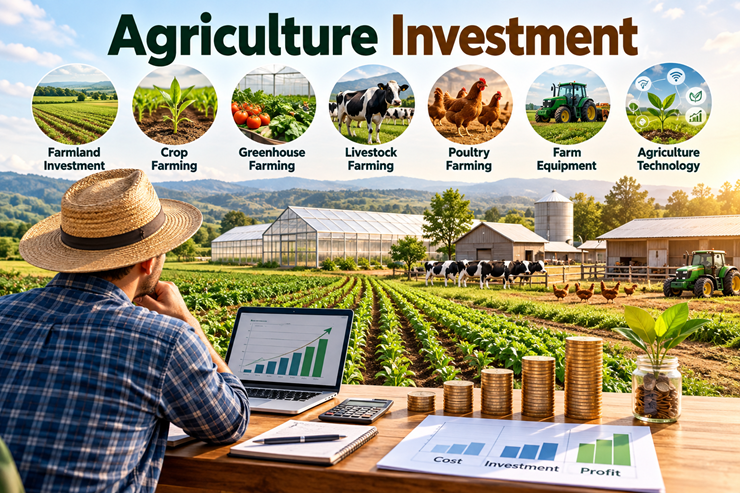
Agriculture investment can include buying agricultural land, starting a crop farm, investing in greenhouse production, livestock, farm equipment, food processing, or agricultural technology.
However, agriculture is different from many other businesses because returns can be affected by weather, crop prices, production costs, water availability, pests, disease and market demand. Therefore, anyone considering an agricultural investment should understand both the opportunity and the risks before committing money.
This guide explains different agriculture investment options, common costs, potential returns, risks and important factors to consider before starting.
#1. What Is Agriculture Investment?
Agriculture investment means putting money, land, equipment or other resources into an agricultural activity with the expectation of generating income, improving production or increasing the value of an agricultural asset.
An investment could be relatively small, such as purchasing equipment for an existing farm, or much larger, such as purchasing agricultural land and developing a commercial farm.
Common examples include:
- Agricultural land
- Crop production
- Vegetable farming
- Fruit orchards
- Greenhouse farming
- Livestock farming
- Poultry farming
- Organic farming
- Farm machinery
- Agricultural technology
The right option depends on available capital, land, farming knowledge, market conditions and the investor’s preferred level of involvement.
#2. Why Is Agriculture Investment Important?
Agriculture plays an important role in food production, employment, rural development and supply chains.
Investment can help farms improve productivity by providing access to better equipment, irrigation systems, improved seeds, storage facilities and modern farming technologies.
For a farming business, investment can potentially help with:
- Increasing production
- Improving farm efficiency
- Reducing avoidable costs
- Improving product quality
- Expanding cultivated land
- Improving storage
- Accessing better markets
- Adding value through processing
However, investment alone does not guarantee profit. Good planning and proper management are equally important
#3. 10 Best Agriculture Investment Options
There are many ways to invest in agriculture. Here are 10 commonly considered options.
#1. Agricultural Land Investment
Buying agricultural land can be a long-term investment. Land may generate income through cultivation, leasing or other permitted agricultural activities.
Before buying land, investors should check location, soil quality, water availability, access roads, legal ownership and local regulations.
#2. Crop Farming Investment
Investing in crop production can involve cereals, pulses, oilseeds, vegetables or commercial crops.
The potential return depends on yield, input costs, selling prices and market demand.
You can learn more about [Crop Farming] by linking this phrase to your Crop Farming article.
#3. Vegetable Farming Investment
Vegetable production can provide opportunities for frequent harvests because many vegetables have shorter production cycles than perennial crops.
However, vegetables can also be highly sensitive to market price changes and post-harvest losses.
Read More About Vegetable Farming.
#4. Fruit Farming Investment
Fruit farming generally requires longer-term planning because many fruit trees take time to reach productive maturity.
The investment may include land preparation, seedlings, irrigation, fencing, labour, orchard management and post-harvest facilities.
Read More About Fruit Farming.
#5. Greenhouse Farming Investment
Greenhouse farming allows crops to be grown under a protected structure where factors such as temperature, irrigation and ventilation can be managed more carefully.
The initial investment can be higher than traditional open-field farming because structures and equipment are required.
Read More About Greenhouse Farming.
#6. Livestock Farming Investment
Livestock farming includes activities such as cattle, goats, sheep and other farm animals.
Major costs can include animals, housing, feed, veterinary care, labour, water and farm infrastructure.
#7. Poultry Farming Investment
Poultry farming can involve egg production or meat production.
Investment requirements depend on the size of the operation, housing system, birds, feed, equipment, labour and biosecurity measures.
#8. Organic Farming Investment
Organic farming focuses on production systems that emphasize natural inputs, soil health and responsible farm management.
Initial costs can vary depending on certification requirements, inputs, labour and production methods.
Read More Information About Organic Farming or Organic Crop Farming
#9. Farm Equipment Investment
Farm machinery can improve efficiency and reduce labour requirements in certain farming operations.
Examples include:
- Tractors
- Seed drills
- Harvesting equipment
- Irrigation equipment
- Sprayers
- Cultivators
- Storage equipment
The investment should be compared with the amount of use the equipment will receive
#10. Agriculture Technology Investment
Technology is becoming an increasingly important part of modern agriculture.
Examples include:
- Precision agriculture
- Soil monitoring
- Automated irrigation
- Farm management software
- Drones
- Weather monitoring
- Smart sensors
Read More About Precision Farming or Modern Farming.
#4. Agricultural Land Investment
Agricultural land is one of the most important assets associated with farming.
However, purchasing farmland should not be based only on the price per acre.
Important factors include:
- Location
- Soil quality
- Water availability
- Climate
- Road connectivity
- Electricity availability
- Existing farm infrastructure
- Local agricultural demand
- Land ownership documents
- Applicable local regulations
A cheaper property may not necessarily be a better investment if it has poor water access, weak soil or limited market connectivity.
#5. Crop Farming Investment
Crop farming investment can cover many different crops.
For example:
- Wheat
- Rice
- Maize
- Pulses
- Oilseeds
- Cotton
- Sugarcane
- Vegetables
- Fruits
Each crop has different production costs, growing periods and market conditions.
Before investing, calculate the expected cost per acre, expected production, selling price and possible losses.
#6. Vegetable Farming Investment
Vegetable farming can be attractive because some crops have relatively short production cycles.
However, investors should consider:
- Seed cost
- Fertilizer
- Labour
- Irrigation
- Pest management
- Harvesting
- Transportation
- Packaging
- Market price
A high market price does not automatically mean high profit because production and marketing costs can also be significant.
#7. Fruit Farming Investment
Fruit farming is generally more long-term than many seasonal crops.
An orchard may require investment in:
- Land preparation
- Quality planting material
- Irrigation
- Fencing
- Labour
- Fertilization
- Pest management
- Harvesting
- Storage
- Transportation
Investors should consider the period before the orchard becomes commercially productive.
#8. Greenhouse Farming Investment
Greenhouse farming can provide greater control over the growing environment, but the setup cost may be substantial.
Possible expenses include:
- Greenhouse structure
- Covering material
- Irrigation
- Ventilation
- Temperature management
- Growing systems
- Seeds or seedlings
- Labour
- Electricity
- Maintenance
Before investing, calculate whether the expected crop revenue can justify the setup and operating costs.
#9. Livestock Farming Investment
Livestock investment requires careful planning because animals need regular feeding, housing, water and health management.
Important expenses include:
Initial costs
- Animal purchase
- Housing
- Equipment
- Water system
Operating costs
- Feed
- Labour
- Veterinary care
- Electricity
- Maintenance
Feed costs can have a major effect on profitability, so they should be included in the financial plan.
#10. Poultry Farming Investment
Poultry farming requires proper housing, feeding and disease-control practices.
Depending on the business model, revenue may come from:
- Eggs
- Meat birds
- Breeding birds
- Poultry-related products
Market demand, feed prices, mortality rates and selling prices can significantly affect financial results.
#11. Organic Farming Investment
Organic farming can be another agriculture investment opportunity for businesses targeting consumers who prefer organically produced food.
Investment may include:
- Organic inputs
- Composting
- Soil improvement
- Natural pest management
- Certification where applicable
- Packaging
- Marketing
Read more about organic crop farming.
#12. Farm Equipment Investment
Buying machinery can be useful when equipment will be used frequently enough to justify its cost.
For example, a farmer should compare:
Buying cost + maintenance + depreciation
with:
Cost of hiring or renting the same equipment.
For smaller farms, renting machinery may sometimes be more practical than purchasing expensive equipment.
#13. Agriculture Technology Investment
Modern technology can help farmers make better decisions.
For example, precision farming systems can help monitor field conditions and improve the use of water, fertilizer and other inputs.
Technology investments may include:
- GPS-based equipment
- Soil sensors
- Weather stations
- Automated irrigation
- Farm management software
- Drones
- Remote monitoring
Technology should be selected based on an actual farm need rather than simply because it is new.
#14. How to Calculate Agriculture Investment
Before investing, create a basic financial plan.
A simple calculation is:
Total Agriculture Investment = Initial Investment + Operating Costs
For example:
| Expense | Example Amount |
|---|---|
| Land preparation | ₹40,000 |
| Seeds/planting material | ₹20,000 |
| Irrigation | ₹25,000 |
| Fertilizer | ₹30,000 |
| Labour | ₹40,000 |
| Equipment | ₹20,000 |
| Transportation | ₹15,000 |
| Other expenses | ₹10,000 |
| Total | ₹2,00,000 |
These figures are only an illustration. Actual costs can vary significantly by crop, location, farm size and production system.
#15. Agriculture Investment Costs
Agriculture investment costs can generally be divided into two groups.
Initial Investment
These are expenses required to establish the business.
Examples:
- Land
- Farm buildings
- Greenhouse
- Machinery
- Irrigation infrastructure
- Livestock
- Storage facilities
Operating Costs
These are recurring expenses.
Examples:
- Seeds
- Feed
- Fertilizer
- Labour
- Electricity
- Water
- Transportation
- Packaging
- Maintenance
Understanding both categories is essential when calculating the total investment requirement.
#16. Potential Returns from Agriculture Investment
Agricultural returns depend on several factors.
A simple formula is:
Farm Profit = Total Revenue − Total Costs
For example, if a farm generates ₹3,00,000 in revenue and total costs are ₹2,00,000:
Profit = ₹3,00,000 − ₹2,00,000 = ₹1,00,000
This is only a simplified example. Actual farm profitability can change because of yield, weather, market prices, input costs and unexpected losses.
#17. Risks of Agriculture Investment
Agriculture can provide opportunities, but it also involves several risks.
Common risks include:
Weather Risk
Drought, excessive rainfall, storms or extreme temperatures can affect production.
Market Risk
Crop prices can change between planting and harvest.
Production Risk
Pests, diseases and poor crop performance can reduce yields.
Input Cost Risk
Prices of fertilizer, feed, fuel and other inputs can increase.
Labour Risk
Availability and cost of farm labour can affect operating expenses.
Infrastructure Risk
Poor roads, storage or irrigation can create additional losses and costs.
Investors should consider these risks before making major financial commitments.
#18. How to Choose the Right Agriculture Investment
Before selecting an investment, ask:
- How much capital can I invest?
- Do I own or lease agricultural land?
- What crops or agricultural products suit the area?
- Is reliable water available?
- What is the local market demand?
- How much labour is required?
- What are the expected operating costs?
- How long before the investment generates revenue?
- What could cause financial losses?
- Do I have the knowledge or management support required?
A realistic plan is generally better than choosing an agricultural business only because it appears profitable.
#19. Tips to Reduce Agriculture Investment Risk
Here are some practical ways to manage investment risk:
#1. Start With a Clear Business Plan
Estimate investment, operating costs, revenue and possible losses.
#2. Research the Market
Understand who will buy your products and what prices are realistic.
#3. Avoid Depending on One Crop
Crop diversification can reduce exposure to problems affecting a single crop.
#4. Control Operating Costs
Track seed, fertilizer, labour, irrigation and transportation expenses.
#5. Maintain Emergency Funds
Unexpected weather, equipment repairs or market changes can create additional expenses.
#6. Improve Storage
Better storage can help reduce post-harvest losses in suitable agricultural businesses.
#7. Use Technology Where It Makes Sense
Technology should solve a real production or management problem.
#8. Review Results Regularly
Compare actual costs and revenue with your original estimates.
FAQs.
Q1. Is agriculture a good investment?
Agriculture can be a viable business and investment area, but returns depend on the type of agricultural activity, location, management, production costs and market conditions.
Q2. What is the best agriculture investment?
There is no single best option for everyone. Crop farming, livestock, greenhouse farming, agricultural land and other options have different capital requirements and risks.
Q3. Is agricultural land a good investment?
Agricultural land can be a long-term asset, but investors should carefully evaluate location, soil, water availability, legal ownership and permitted uses before purchasing.
Q4. Can agriculture investment be profitable?
Yes, agricultural businesses can generate profits, but profitability is not guaranteed. Production costs, yield and selling prices have a major impact.
Q5. How much money is needed to invest in agriculture?
The amount varies significantly. A small farming operation may require relatively limited capital, while land purchase, greenhouse projects or large commercial farms can require substantially more investment.
Conclusion:
Agriculture investment offers opportunities across crop production, agricultural land, livestock, greenhouse farming, organic farming, equipment and technology.
However, successful agricultural investment requires more than simply putting money into a farm. Investors need to understand production costs, market demand, available resources, risks and the time required to generate returns.
Before investing, prepare a realistic financial plan and consider conservative, expected and optimistic scenarios. Start with an investment size that matches your resources and management capabilities rather than relying only on expected returns.
Agriculture can be rewarding when investment decisions are supported by proper planning, cost control and good farm management.