

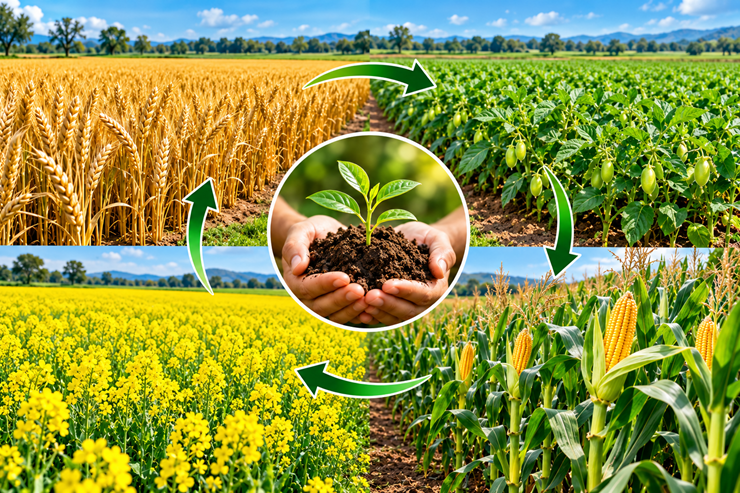
Crop rotation is a farming practice in which different crops are grown on the same piece of land in a planned sequence over several growing seasons. Instead of planting the same crop repeatedly, farmers change the crop according to soil conditions, water availability, pest pressure, climate and market requirements.
For example, a farmer may grow wheat in one season, chickpeas in the next, and maize after that. Each crop uses nutrients differently and has different effects on the soil.
Crop rotation is not a new concept. Farmers have used different forms of crop rotation for generations. Today, it is also an important part of sustainable agriculture because it can help with soil management, pest control, crop diversity and long-term farm planning.
In this guide, we will look at 10 major benefits of crop rotation, different types, practical examples, planning methods, common mistakes and ways farmers can improve their crop rotation system.
What Is Crop Rotation?
Crop rotation means growing different crops on the same field in a planned sequence rather than growing the same crop repeatedly.
The sequence can be based on:
- Crop nutrient requirements
- Soil condition
- Climate
- Water availability
- Pest and disease pressure
- Crop maturity period
- Market demand
- Farm resources
A simple rotation could look like:
- Year 1 → Wheat
- Year 2 → Chickpea
- Year 3 → Maize
- Year 4 → Oilseed crop
The exact rotation depends on the location, soil type, climate and crops available to the farmer.
For a broader understanding of different farming systems, readers can also explore Crop Farming, which covers crop production methods and major crop categories.
Why Is Crop Rotation Important?
Growing the same crop continuously can create several challenges.
A particular crop may repeatedly remove similar nutrients from the soil. Some pests and diseases can also become easier to maintain when their preferred host crop is planted year after year.
Crop rotation introduces variation into the field.
Different crops have different:
- Root structures
- Nutrient requirements
- Growing periods
- Water needs
- Pest relationships
- Soil effects
This variation can make farm management more balanced.
A Simple Practical Example
Imagine a farmer growing maize on the same field every year.
Over time, the farmer may need to pay closer attention to nutrient management, weeds and crop-specific pests. Instead of continuing the same pattern, the farmer could introduce soybean or another suitable legume into the rotation.
The following season might look like:
Maize → Soybean → Wheat → Legume
The goal is not simply to change crops. The farmer is planning a sequence where each crop has a different role in the overall farming system.
10 Benefits of Crop Rotation
#1. Supports Soil Health
Different crops interact with soil in different ways.
Deep-rooted crops can explore different soil layers, while crops with dense root systems can contribute organic material when their residues remain in the field.
A well-planned rotation can therefore support better long-term soil management.
#2. Helps Manage Nutrient Use
Different crops have different nutrient requirements.
For example, cereal crops generally have different nutrient demands from legumes. Including legumes in a rotation can be useful as part of an overall nutrient-management strategy.
Farmers should still use soil testing and appropriate fertilization rather than assuming that rotation alone will provide all required nutrients.
#3. Can Help Reduce Pest Problems
Some agricultural pests depend heavily on particular crops.
If the same host crop is continuously planted, pests may have more opportunities to remain established.
Changing crops can interrupt this pattern in some farming systems.
For example:
Crop A → Crop A → Crop A
may create a different pest-management situation than:
Crop A → Crop B → Crop C
Crop rotation should therefore be considered as one part of an integrated pest-management approach.
#4. Helps With Disease Management
Some plant diseases are associated with specific crops and crop residues.
Changing the crop in the following season can reduce the opportunity for certain crop-specific diseases to continue their cycle.
However, crop rotation does not eliminate every disease. Seed quality, field sanitation, resistant varieties and other management practices may also be required.
#5. Can Improve Weed Management
Different crops require different planting dates, row spacing and cultivation practices.
This variation can make weed management more difficult for some weeds that are adapted to one particular cropping system.
For example, changing between a winter cereal and a summer crop changes the timing and conditions under which weeds grow.
#6. Supports Biodiversity
Growing multiple crop types instead of repeatedly planting one crop increases diversity within the farm system.
Different crops can provide different habitats and food resources for organisms living around the field.
Greater crop diversity can also reduce dependence on a single crop.
#7. Can Improve Soil Structure
Different root systems interact with soil differently.
Deep roots, fibrous roots and other root structures can affect soil aggregation, pore spaces and organic matter over time.
Crop residues can also contribute organic material to the soil when properly managed.
#8. Spreads Production Risk
Farming always involves uncertainty.
Weather, pests, disease and market prices can change from one season to another.
If a farmer grows several crops across a planned rotation, poor performance in one crop may not affect the entire production system in the same way as a farm that depends on one crop alone.
This does not remove financial risk, but it can help diversify production.
#9. Supports Sustainable Farming
Crop rotation is commonly associated with sustainable farming systems because it focuses on maintaining productive farmland over the long term.
It can be combined with:
- Soil testing
- Cover crops
- Reduced tillage
- Organic matter management
- Efficient irrigation
- Integrated pest management
For more information, readers can explore Sustainable Farming.
#10. Makes Long-Term Farm Planning Easier
A planned rotation gives farmers a framework for deciding:
What to plant
When to plant
Which fields to use
What inputs may be required
What equipment is needed
When crops are expected to reach harvest
How crops will be marketed
This can make farm management more organized.
Types of Crop Rotation
There is no single crop rotation system suitable for every farm.
The following are common approaches.
- Two-Year Crop Rotation
A two-year system uses two crops in a repeating sequence.
Example:
Year 1: Wheat
Year 2: Chickpea
Then the cycle begins again.
This type of rotation can be relatively simple to manage.
- Three-Year Crop Rotation
A three-year rotation uses three crops.
Example:
Year 1: Maize
Year 2: Soybean
Year 3: Wheat
This provides greater crop diversity than a two-crop system.
- Four-Year Crop Rotation
A four-year system can include cereals, legumes, oilseeds and other crops.
Example:
Year 1: Wheat
Year 2: Chickpea
Year 3: Maize
Year 4: Mustard
The exact crops should be selected according to local growing conditions.
- Cereal-Legume Rotation
This system alternates cereal crops with legumes.
Examples include:
Wheat → Chickpea
Maize → Soybean
Rice → Pulses
Cereal crops and legumes have different nutrient and root characteristics, making them useful components of many rotation systems.
Read More Information About Cereal Crop Farming.
- Cash Crop Rotation
A farmer may include commercially valuable crops as part of the rotation.
For example:
Cotton → Wheat → Chickpea → Cotton
This allows the farmer to consider both soil management and market opportunities.
More information can be found in Cash Crop Farming.
Practical Crop Rotation Examples
The following examples show how rotation can work in real farming situations.
Example 1: Wheat and Chickpea
A farmer growing wheat every year may introduce chickpea into the following season.
A simple system could be:
Year 1 → Wheat
Year 2 → Chickpea
The farmer can then repeat the cycle if it fits local soil, climate and market conditions.
The benefit is not simply that two crops are being grown. The farmer is deliberately changing the crop type and its demands on the field.
Example 2: Maize and Soybean
Another common example is:
Maize → Soybean → Maize → Soybean
Maize and soybean have different nutrient requirements and growth characteristics.
This type of rotation is widely discussed in crop-management systems because it provides crop diversity while allowing farmers to produce commercially useful crops.
Example 3: Wheat, Legume and Maize
A longer rotation could be:
Year 1 → Wheat
Year 2 → Chickpea
Year 3 → Maize
This gives the farmer three different crop types rather than repeating one crop continuously.
Before using such a system, the farmer should consider rainfall, irrigation, soil type, crop duration and local market demand.
Example 4: Vegetable Crop Rotation
Crop rotation is not limited to large grain farms.
A vegetable grower could avoid planting the same vegetable family repeatedly in the same bed.
For example:
Season 1 → Tomato
Season 2 → Beans
Season 3 → Cabbage
Season 4 → Carrots
The exact sequence should depend on the crops, local conditions and pest or disease history of the field.
This approach can be particularly useful in small-scale vegetable production.
Read More Information about: Vegetable Farming
How Crop Rotation Works
A successful crop rotation is based on planning rather than simply changing crops randomly.
Farmers generally consider:
- Previous Crop
The crop grown previously can influence the choice of the next crop.
- Soil Condition
Soil texture, fertility, pH and organic matter should be considered.
- Water Availability
Some crops require significantly more water than others.
- Pest and Disease History
Fields with recurring pest or disease problems may require carefully selected crop sequences.
- Market Demand
A crop may grow well but still be difficult to sell profitably.
- Available Equipment
Farmers should consider whether they have the machinery required for planting, harvesting and processing each crop.
How to Plan a Crop Rotation
Before creating a rotation schedule, make a simple record of each field.
For example:
| Year | Crop | Main Purpose |
| Year 1 | Wheat | Grain production |
| Year 2 | Chickpea | Legume crop |
| Year 3 | Maize | Grain production |
| Year 4 | Mustard | Oilseed crop |
This type of record helps farmers see the sequence clearly.
Practical Planning Tip
Don’t choose crops only because they are currently selling at a high price.
A crop rotation should consider soil, climate, water, production cost, equipment, labour and market demand together.
A profitable crop in one region may not produce the same results in another.
Crop Rotation and Soil Health
Soil is one of the most important resources on a farm.
A long-term cropping system should therefore consider more than one harvest.
Crop rotation can contribute to soil management by introducing different root systems, crop residues and nutrient requirements.
For example, a cereal crop may have a different root structure from a legume. When these crops are included in a planned sequence, the field experiences different biological and physical interactions over time.
However, farmers should combine crop rotation with other soil-management practices such as:
- Soil testing
- Appropriate fertilization
- Organic matter management
- Erosion control
- Efficient irrigation
- Proper residue management
Crop Rotation for Pest and Disease Management
Repeatedly growing the same crop can sometimes make it easier for crop-specific pests and diseases to persist.
Changing crops can interrupt some of these cycles.
For example, if a pest primarily depends on one crop as its host, replacing that crop with a non-host crop in the next season may reduce its opportunity to continue developing.
However, this depends on the pest, disease, crop and local conditions.
Crop rotation should therefore be combined with other methods rather than treated as a complete pest-control solution.
Crop Rotation in Organic Farming
Crop rotation is particularly important in many organic farming systems.
Organic farmers generally focus heavily on:
- Soil fertility
- Crop diversity
- Organic matter
- Natural pest-management approaches
- Reduced dependence on synthetic inputs
A rotation might include:
Cereal → Legume → Vegetable → Cover Crop
The exact system depends on the farm and local conditions.
You can internally link Organic Farming here.
Crop Rotation in Sustainable Farming
Sustainable farming focuses on maintaining agricultural productivity while managing natural resources responsibly.
Crop rotation can form one part of this approach.
A farmer may combine crop rotation with:
- Efficient water use
- Soil conservation
- Cover cropping
- Integrated pest management
- Reduced soil disturbance
- Organic matter management
For a complete overview, Sustainable Farming.
Common Crop Rotation Mistakes
Crop rotation can be useful, but poor planning can reduce its benefits.
Mistake 1: Changing Crops Without a Plan
Simply changing crops every season does not automatically create a good rotation.
Mistake 2: Ignoring the Local Climate
A crop should be suitable for the temperature and rainfall conditions of the region.
Mistake 3: Ignoring Water Availability
A rotation that requires more irrigation than the farm can provide may not be practical.
Mistake 4: Choosing Crops Only for Price
Market prices can change quickly.
Farmers should consider production costs and expected demand as well.
Mistake 5: Ignoring Pest History
A rotation should take previous pest and disease problems into account.
Mistake 6: Planting Crops With Similar Problems
If several crops are affected by the same pest or disease, simply changing between them may not provide enough variation.
How to Improve a Crop Rotation Plan
A good rotation should be reviewed regularly.
Farmers can improve their system by:
- Keeping records of previous crops.
- Recording pest and disease problems.
- Testing soil periodically.
- Comparing crop production costs.
- Tracking water requirements.
- Reviewing market demand.
- Including suitable legumes or cover crops.
- Avoiding repeated planting of crops with similar disease risks.
- Reviewing yields after every season.
- Adjusting the next rotation based on actual farm results.
A Practical Farm Record
Instead of relying only on memory, keep a simple record:
Field: Field A
Previous Crop: Wheat
Next Crop: Chickpea
Soil Observation: Low organic matter
Water Availability: Moderate
Pest Issue: Weed pressure
Expected Market: Local grain market
These records can make future crop planning more informed.
Crop Rotation vs Continuous Cropping
| Feature | Crop Rotation | Continuous Cropping |
| Crop diversity | Higher | Usually lower |
| Crop sequence | Planned | Same crop may repeat |
| Soil management | More varied | Similar nutrient demand may repeat |
| Pest management | Can help interrupt some cycles | Some pests may persist |
| Planning | Requires advance planning | Often simpler |
| Planning | Production may be diversified | Greater dependence on one crop |
| Long-term management | Focuses on crop sequence | Focuses heavily on one crop |
Neither system is automatically suitable for every farm. Local conditions, economics and production goals should determine the approach.
FAQs.
What is crop rotation?
Crop rotation is the practice of growing different crops on the same field in a planned sequence over multiple growing seasons.
What is the main purpose of crop rotation?
The main purpose is to manage the cropping system more effectively by varying crops and their effects on soil, pests, diseases and farm resources.
What is an example of crop rotation?
A simple example is:
Wheat → Chickpea → Maize → Mustard
The actual sequence should be adapted to local conditions.
Is crop rotation good for soil?
It can support soil management by introducing different root systems, crop residues and nutrient requirements. Soil testing and other management practices are still important.
Can crop rotation reduce pests?
It can help interrupt the life cycles of some crop-specific pests, but it does not control all pests.
Is crop rotation used in organic farming?
Yes. Crop rotation is commonly used in organic farming systems as part of soil fertility and pest-management strategies.
How many years should a crop rotation be?
There is no universal number. Two-, three- and four-year rotations are common examples, but the appropriate period depends on the crops, soil, climate, pests and farm objectives.
Is crop rotation profitable?
It can contribute to farm risk management and production efficiency, but profitability depends on crop prices, input costs, yield, labour, water availability and local market conditions.
Conclusion:
Crop rotation is a practical way to bring greater diversity into a farming system. Instead of relying on the same crop year after year, farmers can create a planned sequence that considers soil condition, water availability, pest pressure, crop requirements and market opportunities.
A simple system such as wheat → chickpea → maize can be easier to manage than a complicated rotation, but the best approach depends on the individual farm.
The most important point is that crop rotation should be planned according to real farm conditions rather than following a fixed formula.
Farmers who keep records, monitor soil conditions and review the results after each season can gradually develop a rotation system that fits their land and production goals.
8 thoughts on “Crop Rotation: 10 Benefits, Types, Examples & Best Practices”