
Farming has never really stood still.
The way people grow food has changed with new tools, better knowledge and changing needs. A farmer today may still depend on sunlight, soil and rain, but they may also use sensors, mobile apps, drones, automated irrigation or even grow plants without soil.
This is where modern farming comes in.
Modern farming is not simply about replacing traditional agriculture with technology. In many cases, it is about finding a practical way to produce food while making better use of limited land, water, labour and other resources.
Some modern farming methods are already being used commercially, while others are still developing. Hydroponics, vertical farming, precision farming, smart farming, aquaponics and indoor farming are six examples that are attracting increasing attention.
But are these methods suitable for every farmer?
Not necessarily.
Each method has its own benefits, costs and limitations. In this guide, we’ll look at how these farming methods work, where they can be useful, their advantages and disadvantages, and how they compare with one another.
What Is Modern Farming?
Modern farming is the use of improved agricultural techniques, technology, scientific knowledge, data and innovative growing systems to make farming more efficient and manageable.
It is a broad term rather than one specific type of farming.
For some farmers, modern farming may mean using GPS-guided machinery or soil sensors in a large field.
For others, it could mean growing lettuce in a hydroponic system or producing vegetables inside a controlled indoor environment.
The common idea is simple: use better information, tools and techniques to solve real farming problems.
Why Is Modern Farming Becoming More Important?
Agriculture faces a number of challenges.
Farmers have to deal with changing weather, water availability, soil health, rising input costs and growing demand for food. At the same time, suitable agricultural land is limited in many parts of the world.
This has encouraged farmers, researchers and businesses to look at new approaches.
For example:
- A farmer with limited water may explore more efficient irrigation.
- A grower with very little land may consider vertical production.
- A large farm may use sensors to understand differences across its fields.
- An urban grower may use hydroponics or indoor farming.
- A fish farmer may combine fish production with vegetable growing through aquaponics.
So, modern farming is less about using technology for its own sake and more about using the right approach for the right problem.
6 Major Modern Farming Methods
The term modern farming covers many different techniques. However, these six methods provide a useful starting point:
- Hydroponic Farming
- Vertical Farming
- Precision Farming
- Smart Farming
- Aquaponics
- Indoor Farming
Let’s take a closer look at each one.
#1. Hydroponic Farming
Plants normally grow in soil, but hydroponics takes a different approach.
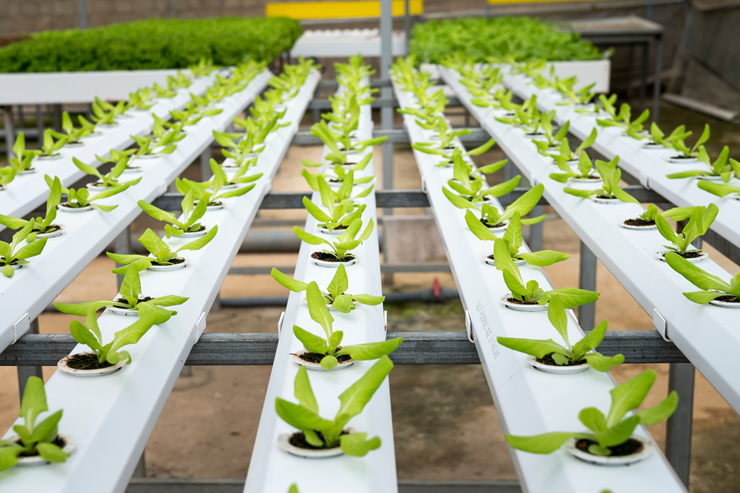
Hydroponic farming is a method of growing plants without traditional soil by supplying their roots with water and the nutrients they need.
Depending on the system, plants may grow with their roots directly in nutrient-rich water or in a growing medium that provides physical support.
The grower can monitor things such as:
Water
Nutrients
pH
Temperature
Light
Leafy greens, herbs, tomatoes and some other vegetables can be grown using hydroponic systems.
One of the interesting things about hydroponics is that it can be used in places where suitable agricultural soil is limited.
However, the equipment and management requirements mean it is not automatically cheaper or easier than conventional farming.
Read the complete guide to Hydroponic Farming
#2. Vertical Farming
What happens when agricultural land is limited but there is unused vertical space?
Vertical farming attempts to answer that question.
Vertical farming involves growing crops in stacked layers rather than spreading the entire growing area across a single horizontal surface.
Vertical farms are often associated with indoor or controlled environments and may use hydroponics, artificial lighting, sensors and automated equipment.
Instead of one growing layer, imagine several layers arranged above one another.
This can make productive use of a relatively small footprint.
Potential benefits include:
- Efficient use of space
- Controlled growing conditions
- Production close to urban areas
- Reduced dependence on outdoor weather
But there is a trade-off.
Artificial lighting, cooling, ventilation and other systems can consume considerable energy, while setting up a vertical farm can require significant investment.
Read the complete guide to Vertical Farming
#3. Precision Farming
A field may look uniform from a distance, but the soil and crop conditions can vary from one part to another.
Precision farming uses technology and data to help farmers recognise these differences.
Precision farming is an approach to agriculture that uses location-specific information and technology to manage crops and farm inputs more accurately.
Tools can include:
- GPS
- Soil sensors
- Drones
- Satellite imagery
- Weather information
- Farm-management software
- Variable-rate equipment
For example, instead of applying exactly the same amount of water or fertiliser everywhere, a farmer may use data to identify areas that need more or less.
The goal is not simply to collect data. The useful part is turning that information into better farming decisions.
Read the complete guide to Precision Farming
#4. Smart Farming
Smart farming is a broader idea that brings connected technology and automation into agricultural operations.
A smart farm may use sensors to collect information and digital systems to help farmers monitor conditions and respond more quickly.
Technologies can include:
- Internet of Things (IoT) devices
- Sensors
- Artificial intelligence
- Automated irrigation
- Drones
- Robotics
- Farm-management software
Imagine a soil sensor detecting that moisture has fallen below a certain level. Instead of relying only on guesswork, the farmer can receive information and decide whether irrigation is needed.
That is the basic idea behind smart farming: using connected information to make farming decisions more informed and timely.
Smart Farming vs Precision Farming
These terms overlap, but they are not identical.
Precision farming focuses strongly on accurate, location-based management of agricultural resources.
Smart farming is broader and can include connectivity, automation, artificial intelligence and real-time monitoring.
Read the complete guide to Smart Farming
#5. Aquaponics
Aquaponics combines two activities that might not seem connected at first: fish farming and plant cultivation.
In an aquaponic system, fish produce waste containing nutrients. Microorganisms help convert these nutrients into forms that plants can use.
Plants then take up nutrients from the water, helping to clean it before the water is circulated back towards the fish.
In simple terms:
Fish → Nutrients → Plants → Cleaner Water → Fish
It is a connected system rather than two completely separate farming activities.
Aquaponics can be used to grow crops such as leafy greens and herbs, while certain fish species are commonly used in suitable systems.
The system does require careful management, though. Water quality, fish health, plant growth, temperature and the biological balance all need attention.
Read the complete guide to Aquaponics
#6. Indoor Farming
Traditional agriculture depends heavily on outdoor conditions.
Indoor farming changes that by moving crop production into a controlled environment.
Indoor farming is the cultivation of crops inside buildings or other enclosed spaces where conditions such as light, temperature, humidity and water can be managed.
Some indoor farms use:
- Hydroponics
- Artificial lighting
- Automated irrigation
- Climate-control systems
- Sensors
- Controlled nutrient delivery
One of the biggest advantages is control over the growing environment.
Instead of being completely exposed to outdoor weather, growers can manage important conditions inside the facility.
The downside is that maintaining these conditions can require substantial energy and investment.
Read the complete guide to Indoor Farming
Modern Farming Methods Compared:
It can be difficult to understand the differences between these methods just from their names.
This simple comparison can help:
| Farming Method | Main Idea | Common Advantage | Main Challenge |
| Hydroponic Farming | Growing plants without traditional soil | Efficient and controlled growing | Equipment and nutrient management |
| Vertical Farming | Growing crops in stacked layers | Makes better use of space | Energy and setup costs |
| Precision Farming | Using data to manage fields accurately | Better resource management | Technology and training costs |
| Smart Farming | Connected technology and automation | Real-time monitoring and decisions | Technical complexity |
| Aquaponics | Combining fish and plant production | Reuses water and nutrients | Requires careful system balance |
| Indoor Farming | Growing crops in controlled indoor conditions | Greater environmental control | Energy requirements |
The table also shows why it would be misleading to call one method “the best”.
Each one solves a somewhat different problem.
Which Modern Farming Method Is Right for You?
There is no universal answer.
The right choice depends on the crop, available land, budget, climate, electricity, water supply and level of technical knowledge.
If you have very limited space
Vertical farming may be worth exploring because it makes use of multiple growing layers.
If suitable soil is a problem
Hydroponic farming can be an option because plants do not depend on conventional soil.
If you manage a large agricultural field
Precision farming may be more practical because it can help you understand variations in soil, moisture and crop conditions across the field.
If you want automation and connected monitoring
Smart farming may be the better direction.
If you want to combine fish and vegetables
Aquaponics is specifically designed around that relationship.
If outdoor weather is a major concern
Indoor farming can provide greater environmental control, although energy and infrastructure costs need to be considered.
This is an important point: modern farming is not about choosing the newest technology. It is about choosing a method that makes sense for your situation.
Advantages of Modern Farming
Modern farming can provide several benefits when the technology is properly selected and managed.
#1. Better Resource Management
Sensors, automated irrigation and precision tools can help farmers understand how resources are being used.
This can potentially reduce unnecessary use of water, fertiliser and other inputs.
#2. Better Use of Limited Space
Vertical and indoor systems can make productive use of areas where conventional farming may be difficult.
This is particularly interesting for urban and peri-urban agriculture.
#3. Greater Control Over Growing Conditions
Hydroponic and indoor systems allow growers to manage several environmental factors.
This can make production more predictable in some situations.
#4. Data Can Support Better Decisions
Farmers can collect information about:
Soil moisture
Weather
Crop conditions
Irrigation
Nutrients
Field variation
The farmer can then use this information alongside experience when making decisions.
#5. Potential for Local Food Production
Indoor and vertical farms can sometimes be located close to cities.
This can make it possible to grow certain fresh crops closer to the people who consume them.
#6. Automation Can Save Time
Automated irrigation, monitoring and machinery can reduce some repetitive tasks.
However, automation does not remove the need for skilled farm management.
Disadvantages of Modern Farming
Modern technology also has limitations.
#1. High Initial Investment
Sensors, automation, climate-control systems and specialised growing equipment can be expensive.
This can make some technologies difficult for small-scale farmers to adopt.
#2. Energy Requirements
Indoor and vertical farms may need artificial lighting, ventilation, heating or cooling.
Their overall environmental performance therefore depends partly on energy efficiency and the source of that electricity.
#3. Technical Knowledge Is Needed
A modern farming system may require knowledge of both agriculture and technology.
Farmers may need training to use sensors, software, automated equipment and other tools effectively.
#4. Equipment Can Fail
Technology can make farming easier, but it can also introduce new points of failure.
A broken pump, sensor or control system can create problems in a highly controlled growing environment.
#5. Not Every Crop Is Suitable
Some crops fit modern controlled systems better than others.
Leafy greens and herbs, for example, are commonly associated with controlled-environment farming, while major field crops such as wheat and maize are still generally grown on large outdoor farms.
Modern Farming in India
Modern farming is becoming an increasingly interesting area in India, but adoption varies from one farm to another.
India has a huge variety of farming conditions, from small family farms to large commercial operations.
Different technologies may therefore make sense in different situations.
Examples include:
Drip and automated irrigation
Soil sensors
Agricultural drones
Protected cultivation
Hydroponics
Precision agriculture
Smart farming tools
Controlled-environment agriculture
For a small farmer, installing an expensive automated system may not make financial sense.
A relatively simple improvement in irrigation, soil testing or farm monitoring may provide more practical value.
For an urban grower, however, hydroponics or vertical farming could be worth considering because available land may be the biggest limitation.
This is why modern farming in India should not be viewed as a single trend. The useful technology is the technology that matches the farmer’s actual needs.
Is Modern Farming Sustainable?
This is one of the most important questions to ask.
Modern technology can improve efficiency, but technology alone does not guarantee sustainability.
For example, a vertical farm may use very little land but require substantial electricity for lighting.
Similarly, hydroponics can recirculate water, but the system still requires equipment, nutrients and careful management.
Sustainable farming needs to consider the complete picture:
- Water use
- Energy consumption
- Soil health
- Biodiversity
- Waste
- Production costs
- Crop suitability
- Long-term productivity
A modern farming method should therefore be judged by how well it works in a particular location rather than simply by how advanced it looks.
Traditional Farming and Modern Farming Can Work Together
It is tempting to think of traditional and modern farming as opposites.
In reality, they can complement each other.
A farmer may use traditional knowledge to understand local soil and weather while using a moisture sensor to decide when irrigation is needed.
Another farmer may continue growing crops outdoors but use improved irrigation and satellite information to manage the field.
This combination can be very practical.
Technology provides information and tools; farming experience provides context.
Neither one has to completely replace the other.
What Does the Future of Modern Farming Look Like?
Agriculture is likely to become increasingly connected with technology.
We may see wider use of:
Artificial intelligence
Agricultural robotics
Drones
Smart sensors
Automated irrigation
Satellite monitoring
Farm-management platforms
Controlled-environment agriculture
But the future of farming will not be determined by technology alone.
Farmers will still need to understand their crops, land, climate and local market.
The most successful systems are likely to be those where technology solves a genuine problem rather than being added simply because it is new.
FAQ’s.
Q1. What is modern farming?
Modern farming is a broad approach to agriculture that uses improved technology, scientific knowledge, data, machinery and innovative growing methods to improve farming and resource management.
Q2. What are the six main types of modern farming?
Six important modern farming methods are hydroponic farming, vertical farming, precision farming, smart farming, aquaponics and indoor farming.
Q3. Is hydroponic farming a type of modern farming?
Yes. Hydroponic farming is a modern growing method in which crops are cultivated without traditional agricultural soil.
Q4. What is the difference between vertical farming and indoor farming?
Vertical farming focuses on growing crops in stacked layers, while indoor farming is a broader term for growing crops inside a controlled environment. A vertical farm can therefore also be an indoor farm.
Q5. Is smart farming the same as precision farming?
No. They overlap, but precision farming focuses more specifically on accurate management of agricultural resources using data, while smart farming can include connected devices, automation, AI and real-time monitoring.
Q6. Is modern farming expensive?
Some modern farming systems can require significant investment. However, costs vary greatly depending on the technology, crop, farm size and level of automation.
Related Article for Farming Guides
Hydroponic Farming: 7 Key Benefits, Types, Examples & How It Works
Vertical Farming: 7 Key Benefits, Types, Examples & How It Works
Precision Farming: 7 Key Benefits, Technology, Examples & How It Works
Smart Farming: 7 Key Benefits, Technologies, Examples & How It Works
Aquaponics: 7 Key Benefits, How It Works, Types & Examples
Indoor Farming: 7 Key Benefits, Types, Crops & How It Works
You can also explore the broader guide:
Types of Farming: 7 Major Types of Farming Explained
Conclusion:
Modern farming is changing, but it is not replacing the basic idea of agriculture.
Plants still need light, water, nutrients and the right growing conditions. Farmers still need knowledge and experience.
What has changed is the number of tools available to help manage those things.
A farmer with a large field might use precision technology to understand which areas need more water. An urban grower might use hydroponics because there is little suitable soil. Someone with limited space might look at vertical farming, while another grower may choose aquaponics to combine fish and vegetable production.
There is no single answer for every farm.
The real value of modern farming lies in matching the right technology with the right agricultural problem.
As agriculture continues to change, the most useful innovations will probably be the ones that are not only impressive, but also practical, affordable and sustainable for the people who actually use them.
5 thoughts on “Modern Farming: 6 Innovative Farming Methods Changing Agriculture”