
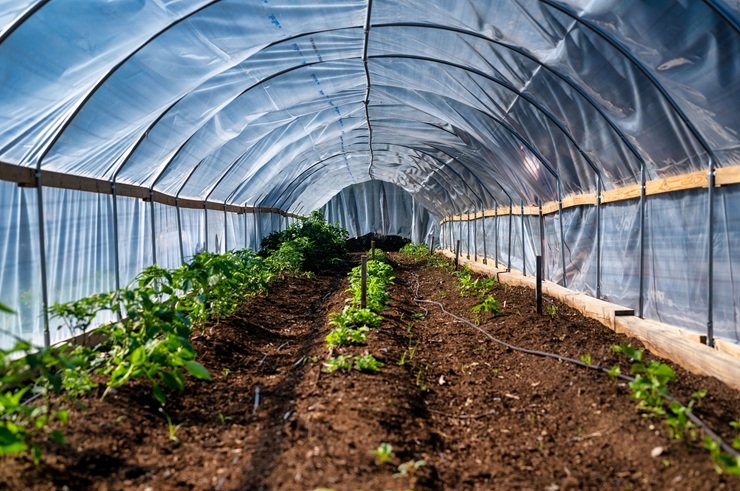
Greenhouse farming is a method of growing crops inside a protected structure where farmers can manage important growing conditions such as temperature, humidity, light, ventilation and irrigation.
Unlike open-field farming, crops grown inside a greenhouse are partly protected from unpredictable weather. The level of control depends on the type of greenhouse, equipment used and crops being grown.
A greenhouse can be a simple structure covered with plastic film or a more advanced facility equipped with ventilation systems, cooling, heating, irrigation, sensors and automated controls.
For farmers, the main attraction is not simply the structure itself. The real advantage is having greater control over the growing environment.
For example, a vegetable farmer growing tomatoes in an open field has to deal directly with rain, temperature changes, wind and other environmental conditions. Inside a greenhouse, some of these factors can be managed more carefully.
In this guide, we will look at 10 types of greenhouses, greenhouse farming methods, suitable crops, benefits, challenges, costs, practical examples and important factors to consider before starting a greenhouse farm. Greenhouse farming is one of several agricultural production systems used around the world. To understand how it fits into agriculture as a whole, you can also learn more about the Types of Farming and how different farming systems are used in different conditions.
What Is Greenhouse Farming?
Greenhouse farming is the practice of growing crops inside a specially designed protected structure.
The structure usually allows sunlight to enter while providing some protection from external weather conditions.
Depending on the greenhouse design, farmers may be able to manage:
- Temperature
- Humidity
- Ventilation
- Irrigation
- Light
- Growing media
- Fertilizer application
- Pest management
Greenhouse farming is also known as a form of protected agriculture or protected cultivation.
It can be used by small farmers, commercial growers, nurseries and specialized agricultural businesses.
For a broader understanding of agricultural systems, you can click here to learn more about crop farming.
How Does Greenhouse Farming Work?
The basic idea behind a greenhouse is straightforward.
Sunlight enters the structure and provides energy for plant growth. The greenhouse covering helps create a more controlled environment than an exposed field.
Farmers can then manage other factors according to the crop’s requirements.
A basic greenhouse system may include:
Greenhouse Structure → Growing Beds → Irrigation → Crop Management → Harvesting
More advanced greenhouses can include:
Sensors → Automated Irrigation → Climate Control → Fertigation → Data Monitoring
The level of technology depends on the farm’s budget, crop requirements and production goals
10 Types of Greenhouses
Greenhouses can be classified according to their shape, construction material, covering and level of environmental control.
#1. Tunnel Greenhouse
A tunnel greenhouse has a curved or semi-circular structure covered with plastic film.
It is relatively simple and can be suitable for vegetables, flowers and nursery plants.
Tunnel structures are commonly considered when farmers want protected cultivation without installing highly complex climate-control systems.
#2. Polyhouse
A polyhouse is a protected structure generally covered with polyethylene or similar plastic material.
It can provide a controlled growing environment while allowing sunlight to reach the crops.
Polyhouses are commonly used for vegetables, flowers and nursery production.
#3. Glass Greenhouse
Glass greenhouses use glass panels as the primary covering material.
They can provide excellent light transmission and are often associated with commercial or research-oriented production systems.
However, construction and maintenance can be more expensive than simpler plastic-covered structures
#4. Net House
A net house uses mesh or netting rather than a completely solid covering.
It provides protection from certain insects, birds and environmental conditions while allowing airflow.
It is useful for crops where complete enclosure or climate control is not necessary.
#5. Shade House
A shade house uses shade material to reduce direct sunlight reaching plants.
It can be useful for crops and nursery plants that require protection from excessive sunlight or heat.
#6. Sawtooth Greenhouse
A sawtooth greenhouse has a roof design with repeated sections that can help improve natural ventilation.
The design may be useful in warm climates where removing excess heat is an important consideration.
#7. Gable Roof Greenhouse
This greenhouse has a roof shape similar to a traditional house.
The design provides usable internal space and can be adapted to different greenhouse sizes and ventilation systems.
#8. Ridge and Furrow Greenhouse
Ridge-and-furrow greenhouses consist of multiple connected greenhouse sections.
They can be useful for larger commercial operations because several growing areas can be combined into one structure.
#9. Automated Greenhouse
An automated greenhouse uses sensors and equipment to monitor or control environmental conditions.
Depending on the system, automation may include:
- Temperature sensors
- Humidity sensors
- Automatic irrigation
- Ventilation
- Cooling
- Fertigation
- Monitoring systems
Automation can reduce some manual work, but it also increases the initial investment and requires proper maintenance.
#10. Hydroponic Greenhouse
A hydroponic greenhouse combines protected cultivation with hydroponic growing techniques.
Instead of growing plants directly in traditional soil, crops can be grown using nutrient solutions and suitable growing systems.
This approach is particularly useful for certain vegetables and leafy greens. Read More Information about Hydroponic Farming
Popular Crops Grown in Greenhouses
Many crops can be grown under protected conditions, but the suitability depends on climate, greenhouse design, market demand and production costs.
Common greenhouse crops include:
Vegetables
- Tomato
- Cucumber
- Capsicum
- Lettuce
- Spinach
- Beans
- Peppers
Fruits
- Strawberry
- Melon
- Certain varieties of berries
Flowers
- Rose
- Gerbera
- Chrysanthemum
- Carnation
Nursery Plants
Greenhouses are also widely useful for producing seedlings and young plants before they are transferred to fields or other growing systems.
For more information about vegetable production, see Vegetable Farming.
Greenhouse Farming Methods
There is no single method of greenhouse farming.
Farmers can choose a production system according to their crop and resources.
#1. Soil-Based Greenhouse Farming
Plants are grown directly in soil inside the greenhouse.
This is one of the simpler approaches because the farmer does not need a separate hydroponic growing system.
However, soil fertility, drainage and disease management still need attention.
#2. Container-Based Growing
Plants are grown in containers filled with suitable growing media.
This provides greater control over the growing medium and can be useful for certain vegetables, flowers and nursery plants.
#3. Hydroponic Greenhouse Farming
Plants are grown without traditional field soil and receive nutrients through a water-based system.
Hydroponic systems can use different techniques, including nutrient film systems, deep-water systems and drip-based systems.
The choice depends on the crop and farm design.
#4. Organic Greenhouse Farming
Organic greenhouse production focuses on organic production principles.
The exact requirements depend on the certification system and country where the farm operates.
Farmers should not assume that simply growing a crop inside a greenhouse makes it organic.
#5. Vertical Greenhouse Production
Some greenhouse operations use vertical growing arrangements to make better use of available space.
This approach may be suitable for selected crops, particularly leafy vegetables and seedlings.
It can require additional structures, lighting or management systems depending on the design.
Benefits of Greenhouse Farming
#1. Better Environmental Control
One of the main benefits is greater control over growing conditions.
Farmers can manage ventilation, irrigation, humidity and other factors more carefully than in many open-field systems.
#2. Protection From Some Weather Conditions
Greenhouses can provide protection from:
- Heavy rain
- Strong winds
- Hail
- Extreme temperature conditions
- Some environmental stresses
The level of protection depends on the greenhouse structure.
#3. Extended Growing Season
A greenhouse can allow farmers to grow certain crops during periods when outdoor conditions are less suitable.
However, this depends heavily on the greenhouse design and local climate.
#4. Efficient Water Management
Drip irrigation and other controlled irrigation systems can deliver water directly to the crop root zone.
This can improve water management compared with uncontrolled irrigation, although the actual water savings depend on system design and management.
#5. Better Crop Monitoring
Because the growing area is more controlled, farmers can monitor plants more closely.
They can identify:
- Nutrient problems
- Pest damage
- Disease symptoms
- Irrigation issues
- Growth differences
earlier in the production cycle.
#6. Suitable for High-Value Crops
Greenhouses can be useful for crops that have higher market value or require specific growing conditions.
Examples include certain:
- Vegetables
- Flowers
- Nursery plants
- Specialty crops
But high-value does not automatically mean high profit. Production and infrastructure costs must also be considered.
#7. Better Use of Limited Land
Greenhouses can allow intensive production from a relatively small area.
This can be useful for farmers operating near cities where agricultural land may be expensive or limited.
#8. Possibility of Multiple Production Cycles
Under suitable conditions, farmers may be able to produce more than one crop cycle during a year.
The number of cycles depends on the crop, climate, greenhouse system and management practices.
#9. Reduced Exposure to Some Pests
A properly designed greenhouse can provide a physical barrier against certain insects and other pests.
However, greenhouse crops can still experience pest problems, so monitoring remains important.
#10. Consistent Production Planning
Protected cultivation can make production planning more predictable in some situations.
Farmers can better coordinate:
Planting → Crop Management → Harvest → Market Supply
This can be particularly useful for commercial growers supplying regular customers.
Challenges of Greenhouse Farming
Greenhouse farming also has limitations.
High Initial Investment
A greenhouse requires investment in:
- Structure
- Covering material
- Irrigation
- Growing beds
- Ventilation
- Equipment
- Labour
Advanced systems can require substantially more investment.
Regular Maintenance
Plastic coverings, irrigation equipment, sensors, fans and other components need maintenance.
Ignoring small problems can eventually affect crop production.
Temperature Management
A greenhouse can become excessively hot if ventilation and cooling are inadequate.
This is particularly important in warm climates.
Pest and Disease Problems Can Still Occur
A greenhouse is not completely pest-proof.
In fact, if a pest or disease enters a protected growing environment, it can sometimes spread quickly because the conditions are favorable for plant growth.
Regular monitoring is therefore essential.
Technical Knowledge
Modern greenhouse farming can require knowledge of:
- Irrigation
- Fertilization
- Temperature management
- Humidity
- Pest management
- Crop scheduling
Farmers may need training before operating advanced systems effectively.
Greenhouse Farming vs Open-Field Farming
| Feature | Greenhouse Farming | Open-Field Farming |
| Environment | More controlled | Mostly natural |
| Weather exposure | Partly reduced | Direct |
| Initial investment | Usually higher | Often lower |
| Land use | Can be intensive | Depends on crop and farm |
| Irrigation | Can be highly controlled | Varies |
| Technology | Can range from basic to advanced | Basic to advanced |
| Crop selection | Suitable for protected crops | Broad range |
| Maintenance | Structure requires maintenance | No greenhouse structure |
| Production planning | Can offer greater control | More weather dependent |
Neither system is universally suitable. The right choice depends on crop, climate, land, budget, labour and market.
How to Start Greenhouse Farming
If you are considering starting a greenhouse farm, don’t begin by purchasing the structure immediately.
Start with planning.
Step 1: Select the Crop
Choose a crop based on:
- Local climate
- Market demand
- Production cost
- Water requirements
- Available technical knowledge
Step 2: Study the Market
Before planting, find out:
- Who will buy the crop?
- What price is normally available?
- How much quantity can local buyers accept?
- When is demand highest?
- Are there nearby wholesalers or retailers?
A greenhouse can produce high-quality crops, but finding a market should be part of the plan from the beginning.
Step 3: Select the Location
Consider:
- Water availability
- Road access
- Electricity
- Drainage
- Sunlight
- Wind conditions
- Distance from the market
Step 4: Choose the Greenhouse Type
A small vegetable farm may not need an expensive automated greenhouse.
A commercial operation with specific environmental requirements may need more advanced equipment.
Choose the structure according to actual production needs.
Step 5: Install Irrigation
Drip irrigation is commonly used in greenhouse production because it allows controlled water delivery.
Step 6: Prepare the Growing Area
Depending on the production system, this may involve:
- Soil preparation
- Raised beds
- Containers
- Growing media
- Hydroponic equipment
Step 7: Monitor the Crop
Record:
- Plant growth
- Temperature
- Irrigation
- Fertilizer use
- Pest activity
- Disease symptoms
- Harvest quantity
Good records can help identify what works and what needs improvement.
Greenhouse Irrigation and Water Management
Water management is particularly important in protected cultivation.
Too little water can cause plant stress, while excessive irrigation can create problems such as poor root health and disease.
A greenhouse irrigation plan should consider:
- Crop type
- Plant growth stage
- Growing medium
- Temperature
- Humidity
- Drainage
- Water quality
Drip irrigation can be combined with fertigation, where nutrients are supplied through irrigation wat
Greenhouse Temperature and Ventilation
Temperature is one of the most important factors in greenhouse management.
When the greenhouse becomes too hot, plants may experience stress even if they receive sufficient water.
Ventilation can help remove excess heat and humidity.
Depending on the greenhouse, ventilation can be:
- Natural
- Mechanical
- Automated
In more advanced systems, sensors can be used to monitor environmental conditions and activate equipment when certain thresholds are reached.
Greenhouse Farming and Modern Agriculture
Greenhouse farming is closely connected with modern agriculture because it can combine protected cultivation with technology.
For example, a modern greenhouse may use:
Sensors → Data Collection → Automated Irrigation → Climate Management → Crop Monitoring
Farmers can use this information to make better decisions about irrigation, ventilation and crop management.
Read Also Information About Modern Farming and Precision Farming.
Practical Greenhouse Farming Examples
Example 1: Small Vegetable Farm
Suppose a farmer has limited land close to a city.
Instead of growing a low-value crop over a large open field, the farmer may consider a small greenhouse for vegetables such as:
- Tomato
- Cucumber
- Capsicum
- Lettuce
The farmer first studies local demand and then chooses crops based on market prices, production costs and available water.
This is more realistic than assuming every greenhouse crop will automatically be profitable.
Example 2: Nursery Business
A greenhouse can also be used to produce seedlings.
A nursery operator may grow young vegetable or ornamental plants under protected conditions and sell them to farmers and gardeners.
In this case, the business model is based on selling healthy planting material, rather than harvesting mature crops.
Example 3: Flower Production
A commercial flower grower may use a greenhouse to produce flowers for local markets, retailers or event suppliers.
The farmer needs to consider flower variety, climate control, labour, post-harvest handling and market timing.
This shows why crop selection and market planning are just as important as greenhouse construction.
Common Greenhouse Farming Mistakes
#1. Building Before Studying the Market
A greenhouse should not be treated as the business plan itself.
First identify the crop and customer.
#2. Choosing the Wrong Greenhouse
An expensive structure may be unnecessary for a simple crop, while a basic structure may be unsuitable for a crop requiring precise environmental control.
#3. Ignoring Ventilation
Poor ventilation can create excessive heat and humidity.
#4. Overwatering
More water does not always mean better plant growth.
#5. Ignoring Pest Monitoring
Greenhouse crops still need regular inspection.
#6. Not Keeping Records
Without production records, it becomes difficult to understand actual costs and crop performance.
#7. Focusing Only on Yield
High yield does not necessarily mean high profit.
Farmers should also calculate:
Revenue − Production Costs = Approximate Farm Return
Is Greenhouse Farming Profitable?
Greenhouse farming can be profitable, but profitability varies widely.
It depends on:
- Crop selection
- Selling price
- Yield
- Greenhouse cost
- Labour
- Electricity
- Water
- Fertilizers
- Pest management
- Maintenance
- Transportation
- Market access
For example, a greenhouse producing a crop with strong local demand may perform differently from one producing a crop with limited buyers.
Before investing, prepare a simple financial plan covering:
Initial Investment + Operating Costs + Expected Production + Expected Selling Price
This gives a more realistic picture than looking only at the potential selling price.
FAQs.
Q1. What is greenhouse farming?
Greenhouse farming is the cultivation of crops inside a protected structure where environmental conditions can be managed more closely than in open-field farming.
Q2. Which crops are suitable for greenhouse farming?
Common examples include tomatoes, cucumbers, capsicum, lettuce, strawberries, flowers and nursery plants. Suitability depends on climate, greenhouse design and market demand.
Q3. Is greenhouse farming expensive?
The cost varies significantly. Simple structures can require less investment, while automated commercial greenhouses can require substantially more.
Q4. Can vegetables be grown throughout the year in a greenhouse?
Some crops can be produced during a larger portion of the year under suitable protected conditions, but production still depends on temperature, light, crop variety and greenhouse technology.
Q5. Is greenhouse farming better than traditional farming?
Greenhouse and open-field farming have different advantages and limitations. The appropriate system depends on the crop, climate, investment, land and market.
Q6. Can greenhouse farming be organic?
It can be possible to produce crops under organic standards in a greenhouse, but the farm must follow the applicable organic certification requirements.
Q7. Does greenhouse farming save water?
Controlled irrigation systems can improve water management, but actual water savings depend on the crop, irrigation system, climate and farm practices.
Conclusion
Greenhouse farming gives farmers greater control over the growing environment and can provide opportunities for vegetable production, flowers, nursery plants and other specialized crops.
But a greenhouse is not a shortcut to guaranteed profits.
The most important decisions come before construction: choosing the right crop, understanding the local market, calculating costs, checking water availability and selecting a greenhouse system that matches the farm’s actual needs.
For someone starting on a small scale, a simpler greenhouse system may be easier to manage than a highly automated setup. Once the farmer understands the crop and market, the production system can be expanded gradually.
When combined with proper irrigation, crop monitoring, pest management and good farm records, greenhouse farming can become an important part of modern protected agriculture.