
Introduction Intensive Animal Farming
Meeting the demand for milk, meat, eggs, and other animal products is an important part of modern agriculture. As farms look for ways to produce more food from limited land, some farmers use intensive animal farming systems.
In intensive animal farming, livestock are raised in carefully managed environments where farmers pay close attention to feeding, housing, breeding, health, and production. These systems may use specialized equipment, formulated feeds, and regular monitoring to support animal growth and productivity.
For example, a poultry farmer may raise chickens in a managed poultry house, while a dairy farmer may use a system that provides planned feeding, comfortable housing, and regular milking.
Intensive animal farming can help produce animal products efficiently, but it also requires responsible management. Animal health, living conditions, waste disposal, feed quality, and environmental protection all matter.
This guide explains how intensive animal farming works, its common types, potential benefits, and the challenges farmers should understand before choosing this production system. Read Also: Types of Farming: 7 Major Types of Farming Explained
What Is Intensive Animal Farming?
Intensive animal farming is a livestock production system in which farmers manage animals in relatively concentrated settings and use planned inputs, such as feed, housing, labour, and veterinary care, to support production.
The term describes the level and style of management, not simply the size of a farm. A farm can be intensive because it uses carefully controlled feeding and housing, even if it is not a very large commercial operation.
Common features may include:
- Purpose-designed animal housing
- Regular feeding schedules and formulated diets
- Planned breeding and production cycles
- Monitoring of animal health and growth
- Veterinary care and disease prevention
- Mechanized feeding, watering, cleaning, or milking
- Organized collection and management of manure
The exact practices vary between species and farms. Intensive poultry production, dairy farming, pig farming, and aquaculture each have different housing, nutrition, health, and welfare requirements.
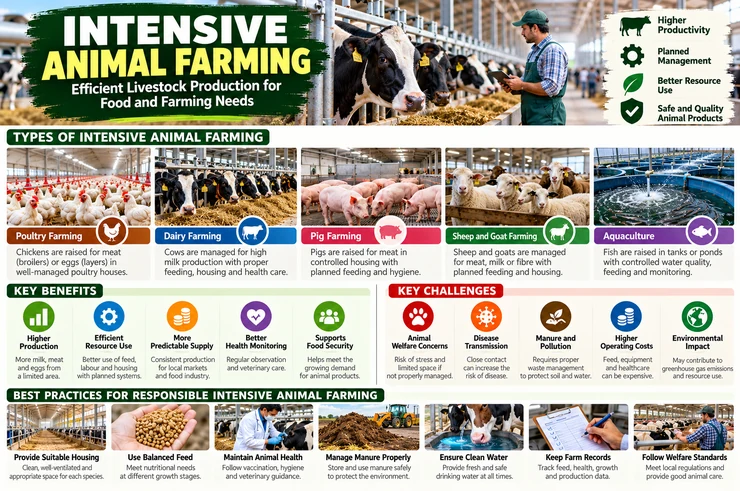
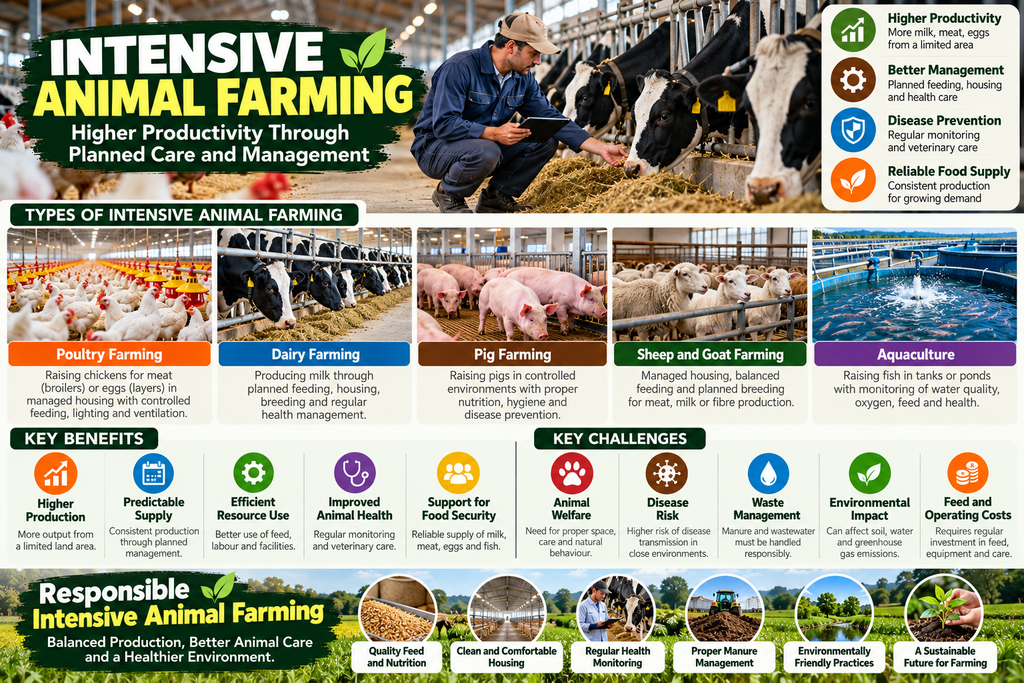
Main Types of Intensive Animal Farming
#1. Intensive Poultry Farming
Intensive poultry farming is a common example of livestock production in which birds are raised under planned conditions.
Broiler chickens are kept primarily for meat production, while layer hens are managed for egg production. Farmers provide suitable feed, clean drinking water, ventilation, lighting, and appropriate housing.
Modern poultry houses may use automated feeding and watering systems, temperature controls, and equipment to monitor environmental conditions.
Important management considerations: Stocking density, air quality, litter condition, access to water, disease prevention, and the birds’ ability to move and express normal behaviour.
#2. Intensive Dairy Farming
Intensive dairy farming focuses on producing milk through planned feeding, housing, breeding, and milking management.
Depending on the farm, cows may be housed in free-stall barns, other suitable indoor systems, or a combination of indoor housing and outdoor access.
Farmers monitor milk production, feed intake, reproductive health, and signs of illness. Mechanical milking systems can reduce some labour requirements, but they do not replace the need for daily observation and animal care.
Good dairy management includes providing adequate resting space, clean water, balanced nutrition, comfortable flooring, and timely veterinary attention.
#3. Intensive Pig Farming
Intensive pig farming involves raising pigs in managed housing with planned feeding, breeding, and health programmes.
Pig farms may have separate areas for breeding animals, piglets, growing pigs, and finishing animals. This organization helps farmers manage the different needs of animals at each stage.
Nutrition, ventilation, hygiene, and disease prevention are important for production and animal health.
Housing must also provide suitable space, comfortable resting areas, opportunities for appropriate behaviour, and protection from heat stress. Welfare requirements differ by country and production system.
#4. Intensive Sheep and Goat Farming
Sheep and goats can also be raised in intensive or semi-intensive systems, depending on local conditions.
Farmers may use managed housing, cut-and-carry fodder, planned breeding, and supplementary feeding to support production of milk, meat, or fibre.
These systems can be useful where grazing land is limited or where farmers want closer control over feeding and animal health.
However, sheep and goats still need adequate space, suitable exercise, clean water, and management that accounts for their natural behaviour and nutritional needs.
#5. Intensive Aquaculture
Intensive aquaculture raises fish or other aquatic animals in managed environments, such as tanks, ponds, or cages.
Farmers monitor water quality, oxygen levels, temperature, feed, and animal health. Some systems use aeration, filtration, or water recirculation equipment.
Aquaculture is not identical to land-based livestock farming, but it shares some intensive-production principles: planned inputs, controlled conditions, close monitoring, and organized harvesting.
Water quality and stocking levels are especially important because poor conditions can quickly affect aquatic animal health.
How Intensive Animal Farming Works
Although each livestock species has different requirements, most intensive production systems involve several common management steps.
#1. Selecting suitable animals
Farmers choose breeds or strains suited to their production goals, climate, housing, and available resources.
Selection should consider more than growth or output. Health, adaptability, reproductive performance, and welfare are also important.
#2. Providing balanced feed
Animals need diets that meet their nutritional requirements at different stages of life.
Feed may include grains, protein sources, forage, minerals, vitamins, and other suitable ingredients. The appropriate diet depends on the species, age, production stage, and local feed resources.
Farmers should use safe feed ingredients and seek qualified nutrition advice when developing feeding programmes.
#3. Maintaining suitable housing
Animal housing should protect livestock from extreme weather, provide appropriate ventilation, and allow adequate space for resting, feeding, and movement.
For poultry, ventilation and litter management are important. For dairy cattle, comfortable resting areas and suitable flooring can help reduce injuries and health problems.
Housing needs should be designed for the animals, not only for the convenience of the operator.
#4. Monitoring health and preventing disease
Intensive systems may bring animals into close contact, making disease prevention and early detection particularly important.
Farmers use hygiene, biosecurity, vaccination programmes where appropriate, and veterinary guidance to protect livestock.
Animals showing signs of illness or injury should receive timely attention. Medicines, including antibiotics, should be used responsibly under appropriate veterinary oversight.
#5. Managing waste and farm records
Manure, used bedding, wastewater, and other farm waste need careful handling.
Farmers may collect manure for appropriate storage, composting, or use as fertilizer, following local regulations and nutrient-management guidance.
Keeping records of feed, animal health, production, mortality, and expenses can help farmers identify problems and improve management.
Benefits of Intensive Animal Farming
Intensive animal farming can offer advantages when animals are healthy and management is effective.
#1. Higher production from a limited area
By organizing housing, feeding, and care, intensive systems may produce substantial quantities of milk, meat, or eggs from a relatively small land area.
This can be useful in regions where agricultural land is limited or expensive.
However, land efficiency should be assessed across the entire production chain, including the land needed to grow animal feed.
#2. More predictable production
Planned feeding, housing, and breeding can help farmers maintain more consistent production schedules.
For example, poultry farms may organize batches according to market demand, while dairy farms can monitor daily milk output.
Predictability can support business planning, though it does not eliminate risks from disease, weather, feed prices, or market changes.
#3. Better monitoring of animal health
When animals are observed regularly and records are maintained, farmers may identify changes in feeding, behaviour, growth, or production more quickly.
Early detection can help animals receive care sooner.
Monitoring only works well when farmers have adequate training, time, and access to veterinary services.
#4. Efficient use of feed and labour
Mechanized feeding, watering, milking, and waste collection can reduce some repetitive tasks.
Well-formulated diets and suitable management can also improve the efficiency with which animals convert feed into products.
The outcome depends on the system, species, feed quality, and animal health.
#5. Reliable supply of animal products
Intensive production can contribute to a steady supply of animal products for local markets and food-processing businesses.
This may support farm businesses, employment, and food distribution. The benefits depend on fair market access, responsible production, and the needs of local communities.
Challenges and Concerns in Intensive Animal Farming
Intensive production also brings responsibilities and potential risks. High output alone does not mean a system is healthy, humane, or environmentally sustainable.
#1. Animal welfare
Crowded or poorly designed housing can restrict movement and natural behaviour. Inadequate resting space, unsuitable flooring, poor ventilation, or stressful handling can affect animal welfare.
Welfare is not determined by stocking density alone. It also depends on the animals’ physical condition, behaviour, health, comfort, and ability to access essential resources.
Farmers should follow applicable animal-welfare standards and regularly assess whether their housing and management meet the animals’ needs.
#2. Disease transmission
Close contact between animals can increase the risk of some infectious diseases, particularly when hygiene, ventilation, or biosecurity is inadequate.
Prevention includes cleaning and disinfection, suitable separation of sick animals, controlled movement of people and equipment, and veterinary guidance.
A farm should have a clear plan for responding to disease outbreaks.
#3. Manure and water pollution
Concentrated livestock production can generate substantial quantities of manure and wastewater.
If waste is stored or applied incorrectly, nutrients and pathogens may reach waterways or contaminate soil and groundwater.
Responsible manure management includes appropriate storage, nutrient planning, and applying manure at suitable rates and times in accordance with local regulations.
#4. Feed and operating costs
Intensive farming may require regular purchases of feed, equipment, energy, veterinary services, and housing materials.
A rise in feed prices can quickly affect profitability. Farmers should calculate production costs, maintain financial records, and assess market risks before expanding.
#5. Environmental impacts
The environmental effects of intensive animal farming vary by species, feed, energy use, manure management, and location.
Potential concerns include greenhouse gas emissions, nutrient pollution, water use, and the land required to produce feed.
Some intensive systems may use fewer resources per unit of product than less productive systems, but this does not automatically mean their total environmental impact is low. Both production efficiency and the overall environmental footprint matter.
Practical Ways to Make Intensive Animal Farming More Responsible
Farmers can improve their production systems by combining productivity goals with animal care and environmental management.
- Provide appropriate space and housing: Design facilities around the needs of the species and follow local welfare requirements.
- Maintain ventilation and temperature control: Reduce heat stress and keep air quality suitable.
- Use balanced, safe feed: Match diets to animal needs and avoid unnecessary feed waste.
- Follow veterinary and biosecurity plans: Monitor health, prevent disease, and use medicines responsibly.
- Manage manure carefully: Store and use manure in ways that protect soil and water.
- Keep production records: Track feed use, growth, health, output, and costs.
- Review performance regularly: Use farm observations and records to identify where welfare, efficiency, or environmental management can improve.
Responsible intensive farming requires ongoing attention. A system that works well for one species or region may not be suitable for another.
Intensive Animal Farming vs. Extensive Animal Farming
Intensive and extensive farming describe different approaches to managing livestock. Many farms use a combination of practices rather than fitting neatly into only one category.
| Feature | Intensive animal farming | Extensive animal farming |
|---|---|---|
| Management | Closely planned feeding, housing, and production | Often relies more on grazing or access to larger areas |
| Land use | May produce more output per unit of farm area | Usually requires more land per animal |
| Feed | Often includes purchased or formulated feed | May rely more heavily on pasture and locally available forage |
| Monitoring | Often involves frequent observation and production records | Monitoring may be more spread across grazing areas |
| Main considerations | Housing, feed costs, waste, welfare, disease prevention | Pasture quality, weather, land availability, animal protection |
Neither approach is automatically better in every situation. The most suitable system depends on the species, land, climate, available resources, market, and how responsibly the farm is managed.
Is Intensive Animal Farming Suitable for Small Farmers?
Intensive animal farming may be suitable for some small farmers, but it should not be adopted simply because it is associated with high production.
Before starting, farmers should consider:
- Market demand: Is there a reliable buyer for the milk, eggs, meat, or other product?
- Feed supply: Can the farm obtain safe, affordable feed consistently?
- Housing and equipment: Can the farmer provide suitable facilities and maintain them?
- Veterinary access: Is professional animal-health support available?
- Waste management: Can manure and wastewater be handled safely?
- Financial risk: Can the farm manage unexpected expenses, disease, or changes in market prices?
A small pilot operation can help farmers learn the practical requirements before making a large investment. Local agricultural extension services and qualified veterinarians can provide guidance suited to the farm’s conditions.
Conclusion:
Intensive animal farming plays a role in modern livestock production by organizing feeding, housing, animal health, and production to meet food demand.
It can support reliable production and efficient use of some resources, but it also requires careful attention to animal welfare, disease prevention, feed costs, and environmental protection.
For farmers, the key is not simply to raise more animals in less space. It is to build a production system that is financially workable, provides proper care, and manages its effects on the surrounding environment.
Further Reading
- FAO: Animal Production
- FAO: Livestock and the Environment
- OECD-FAO: Livestock Intensification and Animal Welfare
Disclaimer: This article is for general educational purposes. Livestock housing, feeding, animal health, and waste-management practices should follow local laws and species-specific guidance. Consult a qualified veterinarian or agricultural extension professional before making farm-management decisions.
FAQs.:
Q1. What is the main purpose of intensive animal farming?
Its main purpose is to produce animal products through planned and closely managed systems that use feed, housing, labour, and animal-health practices efficiently.
Q2. Is intensive animal farming the same as factory farming?
The terms are sometimes used interchangeably, but they are not always identical. Intensive animal farming describes production with concentrated management and inputs. “Factory farming” is a broader, often critical term commonly used for large-scale industrial livestock operations.
The actual housing, scale, welfare, and environmental practices should be examined rather than judged by the label alone.
Q3. Which animals are commonly raised intensively?
Common examples include broiler chickens, laying hens, dairy cattle, pigs, and some sheep and goats. Fish are also raised in intensive aquaculture systems.
Q4. Does intensive animal farming always harm animal welfare?
No. Outcomes depend on housing, stocking levels, management, health care, and whether animals can meet their behavioural and physical needs.
However, intensive systems can create welfare risks if animals are crowded, stressed, injured, or kept in unsuitable conditions. Welfare needs to be assessed directly.
Q5. Can intensive animal farming be environmentally sustainable?
It can reduce certain impacts per unit of product when managed efficiently, but sustainability depends on the complete system, including feed production, energy use, manure handling, water, and animal welfare.
Good management and careful environmental monitoring are essential.
One thought on “Intensive Animal Farming: Types, Benefits, Challenges, and Sustainable Practices”