
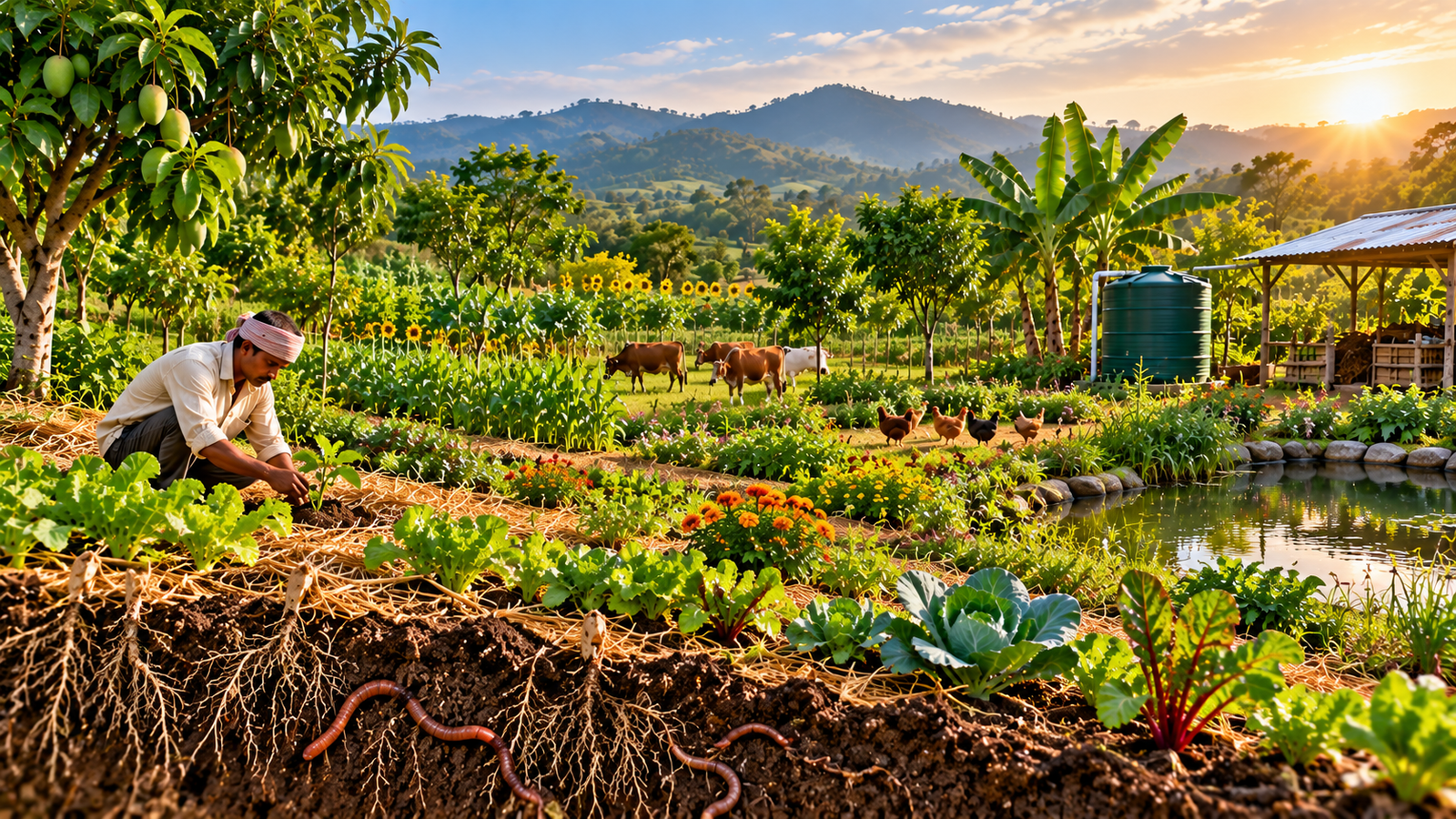
Regenerative farming is an approach to agriculture that aims to improve the condition of farmland while producing food, fibre and other useful products. It focuses particularly on soil health, crop diversity, water management and the long-term resilience of the farming system.
Rather than following one fixed recipe, farmers choose practices that suit their soil, climate, crops, water supply and resources. These practices may include keeping the soil covered, reducing unnecessary tillage, growing cover crops, rotating crops and integrating trees or livestock where appropriate.
The goal is to improve how the farm functions over time. However, regenerative farming does not guarantee higher yields, lower costs or better profits. Results depend on the methods used and the conditions on each farm.
This guide explains what regenerative farming means, its main principles, 10 practical methods, suitable crops, potential benefits and limitations, and how farmers can begin.
#1. What Is Regenerative Farming?
Regenerative farming, also called regenerative agriculture, is a broad approach to managing farmland with the aim of improving soil function, biodiversity and the resilience of agricultural systems.
There is no single universally accepted definition or compulsory list of practices. Many regenerative farming systems emphasise reducing unnecessary soil disturbance, maintaining soil cover, increasing crop diversity and keeping living roots in the soil for longer.
The USDA Natural Resources Conservation Service (NRCS) describes four key soil-health principles: minimise disturbance, maximise soil cover, maximise biodiversity and maintain continuous living roots. These principles can help farmers plan soil-management practices, although the best combination will differ between farms
Regenerative farming may involve:
- Reducing unnecessary ploughing or cultivation.
- Growing cover crops between main crop seasons.
- Rotating crops and increasing diversity.
- Returning suitable crop residues and organic materials to the soil.
- Managing water to reduce erosion and moisture loss.
- Integrating trees or livestock where they fit the farm.
Regenerative farming is not automatically chemical-free, organic-certified or no-till. Farmers may use different combinations of practices, depending on their production system and goals. The term itself does not guarantee a particular environmental outcome or product standard.
#2. Main Principles of Regenerative Farming
The principles help farmers decide which practices may be appropriate. They should be adapted to local conditions rather than followed as rigid rules.
Minimise soil disturbance
Repeated or intensive tillage can affect soil structure and soil organisms. Reducing unnecessary disturbance may help preserve soil structure, but the right approach depends on soil type, weeds, compaction, equipment and crop establishment.
Keep soil covered
A covered soil surface is less exposed to direct rainfall, wind and rapid moisture loss. Cover can come from growing crops, cover crops or suitable plant residues.
Increase crop diversity
Growing different crops across a rotation or in suitable combinations can diversify root systems and crop residues. Diversity must be planned carefully because crops can compete for light, water and nutrients.
Maintain living roots for longer
Living roots provide carbon compounds to soil organisms and help maintain biological activity. Cover crops or suitable perennial plants can extend the time that roots remain in the soil between main crops.
Integrate livestock where appropriate
Livestock can be included in some regenerative systems to use suitable forage and recycle nutrients. Their movement, stocking rate, feed, welfare and effects on soil must be managed carefully.
Adapt practices to the farm
Regenerative farming is not a one-size-fits-all system. Soil, rainfall, slope, crop type, labour, machinery and market requirements should influence the choices a farmer makes.
For additional guidance, read the NRCS soil-health principles for small-scale agriculture.
#3. 10 Regenerative Farming Methods
The methods below are commonly associated with regenerative agriculture. They can be combined, but not every farm needs all ten.
- Reduced Tillage and Minimal Soil Disturbance
Reduced tillage means limiting how often or how deeply the soil is cultivated. Some farmers use strip-tillage or direct seeding, while others reduce the number of cultivation passes.
Potential benefits include less disruption to soil structure and reduced erosion in suitable conditions. However, reduced tillage may require different weed-management strategies, specialised equipment or a transition period.
Practical example: A cereal farmer could trial reduced tillage on a small section of a field, then compare crop establishment, weed pressure, fuel use and yield with the usual method.
Do not assume that no-till is always the best option. Compacted soil, difficult weeds, drainage problems or unsuitable machinery may require a different approach.
- Cover Cropping
Cover crops are grown mainly to protect and improve the soil rather than to be harvested as the main commercial crop. They may be planted after a harvest or between growing seasons.
Depending on the species, cover crops can protect soil from erosion, provide living roots, suppress some weeds and recycle nutrients. Legumes may contribute nitrogen under suitable conditions, but they do not automatically supply all the nutrients needed by the next crop.
Choose cover crops based on the local climate, sowing window, water availability and the time before the next main crop.
The NRCS guide Cover Crops for Soil Health explains how cover crops can protect soil and support soil-health management.
- Crop Rotation and Crop Diversity
Crop rotation means growing different crops in a planned sequence. A diverse rotation can change the types of roots, residues and growing conditions present in a field over time.
For example, a farmer may alternate a cereal crop with a suitable pulse crop where the climate and planting calendar allow. Rotations can help manage some crop-specific pests and diseases, but the sequence must suit the farm.
Read our guide to Crop Rotation for examples and planning tips.
- Keeping Soil Covered with Crop Residues or Mulch
Crop residues, straw or other suitable organic materials can protect the soil surface after harvest. In some systems, living ground cover may also be used.
Soil cover can help reduce erosion and moderate moisture loss. Its effectiveness depends on the material, amount, climate and crop.
Use residues responsibly. Diseased material, weed-infested residues or materials contaminated with unsuitable chemicals may create problems if returned to the field.
- Maintaining Living Roots
Keeping living roots in the soil for a greater part of the year can support soil biological activity and help maintain soil structure.
Farmers may use cover crops, perennial plants or carefully planned crop sequences to extend root growth between main crops.
In dry regions, however, a cover crop can compete with the next crop for scarce water. Select species and termination dates carefully, and consider local recommendations.
- Composting and Nutrient Recycling
Suitable compost, manure and crop residues can return organic matter and nutrients to the soil. These materials may support soil structure and nutrient cycling when managed properly.
Their nutrient content varies. Compost and manure should not be treated as complete replacements for all fertiliser needs without considering crop requirements and soil-test results.
Use mature compost and manage manure safely to protect crops, workers, water and food hygiene.
- Agroforestry
Agroforestry combines trees or shrubs with crops or livestock. Trees may provide fruit, fodder, shade, timber, wind protection or other products, depending on the species and location.
A farmer might grow suitable fruit trees alongside seasonal crops, or establish trees along field boundaries. Tree spacing and species selection matter because trees can compete with crops for water, nutrients and sunlight.
Agroforestry is a long-term investment. Consider establishment costs, maintenance, mature tree size and the time before useful products become available.
- Integrating Livestock and Managed Grazing
In suitable systems, livestock can graze planned areas and use forage crops or crop residues. Manure may return nutrients to the land.
Grazing must be managed according to forage availability, soil moisture, animal needs and recovery time for plants. Overgrazing or grazing on wet soil can damage vegetation and increase compaction or erosion.
Livestock integration is not appropriate for every farm. It requires adequate feed, water, fencing, animal care and a workable management plan.
- Water Conservation and Erosion Control
Regenerative farming may include practices that reduce runoff and protect soil, such as maintaining cover, using suitable contour-based measures, improving irrigation management and protecting waterways.
The correct approach depends on rainfall, slope, soil infiltration and drainage. Earthworks, ponds or channels need careful design because poorly planned structures can redirect water and cause erosion or waterlogging.
Water-saving methods should be selected for the farm’s actual conditions rather than applied as a universal solution.
- Biodiversity and Integrated Pest Management
Biodiversity can be supported through crop diversity, suitable flowering plants, field margins, trees and habitats for beneficial organisms.
Integrated pest management combines prevention, monitoring and appropriate control. Farmers should identify pests and diseases before acting and use locally recommended measures when needed.
Biodiversity does not eliminate pests, and a natural or homemade treatment is not automatically safe or effective. Regular field monitoring remains important.
#4. Crops Suitable for Regenerative Farming
Regenerative practices can be adapted to many crop groups. The best choice depends on the soil, climate, water, local pests, equipment and market.
| Crop group | Examples | Regenerative considerations |
|---|---|---|
| Cereals | Wheat, rice, maize, millets | Residue management, rotation, soil cover and weed control |
| Pulses | Chickpea, lentil, mung bean, pigeon pea | Rotation planning, drainage and suitable planting dates |
| Vegetables | Beans, okra, leafy vegetables, gourds | Frequent monitoring, soil cover and nutrient planning |
| Fruit crops | Guava, mango, citrus, apple | Orchard soil cover, tree spacing, pruning and water management |
| Oilseeds | Mustard, sesame, groundnut, sunflower | Crop rotation, residue handling and soil moisture |
| Fodder crops | Locally suitable grasses and forage legumes | Grazing management, recovery periods and livestock needs |
Farmers should not choose a crop simply because it is described as regenerative. It must also be suitable for local growing conditions and have a realistic production and marketing plan.
For crop-specific guidance, explore Crop Farming, Cereal Crop Farming, Pulse Farming and Oilseed Farming.
#5. Benefits of Regenerative Farming
Regenerative farming may improve aspects of soil and farm management, but the results depend on the practices used and the starting condition of the land.
Better soil protection
Maintaining soil cover and reducing unnecessary disturbance can help protect the soil surface from erosion. The benefit depends on rainfall, wind, slope and how well the practices are managed.
Improved water infiltration and soil structure
Some soil-health practices can improve the way water enters and moves through soil. Outcomes vary by soil type, compaction, organic matter and management history.
More diverse farm systems
Crop rotations, cover crops and suitable trees can increase the diversity of plants grown on a farm. This may help spread production risk, although a diverse system also requires planning and labour.
More efficient nutrient cycling
Returning suitable residues and organic materials can recycle nutrients. Farmers still need to monitor nutrient requirements and avoid assuming that recycled materials meet every crop’s needs.
Potential resilience to weather stress
Healthy soil structure, good ground cover and appropriate water management may help farms cope with some weather stresses. They cannot prevent drought, floods or crop losses, and results differ between locations.
Possible long-term economic advantages
Some practices may reduce particular input costs or improve resource efficiency. However, establishment expenses, labour, equipment, yields and market prices determine whether a farm becomes more profitable.
For more detail, the NRCS explains how soil-health practices can support soil structure, water movement and erosion control in its soil-health guidance for cropland.
#6. Challenges and Limitations of Regenerative Farming
Regenerative farming is not automatically cheaper, easier or more productive than conventional farming. Farmers should consider these challenges before making major changes.
Transition costs: New seed, equipment, fencing, cover crops or tree planting may require upfront investment.
Learning and management: Different rotations and soil-management practices may need new skills and monitoring.
Weed pressure: Reduced tillage can change weed-management needs and may not suit every field.
Water competition: Cover crops and trees can compete with main crops for moisture in dry conditions.
Nutrient planning: Compost and residues may not supply every nutrient in the quantity or timing required.
Labour requirements: Diverse crops, livestock and cover-crop management can add work.
Uncertain financial returns: Yields, input savings and market premiums are not guaranteed.
Claims and certification: “Regenerative” does not automatically mean certified organic or verified to a particular standard.
A farmer should compare costs, yields, labour and soil conditions over time rather than judge a new system after one season.
#7. How to Start Regenerative Farming
A gradual, measured transition is often more practical than changing every field at once.
Step 1: Assess the farm
Record the crops grown, soil condition, water supply, erosion concerns, input costs, labour and current management practices. Soil testing can help identify nutrient or soil constraints.
Step 2: Set clear goals
Decide what you want to improve: soil cover, erosion, crop diversity, water management, input efficiency or another specific issue. Clear goals make it easier to choose suitable practices.
Step 3: Start with a manageable trial
Choose one field or plot. Depending on the conditions, you might test a cover crop, a more diverse rotation, residue retention or reduced tillage.
Step 4: Select locally suitable practices
Seek advice from agricultural extension services or knowledgeable local practitioners. Consider climate, soil type, crop requirements, machinery and available labour.
Step 5: Monitor crop and soil performance
Record crop establishment, weeds, pests, irrigation, labour, yield and input use. If possible, compare the trial with a similar area managed using your usual method.
Step 6: Review financial results
Include seed, labour, equipment, irrigation, transport, crop losses and selling prices. Do not judge profitability only by the amount spent on fertiliser or pesticides.
Step 7: Expand based on evidence
Keep the practices that fit your farm and revise those that do not. Regenerative farming is an adaptive process, not a fixed package.
For practical farm budgeting, see Farming Cost & Profit.
#8. Practical Regenerative Farming Examples
These examples illustrate possible applications. They are not guarantees of higher yields, improved soil or increased income.
Example 1: A cereal farm using cover crops
After harvesting a cereal crop, a farmer may plant a suitable cover crop to protect the soil during a period when the field would otherwise remain bare. The farmer must choose a species and termination time that do not create water or planting problems for the next crop.
Example 2: A diverse crop rotation
A farmer may include cereals, pulses and oilseeds in a planned rotation. This changes the crops and root systems grown over time, but the sequence should match local growing seasons, soil and market demand.
Example 3: An orchard with soil cover
A fruit grower may maintain suitable vegetation or mulch in selected areas of an orchard to protect soil. The grower must also manage competition for water, tree nutrition, pests and access for harvesting.
Example 4: A crop–livestock system
Where suitable, a farmer may use planned grazing or forage crops as part of a wider farm system. Grazing intensity, animal welfare, soil moisture and recovery periods must be managed carefully.
#9. Regenerative Farming vs Sustainable and Organic Farming
These terms overlap, but they are not identical.
| Feature | Regenerative Farming | Sustainable Farming | Organic Farming |
|---|---|---|---|
| Main emphasis | Improving soil health and ecological function | Maintaining production while reducing environmental and resource harm | Producing according to organic principles and applicable standards |
| Typical approach | Soil cover, crop diversity, reduced disturbance, living roots and other context-specific practices | Efficient resource use, environmental protection and long-term viability | Permitted inputs, soil management, rotations and organic production rules |
| Certification | No single universal regenerative certification or definition | Standards vary by programme | Organic claims may require compliance with formal certification rules |
| Intended outcome | Restore or improve aspects of the farming system | Maintain or improve long-term sustainability | Meet organic production requirements and market standards |
A farm can use regenerative practices and also be organic, but regenerative farming does not automatically mean the produce is certified organic. The meaning of these labels depends on the applicable programme and market rules.
FAQs.
Q1. What is regenerative farming in simple words?
Regenerative farming is an approach that aims to improve soil health, biodiversity and the resilience of a farm while producing agricultural products.
Q2. What are the main methods of regenerative farming?
Common methods include reduced tillage, cover cropping, crop rotation, keeping soil covered, maintaining living roots, nutrient recycling, agroforestry, managed livestock integration, water conservation and integrated pest management.
Q3. Is regenerative farming the same as organic farming?
No. Regenerative farming is a broad approach focused on improving the farming system. Organic farming follows particular production principles and, where required, certification rules. The two approaches can overlap.
Q4. Can regenerative farming increase yields?
It may improve some aspects of soil function or crop resilience in suitable conditions, but yield responses vary. Farmers should monitor results locally and avoid assuming that a regenerative practice will always increase production.
Q5. Is regenerative farming chemical-free?
Not necessarily. The term does not have one universal definition that automatically excludes all synthetic inputs. Farmers should understand the standards or claims associated with the specific programme or product.
Q6. Is regenerative farming suitable for small farms?
Some practices, such as crop rotation, suitable mulching, cover crops and careful nutrient management, can be adapted to small farms. The right combination depends on the land, water, labour and crops.
Q7. How long does it take to see results?
Some changes, such as improved soil cover, can be observed within a season. Changes in soil structure, organic matter, crop performance or farm economics may take longer and depend on starting conditions and management.
Q8. Does regenerative farming guarantee better profits?
No. Profit depends on yield, costs, labour, equipment, market prices and the time needed to establish new practices. Keep financial records and evaluate the results before expanding.
Conclusion:
Regenerative farming offers a practical framework for improving the way farmland is managed, with particular attention to soil health, crop diversity, water and biodiversity.
Practices such as cover cropping, crop rotation, soil cover and reduced disturbance can be useful, but they must be selected for local conditions. Some farms may benefit from integrating trees or livestock, while others may need to focus first on soil testing, water management or a more suitable crop rotation.
The best way to begin is to identify a specific farm problem, test an appropriate practice on a manageable area and record the results. Over time, farmers can use that evidence to decide which changes are worth expanding.
Regenerative farming is not a guaranteed formula for higher yields or profits. Its success depends on careful design, sound agronomy and ongoing learning.