
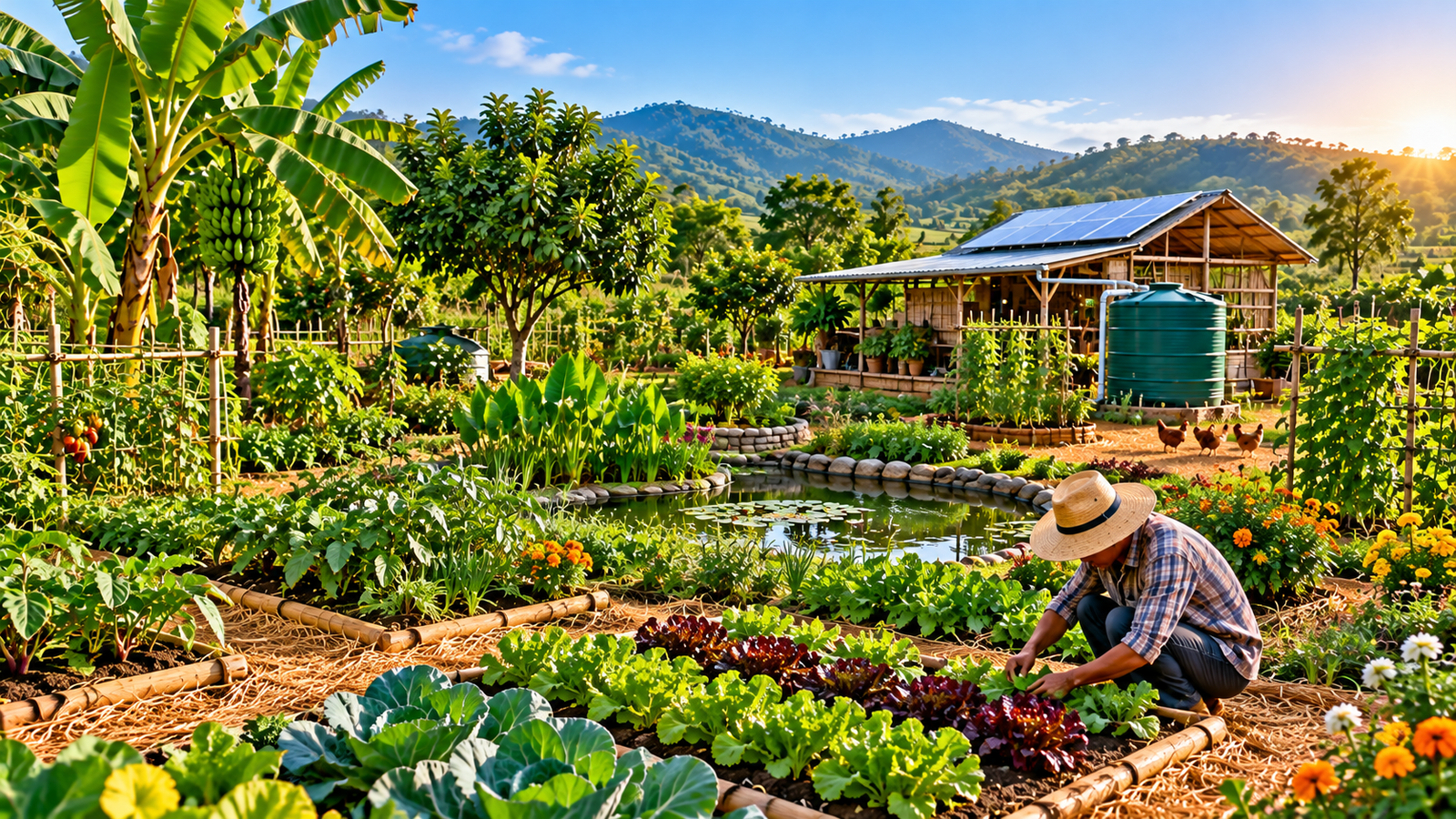
Permaculture farming is a way of planning farms and gardens so that crops, trees, water, soil, animals and people work together as a connected system. Instead of designing each part separately, farmers look for useful relationships that can reduce waste, make better use of resources and support long-term productivity.
For example, a farm might combine fruit trees, seasonal vegetables, flowering plants and a composting area. Fallen leaves can provide mulch, flowers can attract pollinators, and suitable crop residues can be returned to the soil. Each element is selected and placed according to the needs of the whole farm.
Permaculture is not one fixed farming recipe. Its methods must be adapted to local climate, soil, land size, water availability and the farmer’s goals. This guide explains the principles, 10 practical methods, potential benefits, challenges and steps for starting a permaculture farm.
#1. What Is Permaculture Farming?
Permaculture farming is a design approach that uses ecological patterns to plan productive and resilient agricultural systems. The word permaculture originally combined the ideas of permanent agriculture and later expanded to include permanent culture and wider sustainable living.
The approach became established through the work of Bill Mollison and David Holmgren in the 1970s. It emphasises observing the land, using resources thoughtfully, reducing waste and connecting different elements so they support one another.
According to NC State Extension’s permaculture design guide, careful observation of sunlight, water movement, existing vegetation and daily activity helps farmers make better design decisions. The Council on Energy, Environment and Water’s overview of permaculture in India also discusses crop diversity, agroforestry, water harvesting and the integration of different farm elements.
Permaculture may include practices such as:
- Growing a mixture of annual crops, fruit trees and perennial plants.
- Collecting rainwater where appropriate and managing runoff.
- Using compost, mulch and suitable plant residues.
- Integrating crops, trees and livestock where practical.
- Creating habitats for pollinators and other beneficial organisms.
- Placing frequently used resources close to the areas where they are needed.
An important distinction: permaculture is primarily a design framework, not a single certified farming method. A permaculture farm may use organic practices, but permaculture and certified organic farming are not interchangeable terms.
#2. Main Principles of Permaculture
Permaculture is guided by three widely recognised ethics and a set of design principles. Different practitioners may explain or group these principles differently, but the central idea is to design systems around relationships rather than isolated components.
Care for the Earth
This means protecting soil, water, biodiversity and other natural resources. Practical actions may include reducing erosion, maintaining suitable soil cover, protecting waterways and choosing plants that fit local conditions.
Care for People
A farm should meet human needs as well as environmental goals. Food production, safe working conditions, manageable labour requirements and reliable access to markets all matter.
Fair Share and Responsible Use of Surplus
This ethic encourages people to recognise limits, avoid unnecessary waste and share surplus resources fairly. On a farm, it may involve returning suitable residues to the soil, sharing excess produce or using resources responsibly.
Other important design principles
Observe and interact: Study sunlight, wind, rainfall, drainage and seasonal changes before making major decisions.
- Catch and store energy: Make sensible use of sunlight, rainwater and other available resources.
- Obtain a yield: Design the system to produce useful food, materials or income.
- Produce no waste: Find safe and practical uses for suitable by-products.
- Integrate rather than separate: Arrange compatible elements so that they can support one another.
- Value diversity: Grow a suitable range of crops and plants instead of relying unnecessarily on a single species.
- Use small and gradual solutions: Test methods on a manageable scale before expanding.
- Adapt to change: Review the system as weather, soil, crops and market conditions change.
These principles are guides for planning, not a guarantee that every permaculture design will succeed.
#3. 10 Permaculture Farming Methods
The following methods can be combined in different ways. Not every farm needs all ten, and some techniques may be unsuitable for particular climates or commercial production systems.
Agroforestry
Agroforestry combines trees or shrubs with crops, livestock or other agricultural activities. Trees may provide fruit, timber, shade, wind protection or other products, depending on the species and location.
For example, a farm may grow suitable fruit trees alongside seasonal crops, leaving enough space and light for both. Farmers should plan tree spacing carefully because mature roots and canopies can compete with crops for water, nutrients and sunlight.
Choose tree species based on local climate, soil depth, water availability and the intended use of the land.
Food Forest Farming
A food forest is a deliberately designed planting system that uses several layers of edible or useful plants. It may include taller trees, smaller fruit trees, shrubs, herbs, ground-cover plants and root crops.
A small food forest could combine a suitable fruit tree with compatible berry shrubs, herbs and ground-cover plants. The aim is to use vertical space and create useful relationships between plants.
Food forests take time to establish. Tree selection, pruning, harvesting access and the expected years before fruit production should all be considered before planting.
Crop Diversity and Intercropping
Crop diversity means growing different crop species or varieties across a farm or over several seasons. Intercropping involves growing two or more crops together in a planned arrangement.
A farmer might test a suitable legume alongside a cereal crop, or grow herbs and flowering plants around vegetable beds. The combination must suit local growing conditions and should not create excessive competition for water, light or nutrients.
Crop diversity can spread production risk, but it does not eliminate crop failure or guarantee better yields.
Crop Rotation
Crop rotation involves growing different crops in a planned sequence on the same plot. Rotations can help manage certain pests and diseases and improve how soil nutrients are used.
For instance, a farmer may alternate a cereal crop with a suitable pulse crop where the climate and planting calendar allow it. The best rotation depends on crop duration, soil fertility, water needs and market demand.
See our guide to Crop Rotation for more practical information.
Composting and Nutrient Recycling
Composting turns suitable organic materials into a soil amendment. Farm residues, fallen leaves and other suitable materials can be managed to recycle nutrients and organic matter.
Good composting requires an appropriate mixture of materials, moisture and aeration. Diseased plant material, contaminated waste and unsuitable materials should not be added without proper guidance.
Compost can support soil management, but its nutrient content varies. Farmers should not assume it automatically meets every crop’s nutrient requirements.
Mulching and Living Ground Cover
Mulching involves covering the soil with suitable material such as clean straw, leaves or other plant residues. Living ground cover uses plants to protect the soil surface.
These methods can help reduce erosion, moderate soil temperature and conserve moisture. The result depends on the material, climate, crop and how the mulch is applied.
Keep mulch away from stems where excess moisture could cause damage, and check that it does not introduce persistent weeds or crop diseases.
Rainwater Harvesting and Water Management
Permaculture designs often consider how rainwater moves through a site and whether some of it can be captured, stored or directed safely into the soil.
Possible approaches include roof-water collection, storage tanks, suitable drainage channels, contour-based water management and mulching. The right choice depends on rainfall, slope, soil infiltration and water needs.
Structures such as ponds, swales and storage systems require careful design. Poorly placed earthworks can cause waterlogging, erosion or damage to nearby land. Follow local water regulations and seek technical advice for larger installations.
Integrated Pest Management
Integrated pest management combines prevention, monitoring and appropriate control methods. It may include crop rotation, regular field inspections, suitable plant diversity, physical controls and biological control where effective.
Flowering plants can provide food or habitat for some beneficial insects, but their presence does not guarantee that pests will be controlled.
Identify the pest before acting. Use locally recommended controls when necessary and avoid assuming that every natural or homemade treatment is safe or effective.
Integrated Crop and Livestock Farming
Where land, animal welfare and labour allow, crops and livestock can be managed as parts of one farm system. Suitable crop residues may be used as feed, while properly managed manure can be recycled for soil improvement.
This approach requires safe storage, appropriate feeding practices and good hygiene. Not all crop residues are suitable for livestock, and raw manure must be managed carefully to protect water, workers and food crops.
Livestock should only be included when the farmer can meet their feed, housing, health and welfare needs.
Permaculture Zones and Efficient Farm Layout
Permaculture design often arranges farm activities according to how frequently they need attention. Frequently visited areas are placed for convenient access, while less frequently managed areas can be located farther away.
For example, herbs and vegetables harvested daily may be close to the house or work area. Fruit trees that need less frequent attention may occupy a different part of the property.
This is a planning tool, not a rigid rule. Farm shape, slopes, access roads, water supply, machinery and safety requirements should determine the actual layout.
#4. Common Permaculture Design Zones
Permaculture can include annual crops, perennial crops, trees, shrubs and useful ground-cover plants. Crop selection should be based on local conditions rather than a universal list of supposedly ideal plants.
| Crop or plant group | Examples | Planning considerations |
|---|---|---|
| Fruit trees | Guava, mango, citrus, apple | Climate, mature size, pollination and time to first harvest |
| Vegetables | Beans, gourds, okra, leafy vegetables | Seasonal conditions, irrigation and pest management |
| Pulses | Chickpea, lentil, mung bean, pigeon pea | Soil drainage, planting season and suitable varieties |
| Herbs | Coriander, basil and locally suitable culinary herbs | Sunlight, water needs and harvesting frequency |
| Ground-cover plants | Suitable clovers or other locally adapted covers | Competition, soil type and water use |
| Flowering plants | Locally suitable pollinator-supporting flowers | Blooming season, water needs and compatibility with crops |
| Useful trees and shrubs | Species selected for fruit, fodder, shade or biomass | Space, water availability and potential competition |
#5. Crops Suitable for Permaculture Farming
Permaculture can include annual crops, perennial crops, trees, shrubs and useful ground-cover plants. Crop selection should be based on local conditions rather than a universal list of supposedly ideal plants
| Crop or plant group | Examples | Planning considerations |
|---|---|---|
| Fruit trees | Guava, mango, citrus, apple | Climate, mature size, pollination and time to first harvest |
| Vegetables | Beans, gourds, okra, leafy vegetables | Seasonal conditions, irrigation and pest management |
| Pulses | Chickpea, lentil, mung bean, pigeon pea | Soil drainage, planting season and suitable varieties |
| Herbs | Coriander, basil and locally suitable culinary herbs | Sunlight, water needs and harvesting frequency |
| Ground-cover plants | Suitable clovers or other locally adapted covers | Competition, soil type and water use |
| Flowering plants | Locally suitable pollinator-supporting flowers | Blooming season, water needs and compatibility with crops |
| Useful trees and shrubs | Species selected for fruit, fodder, shade or biomass | Space, water availability and potential competition |
#6. Benefits of Permaculture Farming
Permaculture can help farmers plan a more connected use of land and resources. The benefits depend on the design, management and local conditions.
More efficient use of space
Combining suitable trees, shrubs and crops can make use of different growing heights and seasons. However, the plants must have enough space and resources to grow without excessive competition.
Soil protection
Mulch, cover crops, perennial plants and carefully planned water management can help protect soil from erosion. The effectiveness of each method depends on slope, rainfall, soil type and maintenance.
Better use of available resources
Permaculture encourages the reuse of suitable residues and the careful placement of water, composting areas and productive plants. This may reduce some waste and unnecessary movement around a farm.
Crop and income diversification
A farm producing several crops may be less dependent on one product. However, diversification also creates more harvesting, storage and marketing tasks, and each crop needs a realistic market.
Support for biodiversity
A mixture of crop species, flowering plants, trees and suitable habitat areas can support a wider range of organisms. The result depends on plant choices and how the farm is managed.
Long-term farm planning
Permaculture encourages farmers to consider how a design will function over several seasons and as trees mature. This can help them identify future shade, water, access and maintenance requirements before planting.
#7. Challenges and Limitations of Permaculture Farming
Permaculture is not automatically cheaper, easier or more productive than conventional farming. Farmers should consider these limitations before investing in a new design.
- Planning time: Observing the land and designing connections between farm elements requires time and knowledge.
- Establishment costs: Trees, fencing, water storage, irrigation and other infrastructure may require upfront spending.
- Delayed returns: Fruit trees and other perennial crops may take several seasons to produce significant harvests.
- Competition between plants: Trees may shade crops or compete for water and nutrients if spacing is poorly planned.
- Labour and skills: A diverse farm may need different harvesting, pruning and pest-management skills.
- Market complexity: Selling several different products can require separate buyers, storage arrangements and transport.
- Water limitations: Water-harvesting structures cannot create rainfall and must be designed for local conditions.
- Variable outcomes: Soil improvement, crop yields, labour savings and profitability are not guaranteed.
Before starting, estimate both establishment and running costs. Include labour, irrigation, fencing, tools, plant replacement, transport and the time required before the first commercial harvest.
#8. How to Start a Permaculture Farm
A practical design begins with observation and gradual testing, not simply planting as many different crops as possible.
Step 1: Observe the land
Study sunlight, wind direction, slope, drainage, soil condition, existing vegetation and seasonal water availability. Keep notes and take photographs to record changes.
Step 2: Define your goals
Decide whether the farm is intended mainly for household food, commercial crops, fruit production, a demonstration garden or a combination of purposes. Your goals will influence the layout and the crops you choose.
Step 3: Map the property
Mark boundaries, buildings, access routes, water sources, slopes, existing trees and areas that remain wet or dry. A simple hand-drawn map can be a useful starting point.
Step 4: Plan water management first
Identify where water comes from, how it moves across the land and where irrigation is needed. Consider safe storage or water-saving practices that fit the site. Obtain expert advice before constructing large ponds or earthworks.
Step 5: Choose locally suitable plants
Select species and varieties suited to the climate, soil and available water. Consider mature tree size, root competition, pollination needs and the time until harvest.
Step 6: Begin with manageable changes
Start with a small vegetable area, composting system, mulched tree planting or a suitable crop rotation. Avoid changing every part of the farm at once.
Step 7: Connect farm elements thoughtfully
Place frequently used resources where they are easy to access. Look for useful relationships, such as using suitable crop residues for composting or placing compatible flowering plants near crops that benefit from pollinator activity.
Step 8: Keep records and review progress
Record spending, labour, yields, crop losses, irrigation and selling prices. Review the results after each season and make changes based on evidence rather than assumptions.
For more guidance on resource-conscious crop management, see Sustainable Farming and Organic & Sustainable Farming.
#9. Practical Permaculture Farming Examples
The following examples show how permaculture ideas might be applied. They are illustrative designs, not promises of particular yields or financial returns.
Example 1: A small mixed vegetable garden
A grower could combine seasonal vegetable beds with suitable herbs, flowering plants and a composting area. Planting decisions should reflect sunlight, water supply, crop compatibility and the time available for maintenance.
Example 2: A fruit orchard with support plants
A farmer could plant locally suitable fruit trees and use selected ground-cover plants or flowering species in appropriate spaces. Mulch may help protect the soil around young trees, while regular pruning and monitoring remain necessary.
Example 3: A farm designed around rainfall
On suitable land, a farmer might collect roof runoff in a storage tank and use mulch or appropriate ground cover to reduce moisture loss. Larger water-harvesting structures need careful design, especially on sloping land.
Example 4: A diversified small farm
A small farm may combine vegetables, pulses and fruit crops where the climate and market permit. This can spread production across different seasons, but the farmer needs a plan for labour, storage, transport and selling each crop.
Real projects in India illustrate how permaculture designs can combine trees, annual crops, water management and mulch. For example, Aranya Agricultural Alternatives describes farm projects using rainwater harvesting, fruit trees and intercropped annual crops. The methods and outcomes of a particular project should not be assumed to apply to every farm.
#10. Permaculture Farming vs Organic Farming
Permaculture and organic farming can overlap, but they describe different things.
| Feature | Permaculture Farming | Organic Farming |
|---|---|---|
| Main focus | Designing relationships between land, water, plants, animals and people | Producing crops according to organic principles and applicable standards |
| Design | Often considers the whole farm or landscape | Can be applied to a crop, farm or production system |
| Crop diversity | Commonly emphasised in the design | May be used, but practices depend on the farm and applicable standard |
| Soil management | May include mulch, compost, perennial plants and nutrient recycling | May include permitted organic soil amendments, rotations and cover crops |
| Certification | Permaculture itself is not a universal organic certification | Organic claims may require compliance with the relevant certification rules |
| Commercial focus | Can support household or commercial production | Can support household or commercial production |
A permaculture farm may use organic farming practices, but a permaculture design does not automatically make its produce certified organic. Always check the rules for the market in which the produce will be sold.
FAQs.
Q1. What is permaculture farming in simple words?
Permaculture farming is a way of designing a farm so that crops, trees, soil, water and other elements work together. The aim is to use resources thoughtfully and create a productive system suited to local conditions.
Q2. What are the main methods of permaculture farming?
Common methods include agroforestry, food forests, crop diversity, crop rotation, composting, mulching, rainwater management, integrated pest management, crop–livestock integration and planning farm zones.
Q3. Is permaculture farming suitable for small farms?
Yes, some permaculture ideas can be used in a small garden or farm. Composting, mulching, crop diversity and careful plant placement may be useful starting points. The design should match the available land, water and labour.
Q4. Is permaculture farming profitable?
It can generate income, but profitability depends on crop choice, establishment costs, yields, labour, time to harvest and market access. Perennial systems may take years to produce meaningful returns, so farmers should prepare a realistic budget.
Q5. Does permaculture farming require a lot of water?
Water requirements depend on the crops, climate, soil and design. Rainwater collection and moisture conservation can help manage available water, but they cannot replace a reliable water plan during dry periods.
Q6. What is a food forest in permaculture?
A food forest is a designed planting system that combines layers of useful plants, often including trees, shrubs, herbs and ground-cover crops. Species must be selected for local conditions and compatible growth requirements.
Q7. Is permaculture the same as natural farming?
No. Natural farming and permaculture can share practices such as mulching, crop diversity and resource recycling, but permaculture is particularly focused on the overall design and connections between elements in a system.
Q8. How long does it take to establish a permaculture farm?
There is no single timeline. A vegetable garden may begin producing within a growing season, while a food forest or fruit orchard may take several years to mature. The time depends on the species, climate, soil and management.
Conclusion:
Permaculture farming offers a framework for planning productive land around natural patterns, useful relationships and responsible resource management. Practices such as agroforestry, food forests, crop rotation, mulching and water conservation can form part of a well-designed system.
However, good design still requires local knowledge, careful planning, regular maintenance and realistic financial expectations. A diverse farm is not automatically profitable, and a technique that works in one climate may not suit another.
Start by observing the land, defining your goals and testing a few suitable practices on a manageable scale. Record what works, learn from what does not, and expand gradually as your experience and resources allow.