

Introduction
Farming does not always have to mean growing crops in open fields without trees. In many agricultural systems, trees and crops can grow together and support different parts of the farm.
This approach is known as agroforestry. It combines trees or shrubs with crops, livestock, or both, in a planned farming system. Instead of treating trees as obstacles to cultivation, farmers manage them as productive components of the land.
Agroforestry can provide fruit, timber, fodder, fuelwood, shade, and other useful products. Depending on the system, trees can also help protect soil, support wildlife, and create a more varied source of farm income.
However, planting trees does not automatically make a farm more productive. Farmers need to select suitable species, plan spacing, consider water availability, and manage competition between trees and crops.
In this guide, we will explore the main types of agroforestry, their benefits, practical examples, and how farmers can decide whether this approach suits their land.
What Is Agroforestry?
Agroforestry is a land-use system in which trees or woody plants are deliberately integrated with agricultural crops, livestock, or both.
The trees are selected and managed to provide useful products or environmental benefits while fitting into the farm’s production system.
For example, a farmer might grow vegetables between widely spaced fruit trees, raise livestock under suitable trees, or plant trees along field boundaries to provide timber, fodder, or wind protection.
Agroforestry differs from conventional farming because trees are part of the planned agricultural system rather than simply growing separately in a forest or plantation.
The exact arrangement varies according to the climate, soil, farm size, available water, and the products a farmer wants to produce.
Main Types of Agroforestry
Agroforestry includes several different systems. The most appropriate one depends on how trees, crops, and livestock are combined.
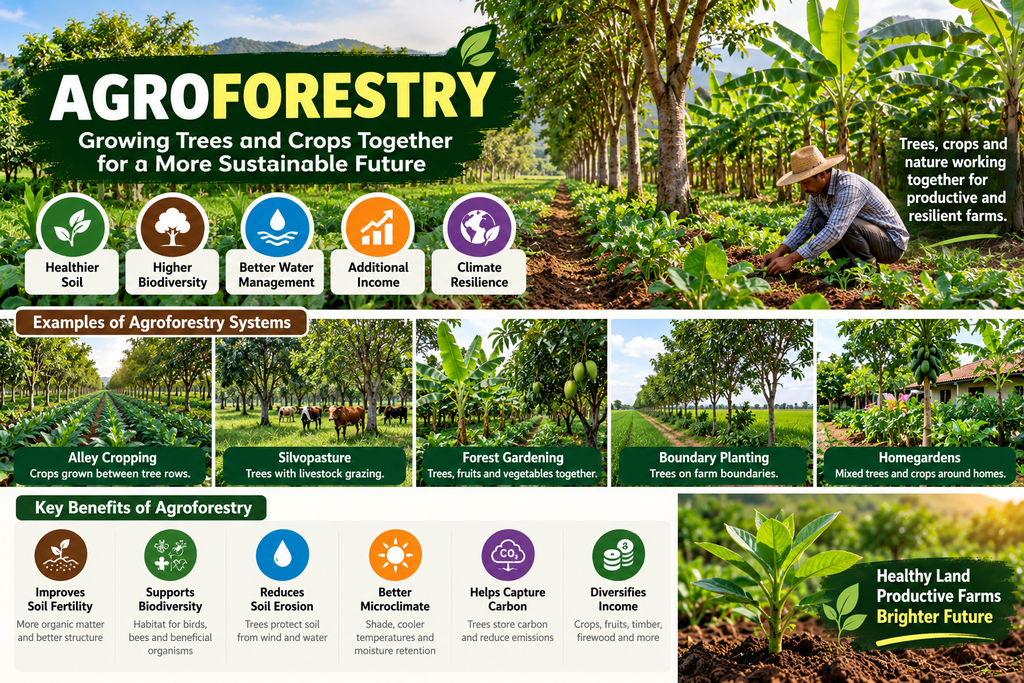
#1. Alley Cropping
Alley cropping involves growing agricultural crops in the spaces between rows of trees or shrubs.
The trees may provide timber, fruit, nuts, or other products. Meanwhile, the crops in the alleys continue to provide seasonal agricultural output.
This system can be useful when farmers want to establish trees without immediately giving up all crop production.
Example: A farmer plants suitable timber or fruit trees in rows and grows vegetables or cereals in the open spaces between them.
Important planning considerations include tree spacing, sunlight reaching the crops, root competition, machinery access, and how the system will change as trees mature.
#2. Silvopasture
Silvopasture combines trees, forage, and livestock on the same land.
Suitable trees may provide shade and shelter, while grasses or other forage plants supply feed. Livestock can graze the area under a managed system.
Silvopasture requires careful planning. Tree protection, grazing intensity, animal access, forage availability, and local livestock requirements all matter.
It is not simply a matter of allowing animals to graze in any wooded area.
#3. Forest Gardening
Forest gardening uses a diverse arrangement of trees, shrubs, herbs, and other plants to produce food and useful materials.
Some systems use different plant heights and growth habits to make productive use of space. A garden might contain fruit trees, berry shrubs, vegetables, and ground-cover plants.
Forest gardening can be suitable for small farms, home gardens, and certain mixed-production systems.
The plant combination should be selected carefully. Species need compatible sunlight, water, nutrient, and maintenance requirements.
#4. Boundary Planting
Boundary planting involves growing trees or shrubs along the edges of fields, farm paths, or property boundaries.
These trees may provide fruit, timber, fodder, wind protection, or other products while using land that might otherwise remain unproductive.
Farmers should choose species and planting arrangements that do not excessively shade neighbouring crops or interfere with irrigation channels, roads, power lines, or property boundaries.
#5. Homegardens and Mixed Tree-Crop Systems
In many regions, homegardens combine fruit trees, vegetables, spices, and other useful plants near the home.
These systems can provide a variety of food and household products throughout the year. Their diversity may also help spread production risks, although results depend on local conditions and management.
A well-planned homegarden can be an accessible way for a small-scale farmer to begin integrating trees into agricultural production.
Benefits of Agroforestry
1. Supports soil health
Trees contribute leaves, small branches, and other organic material to the ground. As this material decomposes, it can contribute to soil organic matter.
Tree roots also help hold soil in place. In appropriate locations, tree-based systems can reduce erosion and improve soil protection.
The results vary with tree species, soil, climate, and management. Trees can also compete with crops for nutrients and water, so species selection and spacing remain important.
2. Helps protect against soil erosion
Tree roots can help stabilize soil, while tree canopies and ground vegetation reduce the direct impact of rainfall.
Trees planted in suitable locations may also help reduce wind exposure.
Agroforestry is not a substitute for every erosion-control measure. Steep slopes, drainage patterns, and severe rainfall may require additional conservation practices.
3. Supports biodiversity
Trees provide habitat, nesting sites, and food for different organisms, including birds, insects, and other wildlife.
A diverse agroforestry system may support more kinds of habitat than a field with a single crop and no trees.
The benefits depend on which species are planted, how they are managed, and the surrounding landscape.
4. Creates additional farm products
Trees may provide products such as:
- Fruit and nuts
- Timber and poles
- Fodder
- Fuelwood
- Leaves or other useful plant materials
These products can diversify farm output. However, many tree products take years to become commercially productive, and their markets may change.
Farmers should consider establishment costs, maintenance, harvest timing, and the availability of buyers before planting trees for commercial purposes.
5. Provides shade and can improve the farm microclimate
Tree shade can reduce direct sunlight on parts of the farm and may help create more favourable conditions for livestock or selected crops.
Windbreaks can also reduce wind exposure in suitable locations.
But too much shade may reduce crop growth. Trees can also use significant amounts of water, particularly in dry environments. A beneficial microclimate for one crop may not suit another.
6. Can contribute to climate resilience
Well-designed agroforestry systems can diversify farm production and help protect soil. Trees also store carbon in their biomass and, under suitable conditions, contribute to carbon storage in the soil.
These benefits are not identical across all systems. Tree survival, growth, land-use history, and long-term management affect the outcome.
Agroforestry should be considered one possible component of climate-resilient farming, rather than a guaranteed solution to drought, heat, or crop losses.
Examples of Agroforestry in Practice
Agroforestry looks different from one region to another.
In parts of India, farmers may integrate fruit trees with suitable seasonal crops, plant trees along field boundaries, or combine trees with fodder production.
In some tropical farming systems, coffee or cocoa is grown beneath selected shade trees. In other areas, silvopasture combines grazing land with trees suited to the local livestock and climate.
These examples demonstrate the range of agroforestry practices. They should not be treated as universal planting recommendations: a species suitable for one region may perform poorly or become invasive in another.
How to Start Agroforestry on a Farm
Step 1: Identify your farming goal
Decide what you want the trees to provide.
Your objective might be fruit production, timber, fodder, wind protection, erosion control, shade, or a combination of benefits.
A clear objective makes it easier to select species and plan the layout.
Step 2: Assess your land
Examine soil type, drainage, rainfall, irrigation availability, slope, and existing crops.
Consider how much sunlight the current crops require and whether tree roots could compete with them.
If the farm has limited water, drought-adapted species and careful spacing may be particularly important.
Step 3: Select locally suitable tree species
Choose species that are suited to the climate and soil and that provide the products or services you need.
Before planting, check local agricultural or forestry guidance for suitable varieties, planting distances, growth characteristics, and management requirements.
Avoid selecting trees only because they grow quickly. Their root systems, canopy size, water use, and potential pest or disease issues are also important.
Step 4: Plan tree spacing and crop arrangements
Trees need enough space to grow without creating excessive competition with nearby crops.
For alley cropping, consider the width of crop alleys, the mature size of trees, sunlight, and machinery access.
For boundary planting, consider shade, root spread, irrigation infrastructure, and the position of neighbouring fields.
The right spacing depends on the species and farming system; there is no single distance that works for every agroforestry farm.
Step 5: Establish and protect young trees
Plant trees at an appropriate time for local weather and soil moisture.
Young trees may require irrigation, mulching, weed management, and protection from livestock or other damage.
Monitor tree survival and replace failed plants where appropriate.
Step 6: Manage trees and crops together
As trees grow, their shade and root systems change. Farmers may need to prune trees, adjust crop choices, manage grazing, or modify the space between rows.
Regular observation helps identify whether trees are supporting the farm or competing too strongly with the main crops.
Challenges and Limitations of Agroforestry
Agroforestry can offer multiple benefits, but farmers should consider its practical limitations.
Initial investment: Trees require planting material, labour, and sometimes fencing, irrigation, or protective equipment.
Time to returns: Timber and many fruit trees take time to reach productive maturity. Farmers need a plan for income during the establishment period.
Competition with crops: Tree roots can compete for water and nutrients, while dense canopies can reduce sunlight.
Management requirements: Pruning, tree protection, harvesting, and crop planning add work to the farming system.
Market uncertainty: A tree product may not provide a reliable income if buyers, storage, transport, or prices are uncertain.
Farmers can reduce some of these risks by starting with a small trial, choosing locally adapted species, and seeking advice from agricultural or forestry extension services.
FAQs.
Q1. Is agroforestry suitable for small farms?
Yes. Agroforestry can be adapted to small farms through boundary planting, homegardens, selected fruit trees, or carefully planned crop-and-tree combinations.
The system should fit the farm’s available land, labour, water, and production goals.
Q2. Does agroforestry increase crop yields?
It can improve some farming outcomes, but it does not automatically increase the yield of every crop.
Tree shade, root competition, water availability, and management can affect crop performance. Farmers should choose suitable combinations and assess the results under local conditions.
Q3. What is the difference between agroforestry and a forest?
A forest is primarily a tree-dominated ecosystem. Agroforestry deliberately integrates trees with agricultural production, such as crops or livestock.
Some agroforestry systems may resemble forests in their structure, but their design and management also consider farm products and agricultural objectives.
Q4. Can agroforestry help reduce erosion?
Trees and associated ground vegetation can help protect soil and stabilize it in suitable locations. The degree of protection depends on the layout, species, soil, slope, and management.
Q5. How long does agroforestry take to become productive?
It depends on the system. Some crops may continue producing during the early years of tree establishment, while timber or certain fruit trees may require several years before significant returns.
Farmers should plan for both short-term agricultural production and longer-term tree benefits.
Conclusion
Agroforestry offers farmers a way to integrate trees into agricultural land while continuing to produce crops, livestock products, or other useful materials.
When thoughtfully designed, it can support soil protection, biodiversity, diversified farm products, and more resilient production systems.
Its success depends on choosing suitable species, understanding the needs of existing crops, and managing trees throughout their growth.
For farmers interested in improving soil management, agroforestry can complement practices such as green manure and cover cropping and regenerative farming.
Disclaimer: This article is for general educational purposes. Agroforestry species, planting distances, and management practices should be adapted to local soil, climate, water availability, and farming conditions. Consult a qualified agricultural or forestry expert or local extension service before making farm-management decisions.