
Farming has always depended on experience, timing and a good understanding of the land. But today, farmers have access to something previous generations could only dream of — detailed information about their crops, soil and weather.
This is where precision farming comes in.
Instead of treating an entire field in exactly the same way, precision farming helps farmers understand that different parts of a field may have different needs. With the help of GPS, sensors, drones, satellite imagery and data analysis, farmers can make more informed decisions about when to plant, irrigate, fertilise and harvest.
The goal is simple: use the right amount of resources in the right place at the right time.
In this guide, we will look at what precision farming means, how it works, the technologies behind it, its major benefits, challenges and some practical examples.
What Is Precision Farming?
Precision farming, also called precision agriculture, is a modern farming approach that uses technology and data to manage crops and farmland more accurately.
Traditional farming often applies the same treatment across an entire field. Precision farming takes a more targeted approach.
For example, if one section of a field needs more water while another section has sufficient moisture, a precision irrigation system can help provide water where it is actually needed.
Similarly, farmers can use soil data to identify areas that require more or less fertiliser.
In simple terms:
Precision farming means managing different parts of a farm according to their specific needs rather than treating the whole farm in exactly the same way.
How Does Precision Farming Work?
How Does Precision Farming Work?
Precision farming generally follows a cycle of collecting data, analysing it and taking action.
#1. Data Collection
Farmers collect information about their fields using:
- Soil sensors
- GPS systems
- Drones
- Satellite imagery
- Weather stations
- Farm machinery
- Crop monitoring devices
The information may include soil moisture, nutrient levels, crop health, temperature and other conditions.
#2. Data Analysis
The collected information is then analysed using software and digital farming platforms.
This can help identify:
- Areas with poor crop growth
- Dry sections of a field
- Nutrient deficiencies
- Pest or disease problems
- Changes in crop health
#3. Making Better Decisions
Farmers can use the information to decide where and when to:
- Irrigate
- Apply fertiliser
- Control pests
- Plant seeds
- Harvest crops
#4. Taking Targeted Action
Modern farm equipment can sometimes automatically apply resources at specific locations.
This helps reduce unnecessary use of water, fertiliser, fuel and other inputs.
7 Key Benefits of Precision Farming:
Precision farming offers several advantages for farmers and the environment.
#1. Better Use of Water
Water is one of the most important resources in agriculture.
Precision irrigation systems can use information from soil-moisture sensors and weather data to determine when crops need water.
Instead of watering the entire field unnecessarily, farmers can focus irrigation where it is needed.
This can be particularly useful in areas where water availability is limited.
#2. More Efficient Fertiliser Use
Applying too much fertiliser can waste money and may contribute to environmental problems.
Precision farming allows farmers to understand variations in soil nutrients across a field.
Based on this information, fertiliser can be applied more accurately.
The result can be:
- Less wastage
- Lower input costs
- Better nutrient management
- More efficient crop production
#3. Improved Crop Monitoring
Walking through a large farm and checking every plant manually can take a lot of time.
Drones, satellites and sensors can provide farmers with a broader view of crop conditions.
They can help identify unusual areas before problems become obvious across the whole field.
Early detection may allow farmers to respond more quickly.
#4. Higher Productivity
Precision farming does not automatically guarantee higher yields, but better management can create conditions that support healthier crop growth.
Farmers can use data to understand:
- Which areas are performing well
- Which areas need attention
- When crops need water
- When nutrients may be required
- Where problems are developing
This can help improve overall farm management and productivity.
#5. Reduced Farming Costs
Inputs such as seeds, fertilisers, pesticides, water and fuel can represent a significant part of farming expenses.
Using these resources more precisely can reduce unnecessary applications.
For example, a farmer who identifies a small problem area may not need to treat an entire field.
Over time, better resource management can contribute to lower operating costs.
#6. Reduced Environmental Impact
Precision farming can support more sustainable agriculture by helping farmers use resources more efficiently.
Better management of:
- Water
- Fertilisers
- Pesticides
- Fuel
- Soil
can reduce unnecessary resource use.
This is one reason precision agriculture is increasingly discussed alongside sustainable and climate-smart farming practices.
#7. Better Farm Management Decisions
Perhaps the biggest advantage is the information precision farming provides.
Instead of relying only on observation and experience, farmers can combine their knowledge with data.
This allows them to make decisions based on actual conditions in their fields.
Technologies Used in Precision Farming
Precision agriculture is not based on one technology. It combines several different tools.
GPS and GNSS
GPS and other satellite positioning systems help farmers determine the exact location of farm machinery and field activities.
They can be used for:
Field mapping
Tractor guidance
Precision planting
Automated machinery
Yield mapping
Soil Sensors
Soil sensors can provide information about conditions such as:
Soil moisture
Temperature
Nutrient levels
Electrical conductivity
This information can help farmers understand how soil conditions vary across their fields.
Drones
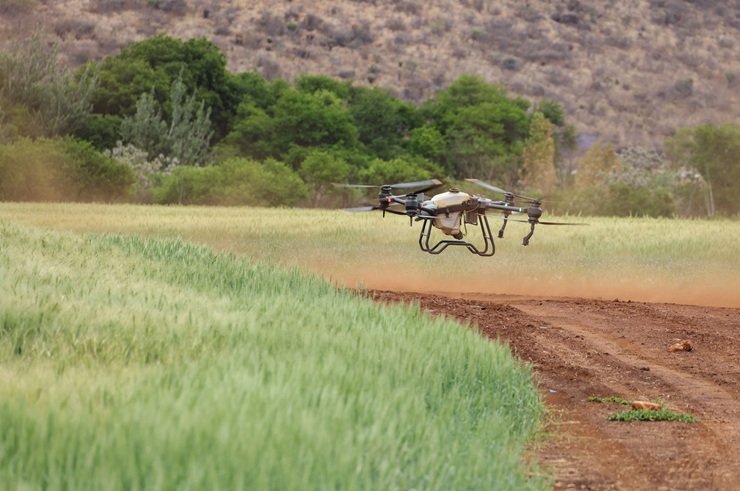
Agricultural drones can capture images of fields from above.
Depending on the equipment, these images can help farmers monitor:
Crop growth
Plant stress
Irrigation problems
Pest damage
Disease symptoms
Drones can be particularly useful for quickly surveying large areas.
Satellite Imagery
Satellites can provide regular images of farmland over large areas.
Farmers and agricultural professionals can use this information to monitor changes in vegetation and crop conditions.
Satellite data can also be combined with other farm information to create more detailed field maps.
Smart Farm Machinery
Modern tractors, harvesters and other agricultural machines can use GPS, sensors and digital systems to perform tasks more accurately.
Some equipment can adjust application rates while moving across a field.
This is often called variable-rate technology.
Weather Stations
Local weather stations can provide information about:
Temperature
Rainfall
Humidity
Wind
Soil conditions
Farmers can use this information to plan irrigation, spraying and other activities.
Examples of Precision Farming
Precision farming can be used at different stages of agricultural production.
Precision Planting
Farmers can use GPS-guided machinery to place seeds more accurately according to a planned field map.
Variable-Rate Fertilisation
Instead of applying the same amount of fertiliser everywhere, machinery can adjust application rates based on field data.
Precision Irrigation
Sensors and automated irrigation systems can help deliver water according to crop and soil requirements.
Crop Health Monitoring
Drones and satellite imagery can help identify areas where crops are developing differently from surrounding plants.
Precision Harvesting
Yield-monitoring systems can collect information during harvesting, helping farmers understand which areas of a field produced more or less.
Precision Farming vs Traditional Farming
| Feature | Traditional Farming | Precision Farming |
| Decision-making | Mainly experience-based | Experience + data |
| Field management | Often uniform | Site-specific |
| Water use | General application | Targeted application |
| Fertiliser | Similar application across fields | Variable application |
| Crop monitoring | Mainly manual | Sensors, drones and satellites |
| Technology | Limited | High |
| Data collection | Relatively low | Extensive |
| Resource efficiency | Variable | Generally improved |
Neither approach is suitable for every farmer. Precision farming can be especially useful where farms have sufficient scale, suitable infrastructure and access to technology.
Advantages and Disadvantages of Precision Farming
Advantages:
Better resource management
More accurate field monitoring
Potential reduction in input waste
Improved decision-making
Better understanding of soil and crops
Supports sustainable agriculture
Can save time on large farms
Disadvantages:
Initial technology costs can be high
Requires technical knowledge
Equipment may require maintenance
Reliable internet or connectivity may be necessary for some systems
Data management can be complicated
Small farmers may find some technologies difficult to afford
Precision Farming in India
Precision farming is becoming increasingly relevant in India as farmers face challenges such as water scarcity, rising input costs, changing weather patterns and the need to improve productivity.
Technologies such as:
- GPS-enabled machinery
- Soil sensors
- Mobile farming applications
- Drones
- Satellite imagery
- Automated irrigation
can potentially help farmers make more informed decisions.
However, adoption depends on factors such as farm size, cost, technical support, connectivity and access to suitable equipment.
For small and marginal farmers, affordable and easy-to-use technologies may be particularly important.
Is Precision Farming the Same as Smart Farming?
The terms are related but not exactly the same.
Precision farming focuses strongly on managing agricultural activities accurately using location-based data and technology.
Smart farming is a broader concept that can include automation, artificial intelligence, Internet of Things devices, robotics, connected machinery and data-driven management.
In practice, the two approaches often overlap.
You can read our related guide on [Smart Farming] once that article is published.
Precision Farming and Sustainable Agriculture
One of the most interesting aspects of precision farming is its potential contribution to sustainability.
Farmers need to produce food while managing limited resources such as water, soil and energy.
Precision agriculture can help by making resource application more targeted.
For example, if soil data shows that one area requires less fertiliser, applying a smaller amount there may reduce unnecessary use.
However, technology alone does not make farming sustainable. Good results still depend on appropriate crop management, soil health, local conditions and responsible decision-making.
How to Start Precision Farming on a Small Farm
You do not necessarily need to purchase expensive equipment immediately.
A farmer can start gradually.
#Step 1: Understand Your Main Problem
First identify what you want to improve.
For example:
Water usage
Fertiliser management
Crop monitoring
Soil health
Machinery efficiency
#Step 2: Start With Basic Data
Soil testing and basic weather information can provide useful insights without requiring a large investment.
#Step 3: Use Simple Digital Tools
Mobile applications and basic farm-management tools can help organise information about crops and field activities.
#Step 4: Add Sensors or Mapping
Once the basic system is working, farmers can consider soil sensors, GPS mapping or drone monitoring.
#Step 5: Expand Gradually
There is no need to adopt every technology at once.
The best approach is to invest in technology that solves a real problem on the farm.
The Future of Precision Farming
The future of precision agriculture is likely to become increasingly connected.
Artificial intelligence, robotics, advanced sensors, satellite technology and automated machinery are already changing the way agricultural data is collected and used.
In the future, farmers may be able to receive increasingly detailed recommendations about individual fields or even specific sections of a field.
The challenge will be making these technologies affordable, reliable and easy to use, particularly for smaller farms.
FAQs.
Q1. What is precision farming in simple words?
Precision farming is a method of managing farmland using data and technology so that resources such as water, fertiliser and pesticides can be applied more accurately.
Q2. What technologies are used in precision farming?
Common technologies include GPS, soil sensors, drones, satellite imagery, weather stations, smart machinery and farm-management software.
Q3. Is precision farming expensive?
Some advanced systems can be expensive, but farmers can start with simpler technologies such as soil testing, mobile applications and basic monitoring tools.
Q4. Does precision farming increase crop yield?
It can help improve farm management and resource efficiency, which may contribute to better yields. However, results depend on the crop, soil, climate, technology and how the system is used.
Q5. Is precision farming sustainable?
Precision farming can support sustainable agriculture by improving the efficiency of water, fertiliser, pesticides and other resources. However, technology should be combined with good agricultural practices.
Related Article for Farming
If you are exploring different modern farming methods, you may also want to read:
Modern Farming: 6 Innovative Farming Methods Explained
Hydroponic Farming: 7 Benefits, Types & How It Works
Vertical Farming: 7 Powerful Benefits, Types & How It Works
Smart Farming: 7 Key Benefits, Technologies, Examples & How It Works
Conclusion:
Precision farming is changing the way farmers understand and manage their fields. Instead of relying only on a one-size-fits-all approach, farmers can use data to see where their crops and soil need attention.
It is not about replacing farmers with technology. It is about giving farmers better information to make better decisions.
As farming becomes more connected and data-driven, precision agriculture could play an increasingly important role in producing food efficiently while making better use of limited natural resources.
3 thoughts on “Precision Farming: 7 Key Benefits, Technologies, Examples & How It Works”