
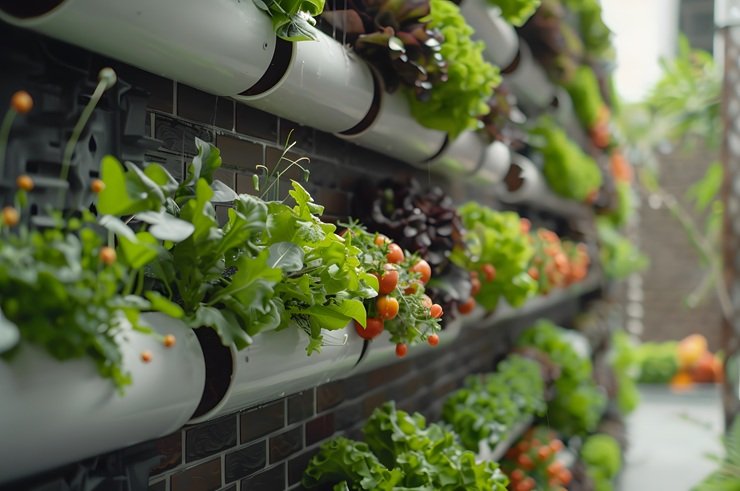
Imagine growing hundreds of plants in a space that would normally be too small for a traditional farm.
Instead of spreading crops across a large field, plants are arranged in stacked layers, one above another. This simple change in the way growing space is used is the basic idea behind vertical farming.
Vertical farming has attracted attention as cities grow, farmland becomes limited and farmers look for new ways to produce fresh food closer to consumers.
But vertical farming is not simply about putting plants on shelves.
Depending on the system, it can involve artificial lighting, hydroponics, sensors, climate control, automated irrigation and carefully managed growing conditions.
It sounds futuristic, but the principle is surprisingly straightforward: grow more in a smaller footprint by making better use of vertical space.
So, how does vertical farming work? What can be grown this way? And is it really a better option than traditional farming?
Let’s take a closer look.
What Is Vertical Farming?
Vertical farming is a method of growing crops in vertically stacked layers rather than spreading them across a traditional horizontal field.
The plants may be grown indoors, inside greenhouses or in other controlled environments.
Vertical farms often combine several technologies, including:
- Hydroponic systems
- LED lighting
- Automated irrigation
- Temperature control
- Humidity control
- Sensors
- Monitoring software
The exact setup can vary considerably.
A small vertical farm might have several shelves of leafy vegetables, while a large commercial facility can contain multiple growing levels arranged across a much larger building.
The main idea remains the same: use height as well as floor space for crop production.
How Does Vertical Farming Work?
A vertical farm needs to provide plants with the basic conditions they would normally receive from their natural environment.
These include:
- Light
- Water
- Nutrients
- Oxygen
- Suitable temperature
- Humidity
- Space for roots and leaves
In an outdoor field, sunlight and rainfall provide some of these naturally.
In a controlled vertical farm, many of these conditions can be managed artificially.
For example, LED lights may provide the light needed for photosynthesis, while a hydroponic system can deliver water and nutrients directly to plant roots.
Sensors can monitor the growing environment and provide information to the grower.
This allows the farm to create a much more controlled environment than a conventional outdoor field.
7 Key Benefits of Vertical Farming
Vertical farming has several potential advantages, particularly where land is expensive or limited.
1. Makes Better Use of Limited Space
This is probably the biggest attraction of vertical farming.
Traditional agriculture mainly uses horizontal land. Vertical farming adds another dimension by growing upwards.
Instead of having one growing surface, a vertical farm can have several layers.
This can make the method particularly interesting in:
Cities
Urban buildings
Warehouses
Greenhouses
Rooftops
Areas where farmland is expensive
However, using less floor space does not automatically mean lower production costs. Building and operating the facility can still be expensive.
#2. Can Bring Food Production Closer to Cities
Many people live far away from the farms where their food is produced.
Vertical farms can sometimes be located closer to urban consumers.
This can make local production of certain crops possible in places where traditional farmland is difficult to find.
For example, a city-based facility could grow leafy greens close to local supermarkets or restaurants.
The benefit is not necessarily that every crop needs to be grown in a city. Instead, vertical farming can provide another option for producing certain fresh crops near the market.
#3. Greater Control Over Growing Conditions
Outdoor farming is influenced by weather.
Rainfall, temperature, storms and seasonal changes can all affect crop production.
A controlled vertical farm can regulate many of these conditions.
Growers may be able to adjust:
- Temperature
- Humidity
- Light
- Water
- Nutrients
- Air circulation
This level of control can make crop production more predictable in some situations.
#4. Potentially Efficient Water Use
Many vertical farms use hydroponic or other recirculating growing systems.
Instead of allowing water to simply move through the soil and away from the root zone, water can be collected and circulated through the system.
This can improve water efficiency.
However, the actual amount of water saved depends on the design and management of the farm.
#5. Less Dependence on Natural Soil
Vertical farming often uses hydroponics or other soilless growing systems.
This means crops don’t necessarily require fertile agricultural soil.
That can be useful in urban areas or locations where suitable soil is limited.
It also gives growers greater control over the nutrients supplied to the plants.
#6. Production Can Continue Throughout the Year
A vertical farm operating in a controlled environment is less dependent on outdoor seasons.
With appropriate lighting, temperature, water and nutrient management, growers can potentially maintain production beyond the normal outdoor growing season.
This doesn’t mean every crop can be produced economically throughout the year.
The crop, energy costs and growing system all matter.
#7. Can Reduce Some Weather-Related Risks
Outdoor crops can be damaged by extreme weather, depending on the crop and location.
Growing crops inside a controlled facility can reduce exposure to some of these conditions.
This can be particularly useful for crops that are sensitive to temperature or weather fluctuations.
Still, indoor farming introduces its own risks, such as equipment failure or power interruptions.
Types of Vertical Farming
Vertical farming isn’t one single system.
Different farms use different structures and growing methods depending on their crops, budget and available space.
#1. Tower Vertical Farming
In tower systems, plants are arranged around or inside tall structures.
Plants can be grown at different heights, making use of vertical space.
These systems can work well for certain leafy crops and herbs.
#2. Stacked Shelf Systems
This is one of the easiest vertical farming systems to visualise.
Plants are placed on multiple shelves or growing levels.
Each layer can have its own lighting and irrigation arrangement.
Large indoor farms may have long rows of these stacked growing levels.
#3. Vertical Hydroponic Farming
Hydroponics and vertical farming are often used together.
In this setup, plants are stacked vertically while water containing nutrients is delivered to their roots.
This combination can make efficient use of both water and space.
If you want to understand the hydroponic side in more detail, read our guide:
Hydroponic Farming: 7 Key Benefits, Types, Examples & How It Works
#4. Aeroponic Vertical Farming
Aeroponics is another option.
Instead of keeping the roots in soil or continuously submerged in water, the roots are suspended and exposed to a nutrient-rich mist.
When combined with vertical structures, this can create a highly controlled growing environment.
However, aeroponic systems can be technically demanding and require reliable equipment.
What Crops Can Be Grown in Vertical Farms?
Vertical farming works particularly well for crops that don’t require large amounts of space.
Common examples include:
- Lettuce
- Spinach
- Kale
- Basil
- Mint
- Coriander
- Microgreens
- Some herbs
- Strawberries
- Certain varieties of tomatoes
Leafy greens and herbs are particularly common because they can have relatively short growing cycles and can be grown in compact systems.
Larger crops can also be grown in controlled environments, but they may require more space, support, lighting and energy.
Vertical Farming vs Traditional Farming
Both systems have their place in agriculture.
| Vertical Farming | Traditional Farming |
| Uses stacked growing layers | Mainly uses horizontal fields |
| Can operate indoors | Usually depends on outdoor conditions |
| Growing environment can be controlled | More exposed to natural weather |
| Can work with little or no traditional soil | Usually depends on soil |
| Can be located near urban areas | Often requires larger agricultural land |
| Often requires specialised technology | Can use relatively simple equipment |
| High infrastructure costs can occur | Large land requirements can be a major cost |
The comparison isn’t about declaring one method the winner.
A field of wheat or maize, for example, is very different from an indoor farm growing lettuce.
The most suitable system depends heavily on the crop and location.
Advantages of Vertical Farming
Let’s summarise the main advantages.
Efficient use of space
Multiple growing layers allow farms to produce crops within a smaller floor area.
Controlled environment
Temperature, humidity, lighting and nutrients can be monitored and adjusted.
Potential water efficiency
Recirculating systems can reduce unnecessary water loss.
Urban agriculture
Vertical farms can potentially operate close to cities and consumers.
Reduced exposure to outdoor weather
Indoor systems can protect crops from some weather-related problems.
Consistent growing conditions
Controlled environments can make production more predictable for suitable crops.
Disadvantages of Vertical Farming
Vertical farming also has some serious challenges.
#1. High Setup Costs
A commercial vertical farm can require significant investment.
Costs may include:
- Buildings
- Growing racks
- LED lights
- Pumps
- Sensors
- Climate-control equipment
- Irrigation systems
- Monitoring software
This makes vertical farming very different from simply growing plants on shelves at home.
#2. Electricity Consumption
This is one of the most important challenges.
Indoor farms often need artificial lighting and climate control.
These systems can consume considerable electricity.
The environmental and economic performance of a vertical farm can therefore depend heavily on energy efficiency and the source of electricity.
#3. Technical Skills Are Required
A modern vertical farm can involve agriculture, electronics, irrigation, software and environmental control.
Farm operators may need specialised knowledge to keep everything working properly.
#4. Equipment Failure Can Affect Crops
A conventional outdoor crop does not usually depend on one pump or lighting system.
In a vertical farm, equipment failure can quickly affect growing conditions.
Power cuts, pump failures or climate-control problems can become serious if they aren’t addressed quickly.
#5. Not Every Crop Is Economically Suitable
Vertical farming is not equally suitable for every crop.
Growing a crop indoors may be worthwhile when it has a suitable market and can justify the cost of controlled production.
For some low-value crops, traditional field farming may remain much more economical.
Vertical Farming in India
India has a large agricultural sector, but it also has rapidly growing cities where land can be expensive and limited.
This creates an interesting opportunity for vertical farming.
Urban and peri-urban growers may consider vertical systems for crops such as:
Leafy vegetables
Herbs
Microgreens
Some fruits
Selected vegetables
However, the economics need careful consideration.
Electricity, equipment, maintenance, labour and market demand can all affect the success of a vertical farm.
For a small grower, a simple greenhouse or protected cultivation system may sometimes make more financial sense than a highly automated vertical farm.
The important question is not simply:
“Can this crop be grown vertically?”
It is:
“Can this crop be grown vertically at a cost that makes sense for the local market?”
Is Vertical Farming Sustainable?
This question doesn’t have a simple yes-or-no answer.
Vertical farming can use land efficiently and some systems can use water efficiently.
But indoor farms may require significant energy for lighting, cooling and ventilation.
So sustainability depends on how the entire system operates.
Important factors include:
Energy source
Lighting efficiency
Water recycling
Crop selection
Equipment lifespan
Waste management
Transport
Overall production efficiency
A vertical farm powered by cleaner energy may have a very different environmental profile from one relying heavily on carbon-intensive electricity.
This is why vertical farming should be evaluated as a complete system rather than judged on one feature alone.
Vertical Farming and Hydroponics: What’s the Difference?
These two terms are often confused.
Vertical farming describes how crops are arranged in space.
Hydroponics describes how plants receive water and nutrients without traditional soil.
They can work together.
For example, a vertical farm may have five growing layers, with lettuce growing hydroponically on every layer.
So:
Vertical farming = stacked growing
Hydroponics = soilless growing
This distinction is useful when learning about modern agricultural systems.
You can also explore our broader guide to Modern Farming: 6 Innovative Farming Methods Changing Agriculture.
How to Start a Small Vertical Farm
If you’re interested in trying vertical farming, starting with a small system can help you understand the basics before making a major investment.
#Step 1: Choose a suitable crop
Leafy greens, herbs and microgreens can be good crops to research for smaller systems.
#Step 2: Decide where the farm will operate
Consider available space, electricity, ventilation, water and access to the market.
#Step 3: Select a growing system
You could explore hydroponic, aeroponic or other suitable systems.
#Step 4: Plan lighting
Indoor crops need an appropriate light source.
#Step 5: Set up irrigation and nutrient delivery
Make sure water and nutrients can reach every growing level reliably.
#Step 6: Monitor the environment
Temperature, humidity, water and plant health should be checked regularly.
#Step 7: Understand the market
Before scaling up, find out who will buy your produce and what price they are willing to pay.
This last step is easy to overlook.
A successful vertical farm needs to grow a product that people actually want to buy.
Is Vertical Farming the Future of Agriculture?
Vertical farming will probably become an important part of modern agriculture, but it is unlikely to replace traditional farming completely.
Large outdoor farms remain extremely important for crops such as wheat, rice, maize and many other field crops.
Vertical farming is more likely to complement traditional agriculture by producing certain crops in places where land is limited or controlled growing conditions provide an advantage.
As technology develops, improvements in LED efficiency, automation, sensors and energy management could make vertical farming more practical.
But the future will depend on economics as much as technology.
A system needs to be productive, reliable and financially sustainable, not just technologically impressive.
FAQs.
Q1. What is vertical farming?
Vertical farming is a method of growing crops in stacked layers instead of using only a traditional horizontal field.
Q2. How does vertical farming work?
Vertical farms provide plants with controlled amounts of light, water, nutrients and other growing conditions. Many systems use hydroponics or other soilless methods.
Q3. What crops are suitable for vertical farming?
Leafy greens, herbs and microgreens are commonly suitable. Certain tomatoes, strawberries and other vegetables can also be grown in appropriate systems.
Q4. Is vertical farming expensive?
Commercial vertical farming can be expensive because it may require specialised lighting, irrigation, climate control, sensors and other infrastructure.
Q5. Does vertical farming use less water?
Some vertical farms use recirculating growing systems that can use water efficiently. Actual water use depends on the technology, crop and management.
Q6. Is vertical farming environmentally friendly?
It can have advantages such as efficient land use and potentially efficient water use, but energy consumption can be significant. Its overall environmental impact depends on how the farm is designed and operated.
Q7. Can vertical farming be done at home?
Yes. Small vertical growing systems can be used at home, particularly for herbs, leafy greens and microgreens.
Related Article for Farming
Modern Farming: 6 Innovative Farming Methods Changing Agriculture
Hydroponic Farming: 7 Key Benefits, Types, Examples & How It Works
Precision Farming: 7 Key Benefits, Technology, Examples & How It Works
Smart Farming: 7 Technologies, Benefits, Examples & How It Works
Aquaponics: 7 Key Benefits, How It Works, Types & Examples
Indoor Farming: 7 Key Benefits, Types, Crops & How It Works
Conclusion:
Vertical farming is an interesting example of how agriculture is adapting to changing circumstances.
Instead of asking how much land is available, it asks a slightly different question:
How much growing space can we create within the land we already have?
By stacking crops and controlling important growing conditions, vertical farms can make productive use of limited space.
But the method isn’t perfect.
High setup costs, electricity requirements, technical complexity and crop limitations all need to be considered before investing.
For an urban grower producing herbs or leafy greens, vertical farming could be a practical solution. For a farmer growing large field crops, traditional agriculture may still be the obvious choice.
In the end, vertical farming isn’t about replacing every traditional farm. It’s about finding another way to grow food where conventional farming may not always be practical.
And that is what makes it such an interesting part of modern agriculture.
3 thoughts on “Vertical Farming: 7 Key Benefits, Types, Examples & How It Works”