
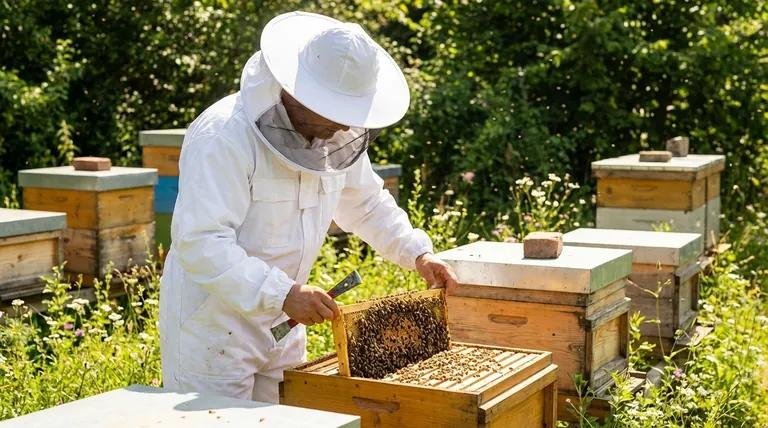
Beekeeping is an agricultural activity that allows farmers to earn income from honey and other bee products while supporting crop pollination. It can be started on a relatively small scale and gradually expanded as the beekeeper gains experience. In India, different climatic conditions, flowering crops, orchards and forest plants create opportunities for maintaining honeybee colonies in several regions.
However, successful beekeeping requires more than purchasing a few bee boxes. Farmers need to understand bee species, seasonal flowering patterns, colony management, honey extraction and local market demand. A poorly managed colony may become weak or leave the hive, resulting in financial losses.
This guide explains how to start beekeeping in India, the equipment required, suitable honeybee species, investment costs, income opportunities and government support.
What Is Beekeeping?
Beekeeping, also known as apiculture, is the practice of maintaining honeybee colonies in specially designed boxes or hives. The purpose is to collect honey, beeswax and other hive products while also providing pollination services to agricultural and horticultural crops.
A managed honeybee colony generally contains three types of bees:
- Queen bee: The reproductive female responsible for laying eggs and maintaining the colony’s population.
- Worker bees: Female bees that collect nectar and pollen, feed young bees, clean the hive and protect the colony.
- Drones: Male bees whose primary role is mating with a queen.
Each member has a different role. A healthy colony depends on the proper functioning of all three.
Beekeeping can be practised as an independent business or combined with fruit farming, vegetable cultivation, mustard cultivation and other agricultural activities.
Why Is Beekeeping Important in India?
India has a wide range of flowering plants, agricultural crops, fruit orchards and forest vegetation. These provide nectar and pollen at different times of the year, creating opportunities for beekeeping.
One important advantage is that honeybees support pollination. When bees visit flowers to collect nectar and pollen, they transfer pollen between flowers, helping many crops with fruit and seed formation.
Farmers may benefit from beekeeping in two ways:
Income from bee products: Honey, beeswax, pollen and other hive products can provide additional sources of revenue.
Support for crop pollination: Honeybee activity can improve pollination in suitable crops, although the actual effect depends on crop type, weather, bee activity and local conditions.
The Government of India’s National Beekeeping and Honey Mission has also recognised the role of scientific beekeeping in improving honey production, pollination and rural livelihoods.
Best Honeybee Species for Beekeeping in India
Choosing the right honeybee species is one of the most important decisions before starting an apiary. Different species have different behaviour, honey production potential and suitability for domestication.
Apis mellifera (European or Italian Honeybee)
Apis mellifera is widely used in commercial beekeeping. It is suitable for managed hive systems and can produce comparatively high quantities of honey under favourable conditions.
It is commonly used by commercial beekeepers who manage multiple colonies and may move their hives according to seasonal flowering.
Apis cerana indica (Indian Hive Bee)
Apis cerana indica is a native Indian honeybee that is traditionally maintained in different parts of the country. It is generally suited to smaller-scale beekeeping and local environmental conditions.
Its honey production per colony is usually lower than that of Apis mellifera, so farmers should select it according to regional suitability and the type of operation they want to establish.
Apis dorsata (Rock Bee)
Apis dorsata is a large wild honeybee commonly found in forests and other natural environments. It builds exposed nests and is not suitable for ordinary domestication in standard commercial bee boxes.
Farmers should not treat wild rock-bee colonies as an easy source of managed honey production.
Apis florea (Dwarf Honeybee)
Apis florea is a small wild honeybee that builds relatively small exposed nests. Its honey production is limited, and it is not generally selected for commercial box-based beekeeping.
Stingless Bees
Stingless bees are smaller than common honeybees and produce only small quantities of honey. Their honey is sometimes marketed as a specialised product, but their management and production system differ from conventional honeybee farming.
Comparison of Honeybee Species
| Species | Main characteristics | Commercial suitability |
|---|---|---|
| Apis mellifera | Higher honey production potential | Widely used in commercial apiaries |
| Apis cerana indica | Native Indian hive bee | Suitable for regional and smaller-scale systems |
| Apis dorsata | Large wild bee | Not suitable for ordinary domestication |
| Apis florea | Small wild bee | Limited honey production |
| Stingless bees | Small colonies and specialised honey | Niche production and pollination |
According to an ICAR article published in July 2025, average annual honey production potential is approximately 20–25 kg per Apis mellifera colony and 3.6–4.5 kg per Apis cerana indica colony. Actual yields can vary considerably with location, flowering resources and colony management.
Land and Location Requirements for Beekeeping
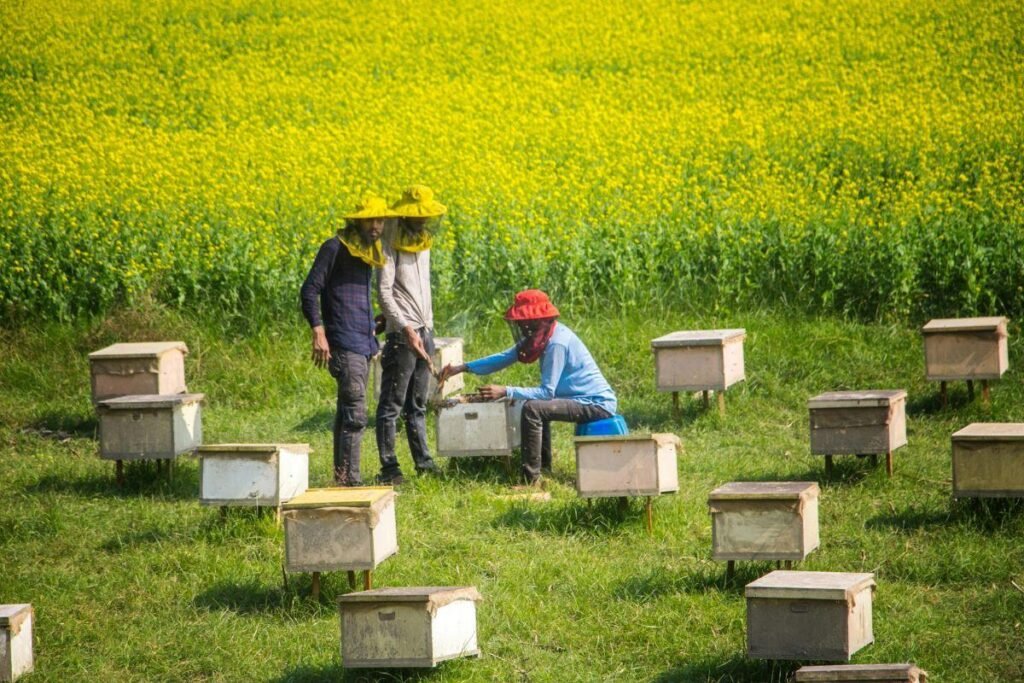
Beekeeping does not always require agricultural land of its own. An apiary can be established near farms, orchards, flowering plants or other suitable locations where bees have access to nectar and pollen.
However, selecting the location carefully is essential.
A suitable apiary site should have:
- A regular supply of flowering plants nearby.
- Access to clean water.
- Good drainage and protection from flooding.
- Partial shade or protection from extreme sunlight.
- Limited disturbance from people and livestock.
- Protection from strong winds and excessive moisture.
- Safe access for inspection and honey collection.
Avoid placing bee boxes close to heavily polluted areas, pesticide-intensive fields or locations where colonies may be disturbed frequently.
Importance of Flowering Plants
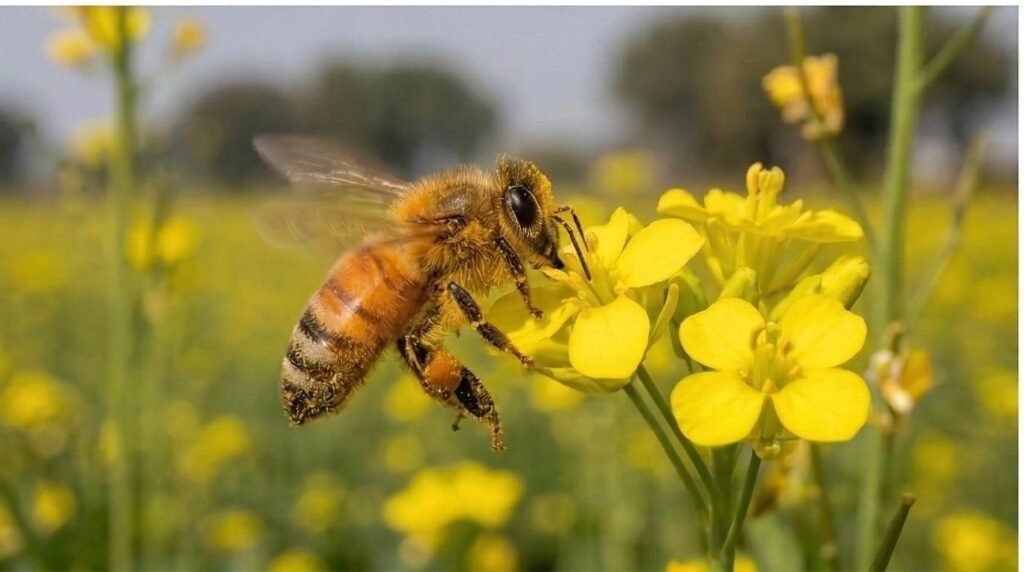
The availability of flowers directly affects the colony’s food supply and honey production.
Different crops and trees provide flowering resources at different times. Mustard, litchi, sunflower, citrus, eucalyptus and other local plants may support bee activity depending on the region and season.
Before placing colonies, farmers should study the local flowering calendar. A location with a long period of nectar and pollen availability can be more useful than a site that offers only a short flowering season.
Equipment Required to Start Beekeeping
A beginner should purchase essential equipment before bringing bee colonies to the farm. Good-quality equipment makes hive inspection, colony management and honey collection easier.
Beehive Boxes
Beehive boxes provide a controlled space for colonies to build combs, raise young bees and store honey. Modern wooden hives generally contain removable frames that allow the beekeeper to inspect the colony.
Bee Colonies
A hive box without a healthy colony cannot produce honey. Purchase colonies from reliable beekeepers or authorised suppliers and check the condition of the queen, brood and worker population.
Honey Extractor
A honey extractor removes honey from combs using centrifugal force. It allows honey to be collected without destroying the entire comb structure.
Protective Clothing
A bee veil, suitable clothing and gloves help protect the beekeeper during hive inspections. Beginners should learn safe handling practices before opening colonies.
Smoker
A smoker produces cool smoke that can help calm bees during hive inspection. It should be used carefully and should never become a substitute for proper handling techniques.
Hive Tools and Brush
A hive tool helps separate hive parts and frames, while a bee brush can be used gently when moving bees away from a particular area.
Other Useful Equipment
Depending on the size of the operation, the beekeeper may also need:
- Hive stands.
- Feeders.
- Queen excluders.
- Wax foundation sheets.
- Food-grade honey containers.
- Strainers and filtration equipment.
- Packaging bottles and labels.
- Transport arrangements for moving colonies.
How to Start Beekeeping in India: Step-by-Step Process
Starting with a manageable number of colonies is generally a sensible approach for beginners. It gives the beekeeper time to understand colony behaviour, seasonal changes and honey extraction.
Step 1: Get Practical Training
Before purchasing bees, attend a practical beekeeping training programme. Training helps beginners understand hive inspection, queen identification, colony division, feeding and safe handling.
Farmers can enquire about training through their nearest Krishi Vigyan Kendra (KVK), agricultural university, state horticulture department or recognised beekeeping institution.
Step 2: Select the Right Bee Species
Choose a species according to the local climate, flowering resources and availability of healthy colonies. Apis mellifera and Apis cerana indica are two commonly considered options, but the final choice should be based on regional advice.
Step 3: Select a Suitable Apiary Location
Identify a location with sufficient flowering resources, clean water, good drainage and protection from extreme weather.
Step 4: Purchase Healthy Colonies and Equipment
Buy colonies from reliable suppliers. Check whether the colony has a healthy queen, sufficient worker bees and active brood.
Do not purchase colonies only because the price is low. A weak or diseased colony can create problems later.
Step 5: Install the Bee Boxes
Place the boxes on stable stands and maintain enough space for inspection and movement. The entrance should be positioned to support normal bee activity while reducing disturbance.
Step 6: Inspect Colonies Regularly
Regular inspection helps identify problems such as a missing queen, weak brood development, pests, diseases and food shortages.
Step 7: Harvest and Store Honey Properly
Honey should be harvested only when the combs are sufficiently mature and capped. Use clean extraction equipment and food-grade containers to maintain product quality.
Feeding and Colony Management
Honeybees collect nectar and pollen from flowers. Nectar provides energy, while pollen supplies protein and other nutrients needed for colony development.
When natural food becomes limited, colonies may require supplementary feeding under appropriate guidance.
Important management practices include:
- Keep a regular supply of clean water near the apiary.
- Monitor the availability of flowering plants.
- Avoid unnecessary disturbance during inspections.
- Maintain strong and healthy colonies.
- Check for queen problems and unusual brood patterns.
- Provide supplementary feed only when required.
- Keep hive equipment clean and in good condition.
Sugar syrup may be used during periods of food shortage under suitable management practices. However, feeding should be planned carefully, particularly when honey supers are present, to avoid contamination or adulteration of marketable honey.
Seasonal Beekeeping Management in India
Seasonal management is especially important because flowering availability and weather conditions change throughout the year.
Summer Management
High temperatures can affect colony activity and honeybee health. Provide suitable shade, ventilation and access to water. Avoid exposing hive boxes to intense direct sunlight for long periods.
Monsoon Management
Rainy weather can reduce foraging activity and increase moisture around the apiary. Keep the site well-drained and inspect boxes for water leakage, dampness and fungal growth.
Winter Management
In colder regions, weak colonies may need additional protection from low temperatures and strong winds. Maintain adequate food reserves and avoid unnecessary opening of the hive during cold weather.
Management During Flowering Seasons
Flowering seasons are important for honey collection. Beekeepers should monitor local crop and tree flowering patterns and ensure that colonies are strong enough to use available nectar resources.
Experienced commercial beekeepers may move colonies between locations to follow flowering crops. This practice is called migratory beekeeping and requires proper transport planning.
Honey Harvesting, Processing and Storage
Honey harvesting should be done carefully to protect the colony and maintain product quality.
When Should Honey Be Harvested?
Honey should generally be collected when a sufficient portion of the comb is capped by bees. Unripe honey may contain excess moisture and can ferment during storage.
Honey Extraction Process
A basic honey extraction process involves:
- Selecting mature honey frames.
- Removing bees from the frames carefully.
- Uncapping the sealed honey cells.
- Placing the frames in a honey extractor.
- Filtering the extracted honey to remove wax particles.
- Storing the honey in clean, food-grade containers.
Storage and Packaging
Store honey in clean, dry and food-grade containers. Keep it away from moisture, strong odours and direct sunlight.
For commercial sales, proper labelling, hygiene and applicable food-safety requirements must be followed. Businesses selling packaged honey should check the relevant FSSAI requirements and labelling rules.
Products You Can Sell Through Beekeeping
Honey is the best-known product of beekeeping, but it is not the only possible source of income.
Natural Honey
Honey can be sold in bulk or packaged form. Depending on the flowering source, beekeepers may produce multifloral honey or specialised varieties such as mustard, litchi and other monofloral honeys.
Beeswax
Beeswax is collected from old combs and wax cappings. It can be used in candles, cosmetics and other products.
Bee Pollen
Pollen collected by bees can be harvested using suitable pollen traps. Its collection should not compromise the nutritional needs of the colony.
Propolis
Propolis is a resinous material collected by bees from plants. It has specialised uses in some commercial products.
Royal Jelly
Royal jelly is a specialised bee product that requires additional technical knowledge and careful handling. It is not usually a beginner’s first product.
Pollination Services
Beekeepers with suitable colonies may provide pollination services to farmers and orchard owners. This can create an additional income opportunity where there is local demand and proper arrangements.
Beekeeping Investment Cost in India (2025–26 Reference)
The investment required for beekeeping depends on the number of colonies, type of hive, equipment quality, transport distance and local operating conditions.
For a practical reference, NABARD’s 2025–26 unit-cost document for Maharashtra provides a detailed estimate for a 10-colony Apis mellifera apiary.
Estimated Investment for 10 Apis mellifera Colonies
| Particulars | Estimated cost |
|---|---|
| 10 teakwood beehive boxes | ₹37,000 |
| 10 bee colonies | ₹27,000 |
| Stainless-steel honey extractor | ₹6,200 |
| 10 hive stands | ₹5,900 |
| 3 nucleus beehives | ₹5,100 |
| Migration gates | ₹560 |
| Ant wells and feeding wells | ₹3,890 |
| Food-grade honey containers | ₹4,400 |
| Pollen traps | ₹3,920 |
| Swarm net | ₹252 |
| Bee veil | ₹252 |
| Knife | ₹106 |
| Hive tool | ₹118 |
| Smoker | ₹383 |
| Bee breeding kit | ₹1,200 |
| Total capital cost | ₹96,281 |
Operating Cost
| Particulars | Estimated cost |
|---|---|
| Sugar for off-season feeding | ₹300 |
| Packing and transport | ₹20,000 |
| Total operating cost | ₹20,300 |
Total indicative first-year unit cost: ₹1,16,581
This is a NABARD Maharashtra regional benchmark, not a fixed price for all Indian states. Actual investment in Punjab, Haryana, Uttar Pradesh, Himachal Pradesh or other regions may differ because of local equipment prices, colony availability and transportation costs.
Alternative: Apis cerana indica Unit
The same NABARD document also provides a 10-colony Apis cerana indica model.
| Particulars | Estimated cost |
|---|---|
| Total capital cost | ₹88,501 |
| First-year operating cost | ₹4,300 |
| Indicative first-year total | ₹92,801 |
These two models are not directly interchangeable. The bee species, colony price, expected yield and selling price assumptions are different.
Important: These estimates are for project planning. They do not include every possible expense for every farm, such as land purchase, major building construction, a dedicated processing plant or additional labour. Obtain current local quotations before investing or applying for a bank loan.
Beekeeping Profit and Income Calculation
The income from beekeeping depends on honey yield, colony strength, flowering conditions, selling price and the cost of managing the apiary.
NABARD’s Maharashtra 2025–26 model provides an example for 10 Apis mellifera colonies. It assumes annual honey production of approximately 30–40 kg per box, or 300–400 kg from 10 boxes, with a model selling price of ₹200 per kg.
Based on the lower end of that model:
300 kg honey × ₹200 per kg = ₹60,000 gross revenue
At the upper end:
400 kg honey × ₹200 per kg = ₹80,000 gross revenue
However, gross revenue is not the same as profit. The first year includes the cost of boxes, colonies and equipment. In the NABARD model, the first-year total unit cost is ₹1,16,581, so the initial year’s income does not recover the full investment under its stated assumptions.
The model estimates recurring costs of ₹21,315 in the second year and gross income of ₹60,000, resulting in an indicative net income of ₹38,685 for that year before considering any additional expenses not included in the model.
These are financial assumptions from a regional project model, not a guarantee of actual production or earnings. Real results may be lower or higher depending on weather, colony health, local honey prices and management quality.
Factors That Affect Beekeeping Profit
- Number of productive colonies.
- Honey production per colony.
- Availability of flowering plants.
- Colony losses and replacement costs.
- Honey quality and selling price.
- Transport and migration expenses.
- Packaging and marketing costs.
- Income from beeswax and other products.
A farmer should prepare a separate business calculation using actual local honey prices rather than relying only on a standard project estimate.
Government Schemes and Financial Support for Beekeeping
The Government of India has promoted scientific beekeeping through the National Beekeeping and Honey Mission (NBHM), implemented through the National Bee Board.
The mission focuses on three broad areas:
Mini Mission I: Improving crop production and productivity through pollination supported by scientific beekeeping.
Mini Mission II: Improving the collection, processing, storage, marketing and value addition of honey and other beehive products.
Mini Mission III: Supporting research and technology development for different regions and agro-climatic conditions.
The mission has also supported infrastructure development, training and institutional activities.
Farmers interested in financial support should contact their state agriculture or horticulture department, district-level implementing agency, KVK or bank to check the currently available programme and eligibility conditions.
Do not assume that every individual beekeeper automatically receives a fixed subsidy for purchasing bee boxes. Assistance may depend on the approved project, implementing agency, beneficiary category, location and current scheme guidelines.
Marketing and Selling Honey in India
Producing good-quality honey is only one part of the business. Farmers also need to identify buyers and decide how they will sell their products.
Direct Selling
Small beekeepers can sell honey directly to local households, retailers and customers through personal networks. Proper packaging and honest product information help build customer confidence.
Selling to Traders and Processors
Farmers with larger quantities may contact honey traders, collection centres and processing businesses. Bulk sales can reduce packaging and marketing work, but the selling price may be different from retail rates.
Online Sales
Honey can be marketed through a business website, social media pages and suitable online marketplaces. Before selling packaged food online, check applicable registration, labelling and food-safety requirements.
Local Branding
A beekeeper may develop a local honey brand based on the floral source or region, provided the claims are accurate and can be supported.
Avoid making unsupported medical claims about honey. Focus on product quality, traceability, hygiene and reliable customer service.
Common Problems and Challenges in Beekeeping
Beekeeping can be rewarding, but it also involves risks that beginners should understand before investing.
Pests and Diseases
Bee colonies can be affected by mites, wax moths, brood diseases and other health problems. Regular inspection and appropriate management help reduce colony losses.
Pesticide Exposure
Pesticide spraying on flowering crops can harm honeybees. Beekeepers should communicate with nearby farmers and coordinate hive placement and spraying schedules wherever possible.
Extreme Weather
Heatwaves, heavy rainfall, drought and cold conditions can affect bee activity and food availability.
Colony Absconding
A colony may leave a hive when conditions become unsuitable or when it experiences serious disturbance, food shortages or other stress.
Lack of Market Access
Farmers may produce honey but struggle to find reliable buyers or receive a suitable price. Market research should therefore happen before the number of colonies is increased.
Seasonal Food Shortages
When flowering plants are unavailable, colonies may become weak. Beekeepers must plan for periods of low nectar and pollen availability.
Is Beekeeping Suitable for Beginners?
Beekeeping can be suitable for farmers, rural entrepreneurs and people interested in agricultural businesses, provided they are willing to learn practical colony management.
A beginner should start with a manageable number of colonies, receive proper training and understand local flowering seasons before expanding.
People who already grow mustard, fruits, vegetables or other flowering crops may explore beekeeping as an additional farm activity. However, colony placement and management should be planned carefully to avoid pesticide exposure and food shortages.
Farmers interested in other agricultural business opportunities can also explore our guides on Agriculture Projects, Goat Farming and Dairy Farming.
FAQs.
Q1. How much investment is required to start beekeeping in India?
NABARD’s 2025–26 Maharashtra reference estimates approximately ₹1,16,581 for a 10-colony Apis mellifera unit. Actual costs vary by state, equipment and colony prices.
Q2. How many bee boxes should a beginner start with?
A beginner can consider a small unit after receiving practical training. The suitable number depends on available time, location, budget and access to healthy colonies.
Q3. Which honeybee is best for commercial beekeeping in India?
Apis mellifera is widely used for commercial honey production, while Apis cerana indica may suit regional and smaller-scale systems. The choice should be based on local conditions and expert advice.
Q4. How much honey can one bee box produce?
Production depends on bee species, colony strength and flowering resources. ICAR’s July 2025 publication gives an average annual potential of approximately 20–25 kg for Apis mellifera and 3.6–4.5 kg for Apis cerana indica.
Q5. Can beekeeping be done without owning agricultural land?
Yes. Beekeeping can be practised on a suitable site with permission and access to flowering plants, clean water and safe hive placement. The beekeeper must also consider nearby farming practices.
Q6. What equipment is needed for beekeeping?
Common equipment includes bee boxes, live colonies, hive stands, a honey extractor, smoker, protective veil, hive tool, feeders and food-grade honey containers.
Q7. Is beekeeping profitable in India?
It can generate income from honey, beeswax, other hive products and pollination services. Profit depends on production, selling prices, colony health and operating costs.
Q8. Does the government provide subsidies for beekeeping?
Government support has been available through beekeeping programmes, including NBHM. Farmers should check current state-level implementation and eligibility conditions before applying.
Q9. What is migratory beekeeping?
Migratory beekeeping involves moving bee colonies to different locations according to flowering seasons. It can help colonies access nectar resources, but transport and colony management require experience.
Q10. Can honeybees improve crop production?
Honeybees support pollination in many crops. The effect on yield and quality depends on the crop, pollination requirements, bee activity and local environmental conditions.
Conclusion
Beekeeping in India offers an opportunity to combine honey production with agricultural pollination. Farmers can earn from honey and other hive products while supporting the productivity of suitable crops.
However, success depends on selecting the right bee species, maintaining healthy colonies, understanding seasonal flowering patterns and finding reliable buyers. NABARD’s 2025–26 unit-cost model provides a useful investment reference for a 10-colony apiary, but local costs and actual income should always be calculated before starting.
For beginners, practical training and a small, well-managed unit are better starting points than investing heavily without experience. With proper planning and scientific management, beekeeping can become a useful additional activity within an integrated farming system.
Disclaimer: Investment and income figures in this article are indicative and based on NABARD’s regional 2025–26 project assumptions. Actual costs, honey yield, market prices and government support may vary. Consult a trained beekeeping expert, local agriculture department and bank before making an investment decision.