
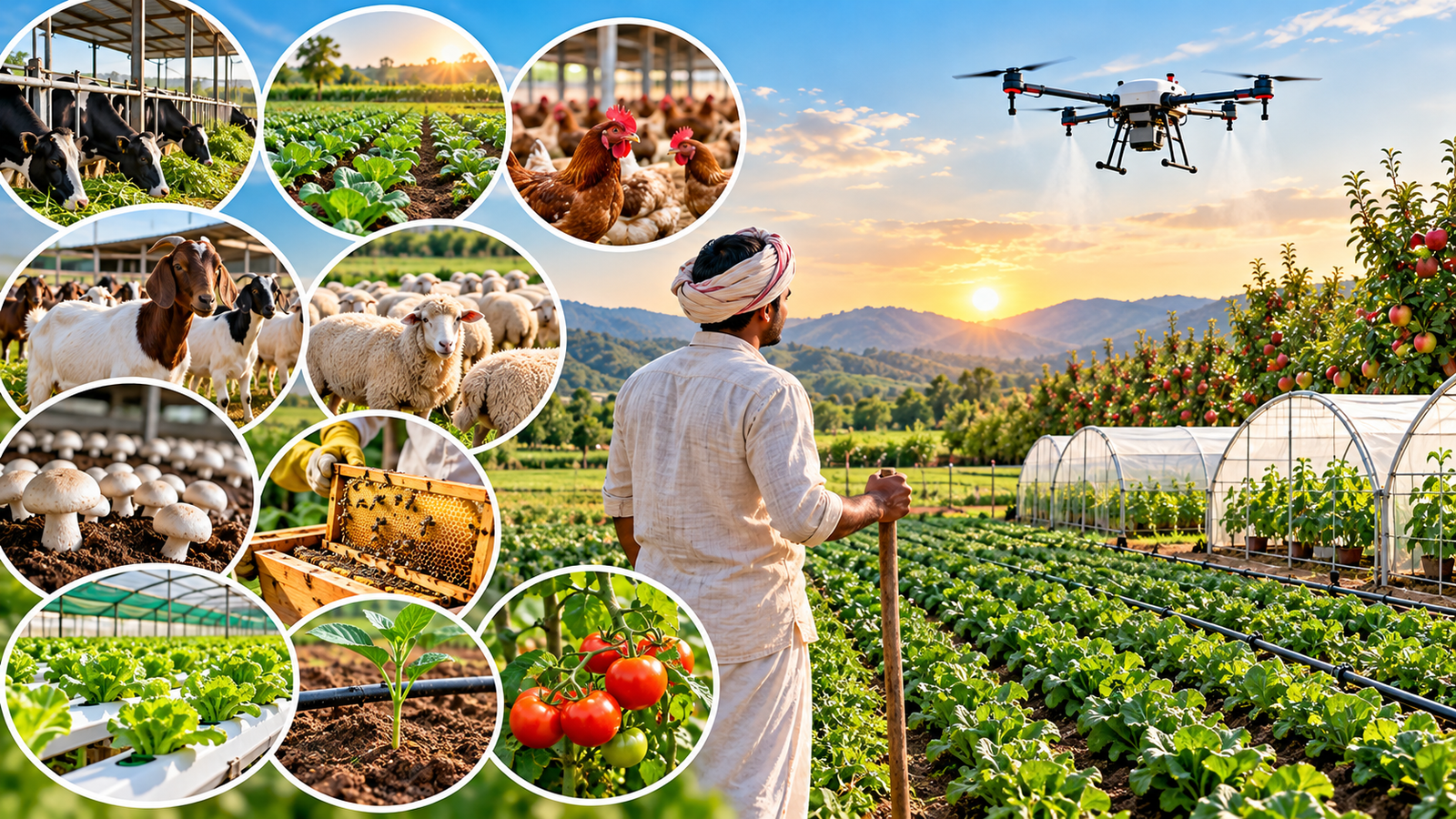
Agriculture is no longer limited to traditional crop cultivation. Today, Indian farmers and rural entrepreneurs can explore several opportunities in vegetable production, fruit farming, dairy, poultry, mushroom cultivation, food processing, organic farming and modern agricultural technology.
An agriculture project can be a small farming activity, a commercial business, a student research assignment or a community-based rural development initiative. The right project depends on available land, investment, climate, water, technical knowledge and market demand.
For example, a farmer with limited land may consider mushroom cultivation, a nursery or vermicomposting. Someone with access to grazing land may explore goat or sheep farming. Farmers with suitable irrigation can consider vegetable production, fruit orchards or protected cultivation.
This guide covers 25 agriculture project ideas in India, including their basic requirements, estimated investment, equipment, potential income sources, challenges and practical planning advice. It also explains government support, project report preparation and how to choose a suitable agriculture project.
What Is an Agriculture Project?
An agriculture project is a planned activity related to farming, livestock, horticulture, agricultural technology, food production or rural agribusiness.
It usually involves a defined objective, a production method, resources, estimated investment, operating expenses and an expected outcome.
Agriculture projects can be divided into four broad categories:
Crop production projects: Vegetable farming, fruit cultivation, cereal farming, pulses, oilseeds and commercial crops.
Livestock and allied projects: Dairy farming, goat farming, sheep farming, poultry, fisheries and beekeeping.
Modern and sustainable agriculture projects: Hydroponics, precision farming, organic farming, agroforestry, drip irrigation and vermicomposting.
Agriculture business and processing projects: Food processing, seedling nurseries, farm equipment services, cold storage and agricultural marketing.
A good project should solve a practical problem or meet an actual market demand. Starting an activity simply because it is popular may not result in a profitable business.
25 Agriculture Project Ideas in India
The following projects cover different investment levels and farming systems. The cost ranges are preliminary planning estimates for small or pilot-scale activities in India, not official subsidy rates or guaranteed market quotations.
Actual investment depends on land ownership, construction, machinery, local material prices, production capacity, labour and the location of the farm.
Project 1: Vegetable Farming
Vegetable farming is one of the most accessible agriculture projects for farmers who have suitable land and irrigation facilities.
Common crops include tomato, cauliflower, cabbage, capsicum, cucumber, spinach, okra, brinjal and peas.
Basic requirements:
- Suitable agricultural land.
- Reliable irrigation.
- Quality seeds or seedlings.
- Organic manure and fertilisers.
- Crop protection and farm tools.
- Access to a vegetable market.
Estimated initial investment: ₹30,000–₹1,50,000 per acre for a basic seasonal cultivation setup, excluding land purchase and major infrastructure.
Income opportunities: Fresh vegetables can be sold to wholesalers, retailers, local markets, hotels, restaurants and directly to consumers.
Important considerations: Vegetable prices fluctuate significantly. Plan sowing dates according to local weather and market demand. Keep some money available for harvesting, packaging and transportation.
Project 2: Fruit Farming and Orchard Development
Fruit farming is a long-term agriculture project that can provide income for several years after the orchard becomes productive.
Popular fruit crops in India include apple, mango, guava, citrus, pomegranate, banana, papaya, pear, plum and peach.
In hill regions such as Himachal Pradesh, farmers may explore apple, pear, plum, peach and other suitable temperate fruits according to altitude and climate.
Basic requirements:
- Suitable soil and climate.
- Certified planting material.
- Proper spacing and orchard layout.
- Irrigation and drainage.
- Pruning and plant protection.
- Post-harvest handling arrangements.
Estimated initial investment: ₹1 lakh–₹4 lakh per acre for a basic orchard establishment plan. High-density plantations, fencing, irrigation and specialised structures can increase the cost.
Income opportunities: Fresh fruit sales, grading, packaging, processing and direct marketing.
Important considerations: Most fruit orchards take time to reach commercial production. Do not calculate first-year fruit sales as regular income. Choose varieties after consulting the local horticulture department.
Project 3: Mushroom Farming
Mushroom farming is an attractive option for people who have limited agricultural land but can arrange a clean and controlled growing space.
Common commercial varieties include oyster mushroom, button mushroom and milky mushroom.
Basic requirements:
- Clean growing room.
- Suitable growing bags or racks.
- Quality mushroom spawn.
- Straw or other recommended substrate.
- Water supply.
- Temperature and humidity management.
- Clean packaging and storage arrangements.
Estimated initial investment: ₹40,000–₹2 lakh for a small growing unit, depending on the room, racks, equipment and production capacity.
Income opportunities: Fresh mushrooms, dried mushrooms, mushroom powder, pickles and processed products.
Important considerations: Mushroom production requires hygiene and suitable environmental conditions. Fresh mushrooms are perishable, so identify buyers before expanding production.
Project 4: Dairy Farming
Dairy farming involves raising milch animals for milk production and selling milk or dairy products.
Farmers can consider suitable indigenous cattle, crossbred cows or buffaloes depending on climate, feed availability and local milk demand.
Basic requirements:
- Healthy milch animals.
- Clean and ventilated shed.
- Green fodder and dry fodder.
- Concentrate feed and mineral supplements.
- Clean drinking water.
- Milking equipment.
- Veterinary support.
Estimated initial investment: ₹2 lakh–₹6 lakh for a small unit, depending on the number and quality of animals, shed facilities and equipment.
Income opportunities: Milk sales, curd, paneer, ghee, manure and breeding animals.
Important considerations: Calculate milk yield, lactation period, dry period, feed cost and veterinary expenses. A high milk-yielding animal is not necessarily profitable if its purchase and maintenance costs are too high.
Read our detailed guide on Dairy Farming to understand breeds, feeding, housing, milk production and farm management.
Project 5: Goat Farming
Goat farming is suitable for farmers who want to start a livestock activity on a relatively small scale.
Goats are raised mainly for meat, breeding animals, milk and manure. Breed selection should match the local climate and market.
Popular Indian breeds include Jamunapari, Beetal, Barbari, Sirohi, Black Bengal and Osmanabadi.
Basic requirements:
- Healthy breeding goats.
- Dry and ventilated housing.
- Green fodder and dry fodder.
- Clean drinking water.
- Breeding and health records.
- Vaccination and veterinary care.
Estimated initial investment: ₹1.5 lakh–₹4 lakh for a small starter unit, depending on flock size, breed and housing arrangements.
Income opportunities: Sale of kids, breeding animals, adult goats and manure.
Important considerations: Check local demand, animal health and breeding performance. Do not assume every goat will produce two or more kids in every kidding cycle.
For more information, read our complete guide on Goat Farming.
Project 6: Sheep Farming
Sheep farming is an important livestock activity in several Indian states. Sheep are raised mainly for meat and wool, while breeding animals and manure can provide additional income.
Suitable breeds vary by region. Examples include Deccani, Nellore, Madras Red, Mecheri, Marwari, Chokla and Muzaffarnagri.
Basic requirements:
- Suitable sheep breeds.
- Grazing land or planned fodder supply.
- Proper sheep shed.
- Water and feeding arrangements.
- Veterinary services.
- Lambing and breeding management.
Estimated initial investment: ₹2 lakh–₹6.5 lakh or more for a small commercial unit, depending on flock size, shed and feeding system.
Income opportunities: Lamb sales, adult animals, breeding stock, wool where a market exists and manure.
Important considerations: Lamb survival, feed costs, disease prevention and market access strongly influence the financial results.
Read our guide on Sheep Farming in India for breed selection, housing, feeding and investment planning.
Project 7: Poultry Farming
Poultry farming is the commercial raising of chickens for meat or egg production.
The two common systems are broiler farming and layer farming.
Basic requirements:
- Proper poultry shed.
- Quality chicks.
- Feeders and drinkers.
- Balanced poultry feed.
- Ventilation and temperature control.
- Vaccination and biosecurity.
- Reliable buyers.
Estimated initial investment: ₹1.5 lakh–₹5 lakh for a small broiler setup, depending on capacity, shed and equipment. Larger commercial projects require a separate financial plan.
Income opportunities: Broiler sales, egg sales, spent hens and poultry manure.
Important considerations: Feed prices, chick prices, mortality, disease outbreaks and market rates affect profitability. Contract farming and independent farming have different financial arrangements.
Project 8: Beekeeping and Honey Production
Beekeeping involves managing honeybee colonies for honey, beeswax and other bee-related products. Bees also support pollination in agricultural crops.
Basic requirements:
- Suitable bee colonies.
- Bee boxes and frames.
- Protective clothing.
- Hive tools and smokers.
- Honey extraction equipment.
- Flowering vegetation and water.
- Knowledge of seasonal colony management.
Estimated initial investment: ₹50,000–₹2 lakh for a small setup, depending on colony numbers and equipment.
Income opportunities: Honey, beeswax, pollen and other bee products where suitable processing and markets exist.
Important considerations: Avoid pesticide exposure, monitor colony health and learn proper seasonal management. Honey production depends on flowering seasons and local conditions.
Project 9: Fish Farming
Fish farming involves raising fish in ponds, tanks or other suitable water-based production systems.
Common freshwater species include rohu, catla, mrigal, common carp and certain other locally suitable species.
Basic requirements:
- Suitable pond or tank.
- Quality fish seed.
- Water quality management.
- Feed and aeration where required.
- Regular monitoring.
- Harvesting and transportation arrangements.
Estimated initial investment: ₹1.5 lakh–₹5 lakh for a small pond-based project, excluding major land acquisition and large civil works.
Income opportunities: Fresh fish sales, direct supply to retailers and local markets.
Important considerations: Water quality, stocking density, feed management and disease prevention are critical. Consult the local fisheries department before stocking a pond.
Project 10: Vermicomposting
Vermicomposting uses earthworms to convert suitable organic waste into nutrient-rich compost.
It can be started on a farm, in a rural enterprise or as a supporting activity for crop production.
Basic requirements:
- Shaded composting area.
- Suitable organic waste.
- Earthworm culture.
- Moisture management.
- Compost beds or containers.
- Sieving and packaging equipment.
Estimated initial investment: ₹25,000–₹1.5 lakh for a small unit, depending on the number of beds and construction materials.
Income opportunities: Sale of vermicompost, earthworm culture and related farm inputs.
Important considerations: Use suitable decomposed organic material, maintain moisture and avoid excessive heat. Identify local nurseries and farmers as potential buyers.
Project 11: Organic Farming
Organic farming focuses on ecological soil management, crop diversity and the use of approved organic production practices.
Farmers may produce vegetables, fruits, pulses, cereals and other crops using suitable organic inputs.
Basic requirements:
- Soil and farm assessment.
- Organic manure and compost.
- Crop rotation.
- Pest management planning.
- Suitable seeds and planting materials.
- Record keeping.
- Market and certification planning.
Estimated initial investment: ₹30,000–₹1.5 lakh per acre for a basic transition and production plan, excluding land purchase and major infrastructure.
Income opportunities: Fresh produce, certified organic produce where eligible, direct sales and value-added products.
Important considerations: Organic production does not automatically guarantee premium prices. Farmers should understand certification requirements and confirm market demand before investing in expensive infrastructure.
Project 12: Hydroponic Farming
Hydroponics is a method of growing plants without conventional soil, using nutrient-rich water or another growing medium.
It is commonly explored for leafy vegetables, herbs and certain high-value crops.
Basic requirements:
- Growing channels or containers.
- Water reservoir.
- Pumps and plumbing.
- Nutrient solution.
- pH and electrical conductivity monitoring.
- Suitable growing environment.
- Electricity backup where necessary.
Estimated initial investment: ₹2 lakh–₹10 lakh for a small pilot system, depending on the growing area, structure and equipment.
Income opportunities: Fresh lettuce, herbs and other suitable vegetables sold to restaurants, retailers and direct customers.
Important considerations: Hydroponics is technology-dependent. Power interruptions, water quality, nutrient imbalance and lack of buyers can create financial losses. Begin with a small pilot before building a large unit.
Project 13: Polyhouse Farming
Polyhouse farming involves growing crops inside a protected structure that helps manage the growing environment.
Farmers may cultivate capsicum, cucumber, tomato, flowers and other suitable crops.
Basic requirements:
- Suitable protected structure.
- Quality planting material.
- Irrigation and fertigation.
- Ventilation and temperature management.
- Crop support systems.
- Pest monitoring.
- Reliable market access.
Estimated initial investment: ₹5 lakh–₹15 lakh or more for a small commercial structure, depending on size, materials and equipment. Large structures can cost considerably more.
Income opportunities: Off-season vegetables, flowers and high-quality produce.
Important considerations: Structure design, climate suitability and subsidy eligibility should be checked with the horticulture department. Do not use one standard cost for every polyhouse.
Project 14: Nursery and Seedling Production
A plant nursery produces seedlings, saplings and planting material for farmers, gardeners, orchards and landscaping businesses.
It can be a suitable business for people with limited land and horticultural knowledge.
Basic requirements:
- Nursery space.
- Shade net or protected area.
- Seed trays and containers.
- Quality seeds and planting material.
- Growing media.
- Water supply.
- Labelling and storage arrangements.
Estimated initial investment: ₹50,000–₹3 lakh for a small nursery, depending on the structure, plant types and production capacity.
Income opportunities: Vegetable seedlings, fruit plants, ornamental plants, flower seedlings and landscaping plants.
Important considerations: Buy genuine planting material, maintain plant health and produce seedlings according to local sowing seasons.
Project 15: Drip Irrigation Project
Drip irrigation supplies water close to the root zone through pipes and emitters. It can help improve water management when properly designed and maintained.
It is useful for orchards, vegetables, nurseries and many other crops.
Basic requirements:
- Water source.
- Pump, if required.
- Filter.
- Main and lateral pipes.
- Emitters.
- Pressure control.
- Maintenance arrangements.
Estimated initial investment: ₹40,000–₹1.5 lakh per acre as a preliminary planning range. Actual cost depends on crop spacing, water source, equipment quality and system design.
Income opportunities: Drip irrigation is generally a supporting farm investment rather than a separate product business. Its benefits may include improved irrigation management and reduced water wastage.
Important considerations: Filter cleaning, pressure management and regular inspection are essential. Check state and central micro-irrigation assistance before purchasing the system.
Project 16: Precision Farming
Precision farming uses data, technology and targeted farm operations to manage crops more efficiently.
It may involve soil testing, GPS-based mapping, sensors, satellite information, variable-rate applications and digital farm records.
Basic requirements:
- Soil testing.
- Crop and field records.
- Suitable sensors or monitoring tools.
- Digital applications.
- Reliable internet or data access where needed.
- Technical training.
Estimated initial investment: ₹50,000–₹5 lakh for a small demonstration or technology-assisted farm, depending on the tools used.
Income opportunities: Precision farming is primarily a productivity and cost-management approach. A service provider may also offer soil mapping, crop monitoring or sensor installation to other farmers.
Important considerations: Choose technology based on a real farm problem. Buying expensive sensors without a clear use case may not improve farm returns.
Learn more in our detailed article on Precision Farming.
Project 17: Smart Farming
Smart farming combines digital tools, sensors, automation and data-based decisions to improve farm management.
Examples include automated irrigation, greenhouse monitoring, livestock tracking and remote crop monitoring.
Basic requirements:
- Suitable sensors and controllers.
- Mobile or computer-based monitoring.
- Internet connectivity where needed.
- Power supply.
- Technical support.
- Maintenance plan.
Estimated initial investment: ₹50,000–₹5 lakh for a small pilot project, depending on the automation level.
Income opportunities: Better farm monitoring, reduced manual work in selected activities and possible technology services for nearby farmers.
Important considerations: Smart farming systems should be simple to operate, repairable and suited to local conditions.
Read our guide on Smart Farming to understand its technologies and applications.
Project 18: Green Manure and Cover Cropping
Green manure and cover cropping involve growing selected plants to support soil fertility, soil cover and moisture management.
Common options include dhaincha, sunn hemp, cowpea and suitable local cover crops.
Basic requirements:
- Suitable seeds.
- Land preparation.
- Appropriate sowing time.
- Moisture or irrigation.
- Crop incorporation or residue management.
Estimated initial investment: ₹2,000–₹15,000 per acre as a basic planning allowance, depending on seed choice and field operations.
Income opportunities: This is generally a soil-improvement project rather than a direct sales business. Its potential financial value comes from improved soil management and possible reduction in some external input requirements over time.
Important considerations: Select species according to the crop rotation and local climate. Avoid planting a cover crop that competes with the main crop for limited water.
Read our guide on Green Manure and Cover Cropping for more information.
Project 19: Agroforestry
Agroforestry combines trees with crops, livestock or other agricultural activities on the same land.
Depending on local conditions, farmers may integrate suitable timber, fruit, fodder or multipurpose trees with annual crops.
Basic requirements:
- Suitable land.
- Appropriate tree species.
- Planting material.
- Tree spacing and layout.
- Water and protection.
- Long-term management plan.
Estimated initial investment: ₹30,000–₹2 lakh per acre for a basic establishment plan, depending on species, fencing and irrigation.
Income opportunities: Fruit, timber where legally permitted, fodder, other tree products and compatible crops.
Important considerations: Trees take time to mature. Check local regulations before planting or harvesting species subject to transit or felling restrictions.
Project 20: Fodder Production
Fodder production involves cultivating grasses and fodder crops to support dairy animals, sheep, goats and other livestock.
Suitable crops may include Napier grass, berseem, lucerne, maize fodder and oats.
Basic requirements:
- Suitable land.
- Quality fodder seeds or slips.
- Irrigation where required.
- Cutting and storage arrangements.
- Chaff cutter where suitable.
- Buyers or livestock demand.
Estimated initial investment: ₹20,000–₹1 lakh per acre for a basic production setup, depending on crop, land preparation and irrigation.
Income opportunities: Sale of green fodder, dry fodder, hay, silage or fodder planting material.
Important considerations: Plan production according to local livestock demand. Storage and transportation costs can affect the selling price.
Project 21: Agricultural Equipment Rental Service
Many small farmers cannot afford expensive machinery for occasional farm operations. An equipment rental service can help meet this demand.
Possible equipment includes power tillers, sprayers, seed drills, threshers, brush cutters and small harvesting machines.
Basic requirements:
- Machinery suited to local farms.
- Storage and maintenance space.
- Trained operator.
- Transport arrangements.
- Booking and payment records.
- Spare parts and repair support.
Estimated initial investment: ₹1 lakh–₹8 lakh or more, depending on the machinery selected.
Income opportunities: Rental charges, operator fees and seasonal machinery services.
Important considerations: Check local demand and expected utilisation before purchasing machinery. A machine that remains unused for most of the year can become an expensive asset.
Project 22: Food Processing and Value Addition
Food processing involves converting agricultural produce into products that are easier to store, transport or sell at a higher level of processing.
Examples include:
- Fruit jams and juices.
- Pickles and chutneys.
- Dehydrated vegetables.
- Potato chips.
- Flour and millet products.
- Spices and packaged pulses.
Basic requirements:
- Raw material supply.
- Processing equipment.
- Clean production space.
- Packaging materials.
- Storage arrangements.
- Food safety compliance.
- Sales and distribution channels.
Estimated initial investment: ₹2 lakh–₹10 lakh for a small processing unit, depending on product, machinery and capacity.
Income opportunities: Packaged food products, direct sales, retail supply and online orders.
Important considerations: Food businesses must meet applicable food safety and licensing requirements. Product quality, shelf life, packaging and branding are important.
Project 23: Agricultural Drone Service
Agricultural drones can be used for selected farm operations such as crop monitoring, mapping and spraying where permitted and technically suitable.
A drone service provider can work with farmers, FPOs and agricultural organisations.
Basic requirements:
- Suitable agricultural drone.
- Required pilot training and certification.
- Applicable permissions and regulatory compliance.
- Batteries and charging arrangements.
- Maintenance and insurance planning.
- Service area and customer network.
Estimated initial investment: ₹5 lakh–₹15 lakh or more for a commercial service plan, depending on equipment, training and supporting infrastructure.
Income opportunities: Paid crop monitoring and other permitted agricultural services.
Important considerations: Drone operations are regulated. Check current Directorate General of Civil Aviation requirements and pesticide-use instructions before offering services.
Project 24: Floriculture
Floriculture involves growing flowers for decoration, religious use, events, landscaping and commercial markets.
Popular flowers include marigold, rose, chrysanthemum, gladiolus, gerbera and other regionally suitable varieties.
Basic requirements:
- Suitable land or protected structure.
- Quality planting material.
- Irrigation.
- Fertiliser and crop protection management.
- Harvesting tools.
- Packaging and transport.
- Access to flower markets.
Estimated initial investment: ₹50,000–₹3 lakh per acre for a basic open-field project. Protected cultivation can require a much higher investment.
Income opportunities: Loose flowers, cut flowers, garlands, nursery plants and event supply.
Important considerations: Flowers are perishable. Plan harvesting and sales around market demand, festivals and local events.
Project 25: Seed Production and Agricultural Input Business
Seed production involves producing quality seed according to the requirements of the relevant crop and applicable seed regulations.
An agricultural input business may also supply seeds, nursery materials, bio-inputs and selected farming products.
Basic requirements:
- Suitable land or business premises.
- Authentic source of seed or planting material.
- Knowledge of seed quality and storage.
- Required registration or licensing.
- Packaging and labelling arrangements.
- Farmer network and sales channels.
Estimated initial investment: ₹1 lakh–₹5 lakh for a small seed-related or agricultural-input activity, depending on the business model and compliance requirements.
Income opportunities: Sale of seeds, planting material and approved agricultural inputs.
Important considerations: Seed production and sale are regulated activities. Follow applicable quality standards, certification and licensing requirements. Do not market unverified seed as certified seed.
3. Comparison of Agriculture Projects by Investment
The following table helps compare the broad investment levels of the 25 project ideas.
| Agriculture project | Indicative starting investment |
|---|---|
| Vegetable farming | ₹30,000–₹1.5 lakh per acre |
| Fruit farming | ₹1–₹4 lakh per acre |
| Mushroom farming | ₹40,000–₹2 lakh |
| Dairy farming | ₹2–₹6 lakh |
| Goat farming | ₹1.5–₹4 lakh |
| Sheep farming | ₹2–₹6.5 lakh |
| Poultry farming | ₹1.5–₹5 lakh |
| Beekeeping | ₹50,000–₹2 lakh |
| Fish farming | ₹1.5–₹5 lakh |
| Vermicomposting | ₹25,000–₹1.5 lakh |
| Organic farming | ₹30,000–₹1.5 lakh per acre |
| Hydroponics | ₹2–₹10 lakh |
| Polyhouse farming | ₹5–₹15 lakh or more |
| Nursery business | ₹50,000–₹3 lakh |
| Drip irrigation | ₹40,000–₹1.5 lakh per acre |
| Precision farming | ₹50,000–₹5 lakh |
| Smart farming | ₹50,000–₹5 lakh |
| Green manure and cover cropping | ₹2,000–₹15,000 per acre |
| Agroforestry | ₹30,000–₹2 lakh per acre |
| Fodder production | ₹20,000–₹1 lakh per acre |
| Equipment rental | ₹1–₹8 lakh or more |
| Food processing | ₹2–₹10 lakh |
| Agricultural drone service | ₹5–₹15 lakh or more |
| Floriculture | ₹50,000–₹3 lakh per acre |
| Seed production/input business | ₹1–₹5 lakh |
Cost note: These are indicative planning ranges, not official NABARD unit costs. They may exclude land purchase, major buildings, taxes, loan interest, working capital or transport. Some projects are quoted per acre, while others are quoted per business unit. Do not compare them as if they use the same production scale.
For bank finance, obtain local quotations and prepare a project-specific budget. NABARD publishes annual unit-cost references for farm-sector activities, including horticulture, irrigation, farm mechanisation and animal husbandry. See its FY 2026–27 Unit Cost publication.
4. Best Agriculture Projects for Small Farmers
Small farmers should select projects that match their land, water supply, labour and local market.
Some options worth evaluating are:
Mushroom farming: Can be started in a relatively small space, but requires hygiene and a reliable market.
Vermicomposting: Suitable for farms with access to organic waste and local compost buyers.
Nursery business: Can be started on limited land with knowledge of plant propagation.
Beekeeping: Can complement suitable crop and horticulture activities.
Seasonal vegetable farming: Can generate income from repeated crop cycles where irrigation and market access are available.
Fodder production: Can support an existing dairy, goat or sheep unit and may also supply neighbouring livestock farms.
Important: A small project is not automatically low-risk. Check local demand, production cost and the availability of buyers before investing.
5. Agriculture Projects Suitable for Himachal Pradesh
Himachal Pradesh has different agro-climatic zones, so project selection should be based on elevation, rainfall, temperature, water availability and local market access.
Some project ideas that farmers may evaluate include:
- Apple, pear, plum and peach orchards in suitable temperate areas.
- Vegetable farming according to local growing seasons.
- Mushroom cultivation where suitable growing conditions can be maintained.
- Beekeeping alongside suitable horticulture and agricultural crops.
- Dairy farming where fodder and veterinary support are available.
- Sheep and goat rearing using locally suitable breeds and management systems.
- Nursery production for fruit trees and vegetable seedlings.
- Vermicomposting for local crop and horticulture farms.
- Food processing of locally available fruits and vegetables.
- Fodder cultivation for livestock units.
Before choosing an activity, consult the district horticulture or agriculture department. A project suitable for a lower-elevation district may not perform equally well at a higher altitude.
6. How to Prepare an Agriculture Project Report
An agriculture project report explains how the proposed activity will operate and whether it has a realistic financial plan.
Banks, government departments and project-support institutions may ask for a detailed project report depending on the activity and scheme.
A useful project report should include the following sections.
A. Project Introduction
Mention the project name, location, purpose and main agricultural activity.
B. Project Objectives
Explain what the project aims to achieve.
Examples:
- Produce vegetables for the local market.
- Establish a small dairy unit.
- Supply healthy nursery plants to farmers.
- Produce and sell vermicompost.
- Start a mushroom production unit.
C. Land and Infrastructure Details
Mention:
- Total land available.
- Land ownership or lease status.
- Soil and water conditions.
- Existing buildings.
- Required sheds, structures or equipment.
- Electricity and transport access.
D. Machinery and Equipment
Prepare an item-wise list of equipment with estimated prices.
Examples:
- Pumps and irrigation pipes.
- Sprayers.
- Feeders and drinkers.
- Mushroom racks.
- Processing equipment.
- Storage containers.
- Farm tools.
Obtain actual quotations from suppliers.
E. Production Plan
Explain:
- Crop varieties or animal breeds.
- Production capacity.
- Growing or breeding cycle.
- Input requirements.
- Labour requirements.
- Harvesting or sale schedule.
F. Financial Plan
A financial plan should include:
- Land development and preparation.
- Building and shed construction.
- Machinery and equipment.
- Seeds, planting material or animals.
- Feed, fertiliser and other inputs.
- Labour expenses.
- Electricity and water.
- Veterinary or crop-protection expenses.
- Packaging and transportation.
- Working capital.
G. Income and Profit Estimate
Calculate expected revenue using realistic production and market assumptions.
Gross revenue = Quantity sold × Selling price
Operating surplus = Gross revenue − Operating expenses
For a more complete business-profit estimate, also account for depreciation, interest, taxes and other applicable expenses.
Do not assume that every crop or livestock unit will achieve maximum production from the first cycle.
H. Marketing Plan
Identify potential customers and selling channels.
These may include:
- Local mandis.
- Wholesalers.
- Retailers.
- Hotels and restaurants.
- Farmer Producer Organisations.
- Cooperatives.
- Direct-to-consumer sales.
- Food-processing companies.
A good project report should explain who will purchase the output and how it will reach the buyer.
Government Schemes for Agriculture Projects in India
The Government of India operates several agriculture and allied-sector programmes. The support available depends on the project, state, applicant category, scheme guidelines and budget availability.
The following are useful schemes and programmes to investigate.
Agriculture Infrastructure Fund (AIF)
The Agriculture Infrastructure Fund supports eligible post-harvest management infrastructure and community farming assets.
Projects may include eligible storage, grading, processing and other approved infrastructure.
Farmers, FPOs, cooperatives and other eligible organisations should check the current guidelines and lending conditions.
Official information: https://agriinfra.dac.gov.in/
Mission for Integrated Development of Horticulture (MIDH)
MIDH supports the development of horticulture, including fruits, vegetables, nursery development, protected cultivation and other approved components.
Assistance depends on the component, location, beneficiary category and current cost norms.
Official information: https://midh.gov.in/
Pradhan Mantri Krishi Sinchayee Yojana (PMKSY)
PMKSY includes irrigation-related interventions. Its Per Drop More Crop component promotes efficient water-use methods such as drip and sprinkler irrigation.
Farmers should contact their state agriculture or horticulture department for current application details and eligibility.
Official information: https://pmksy.gov.in/
National Livestock Mission (NLM)
The National Livestock Mission supports eligible livestock entrepreneurship and related activities.
Its Entrepreneurship Development Programme includes specified breeding-farm and fodder-related projects. Government information published in December 2025 describes a 50% capital subsidy, subject to the eligible project category, limits and scheme conditions.
A normal small animal-rearing unit should not assume that it automatically qualifies.
Official information: https://www.dahd.gov.in/en/schemes/programmes/national_livestock_mission
Pradhan Mantri Formalisation of Micro Food Processing Enterprises (PMFME)
PMFME has supported the formalisation and development of micro food-processing enterprises, including eligible individual units and groups.
Before planning a project around this scheme, verify whether applications are currently being accepted and which components are active in your state.
Official information: https://www.mofpi.gov.in/
Pradhan Mantri Fasal Bima Yojana (PMFBY)
PMFBY provides crop insurance for notified crops and areas under applicable scheme conditions.
It is a risk-management measure rather than a direct grant for setting up a farming business.
Official information: https://pmfby.gov.in/
National Mission on Natural Farming (NMNF)
The National Mission on Natural Farming promotes natural farming practices through training, demonstration and other approved support activities.
Farmers interested in natural farming should check current state-level implementation and participation arrangements.
Official information: https://agriwelfare.gov.in/
Important Note About Subsidies
A government scheme does not mean that every applicant receives a subsidy. Eligibility, project size, documentation, approved cost norms, bank finance and application windows can differ.
Always verify the latest guidelines with the implementing department before making a financial commitment.
How to Choose the Right Agriculture Project
Before investing, evaluate the following factors.
#1. Available Land
Check whether the project requires open land, a shed, a greenhouse, a pond or only a small growing space.
#2. Water Availability
Water is essential for crop cultivation, livestock and many processing activities. Check both the quantity and quality of the available water.
#3. Climate and Soil
Choose crops and livestock suitable for the local environment. Soil testing can help identify nutrient and soil-management requirements.
#4. Initial Investment
Calculate the total cost, including equipment, infrastructure, inputs and working capital. Do not invest all available money in setup expenses.
#5. Market Demand
Find out who will buy the product, what quality they require and how much they currently pay.
#6. Technical Knowledge
Some activities, such as hydroponics, mushroom farming, dairy management and food processing, require specialised training.
Risk and Time to Income
Vegetables may generate income in a relatively short production cycle, while orchards and tree-based projects may take years to mature.
Choose a project that matches your financial capacity and income requirements.
Common Mistakes to Avoid in Agriculture Projects
New farmers and entrepreneurs often make mistakes because they focus on expected income without understanding the operating requirements.
Avoid the following:
Starting without market research: Production is only one part of the business. A buyer is equally important.
Underestimating working capital: Daily expenses continue even when the crop is not ready for harvest.
Choosing unsuitable varieties or breeds: Local climate and adaptation matter.
Ignoring training: Practical knowledge can help prevent avoidable production losses.
Depending entirely on subsidies: Subsidy approval should never be treated as guaranteed income.
Building too much infrastructure initially: Begin with a manageable capacity and expand after testing the business model.
Ignoring transport and storage: Perishable agricultural products can lose value if they are not handled properly.
Using unrealistic profit projections: Prepare conservative, expected and optimistic financial scenarios rather than relying on one profit figure.
Agriculture Project Ideas for Students
Agriculture projects are also useful for school, college, diploma and university students.
A student project can be an experiment, demonstration model, field survey or research assignment.
Here are 10 practical project ideas:
- Comparison of organic manure and chemical fertiliser on plant growth.
- Effect of different irrigation schedules on vegetable growth.
- Vermicompost production using different organic materials.
- Study of seed germination under different conditions.
- Comparison of mulching materials for soil moisture conservation.
- Small hydroponic growing system demonstration.
- Study of composting and agricultural waste management.
- Survey of farming practices used by local farmers.
- Effect of different growing media on nursery seedlings.
- Demonstration of drip irrigation and water-use management.
Students should clearly state the objective, materials, method, observations, results and conclusion of their projects.
A student experiment should not be presented as a proven commercial farming model without sufficient evidence.
FAQs About Agriculture Projects
Q1. Which agriculture project is best in India?
There is no single best agriculture project for every farmer. Vegetable farming, dairy farming, mushroom cultivation, nursery production, beekeeping and vermicomposting can be considered according to local resources and market demand.
Q2. Which agriculture project can be started with low investment?
Vermicomposting, seasonal vegetable cultivation, a small nursery and some mushroom-growing setups may be started with relatively modest investment. The actual cost depends on available infrastructure and production capacity.
Q3. Which agriculture project is suitable for small land?
Mushroom farming, nursery production, beekeeping, vermicomposting and selected protected-cultivation activities may suit limited land. Their success still depends on technical knowledge and buyers.
Q4. Are agriculture projects eligible for government subsidies?
Some agriculture, horticulture, livestock, irrigation and food-processing projects may qualify for support under government programmes. Eligibility varies by scheme and state.
Q5. How can I get a loan for an agriculture project?
Prepare a project report, collect supplier quotations, estimate working capital and approach a bank or eligible financial institution. The bank will assess the project, repayment capacity and applicable lending conditions.
Q6. What should an agriculture project report include?
It should include project objectives, land details, infrastructure, equipment, production planning, investment, operating costs, income estimates, marketing arrangements and risk assessment.
Q7. Which agriculture projects are suitable for Himachal Pradesh?
Depending on altitude and local conditions, farmers may explore fruit orchards, seasonal vegetables, mushroom farming, beekeeping, dairy, sheep rearing, nurseries and food processing.
Q8. Can agriculture projects be started without owning land?
Some activities, such as mushroom cultivation, vermicomposting, nursery production and food processing, may be possible on leased or small spaces. Always confirm land-use, lease and local compliance requirements.
Q9. Is organic farming a profitable agriculture project?
Organic farming can be commercially viable where production is well managed and buyers are available. Certification, transition costs, crop yields and marketing arrangements should be considered.
Q10. How do I calculate agriculture project profit?
Estimate total sales revenue and subtract all operating costs. For a complete profit calculation, also include depreciation, interest, taxes and other applicable expenses.
Conclusion
Agriculture offers many opportunities for farmers, students and rural entrepreneurs in India. From vegetable farming and fruit orchards to mushroom cultivation, dairy farming, beekeeping, hydroponics and food processing, there are different projects for different investment levels and land conditions.
However, a successful agriculture project starts with proper planning. Understand the local climate, soil, water supply, production requirements and market demand before investing. Prepare a realistic project report, include working capital and check the latest government scheme guidelines.
Start with a manageable project, learn from practical experience and expand only when the business shows consistent results.
The best agriculture project is not necessarily the one with the highest advertised profit. It is the one that matches your resources, skills, local conditions and available market.
Disclaimer: All investment ranges in this article are indicative planning estimates, not official quotations or guaranteed returns. Actual costs and income vary by state, district, scale, season, input prices and management. Government scheme benefits are subject to current guidelines and eligibility. Consult local agriculture, horticulture, livestock or fisheries officials before investing.
References and Useful Government Resources
- NABARD – Unit Cost for Farm Sector Activities, FY 2026–27: https://www.nabard.org/auth/writereaddata/tender/pub_2407250448311651.pdf
- Ministry of Agriculture and Farmers Welfare: https://agriwelfare.gov.in/
- Department of Agriculture and Farmers Welfare: https://agricoop.nic.in/
- Mission for Integrated Development of Horticulture: https://midh.gov.in/
- Department of Animal Husbandry and Dairying: https://www.dahd.gov.in/
- Ministry of Food Processing Industries: https://www.mofpi.gov.in/
- Indian Council of Agricultural Research: https://icar.gov.in/
- Pradhan Mantri Fasal Bima Yojana: https://pmfby.gov.in/